Calculate your eGFR
This is an estimate, not a measured GFR. One result cannot diagnose or stage chronic kidney disease on its own. Discuss your result with your clinician.
How the eGFR calculator works
Glomerular filtration rate (GFR) is the volume of fluid the kidneys filter from the blood each minute. Measuring it directly requires injecting a marker substance and collecting timed samples, which is impractical outside research. In routine care, GFR is therefore estimated from serum creatinine, a waste product of muscle metabolism that healthy kidneys clear at a fairly steady rate. When kidney function falls, creatinine accumulates in the blood, so a higher creatinine generally means a lower eGFR.
Creatinine alone is not enough, because healthy creatinine levels depend on muscle mass, which varies with age and sex. That is why every eGFR equation combines creatinine with age and sex. This calculator uses the CKD-EPI 2021 creatinine equation (Inker and colleagues, New England Journal of Medicine 2021), which is the equation current KDIGO guidance recommends for routine use:
eGFR = 142 × min(Scr/κ, 1)a × max(Scr/κ, 1)−1.200 × 0.9938Age × 1.012 (if female),
where κ is 0.7 for females and 0.9 for males, and a is −0.241 for females and −0.302 for males. Scr is serum creatinine in mg/dL.
The key feature of the 2021 equation is that it is race-free. Earlier equations multiplied the result by a factor for Black patients, a practice that embedded race into clinical decisions and could delay referral and transplant listing. The 2021 equation was refit on diverse datasets without any race term and performs well across populations, so this tool applies the identical maths to everyone. The optional race or ethnicity field above exists only for transparency: selecting a value shows a note and never alters your result.
If your lab reports creatinine in micromoles per litre (µmol/L), choose that unit before calculating. The calculator converts it internally by dividing by 88.4, so 88.4 µmol/L is treated as exactly 1.0 mg/dL and both paths give the identical result. Results are rounded to the nearest whole number and reported in the standard units of mL/min/1.73 m².
What your eGFR result means
KDIGO groups eGFR into six GFR categories, from G1 (normal or high) to G5 (kidney failure). The chart below shows the bands and their thresholds.
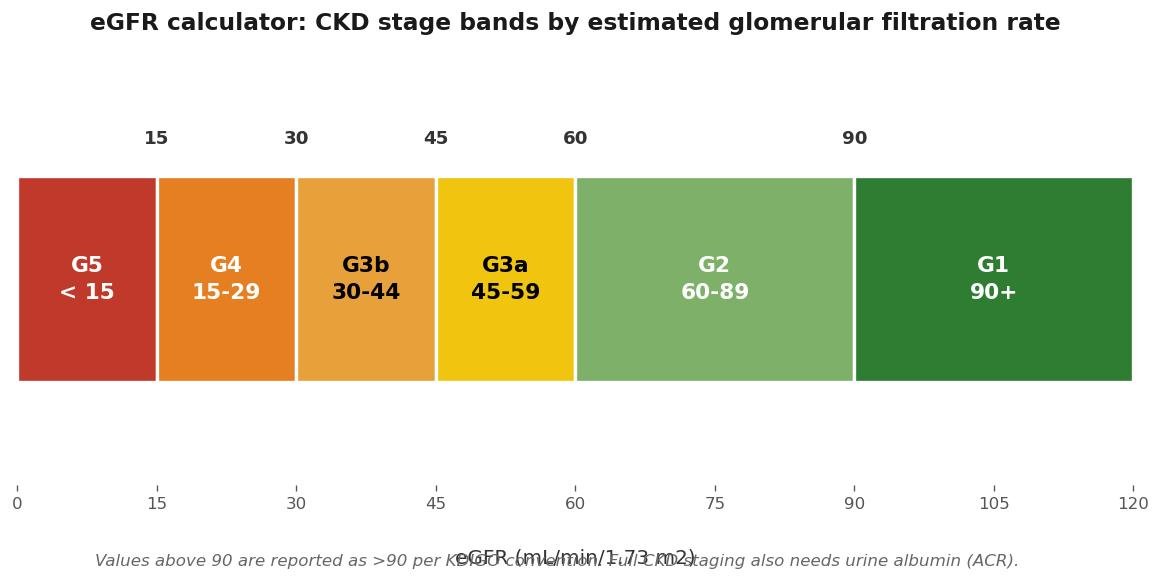
| Stage | eGFR range | What it means and typical next steps |
|---|---|---|
| G1 | 90 and above | Normal or high kidney function. Without protein in the urine or another marker of kidney damage, this is not kidney disease. Keep monitoring blood pressure, blood sugar and cardiovascular risk factors as part of routine care. |
| G2 | 60 to 89 | Mildly decreased. In older adults this often reflects normal ageing rather than disease. With a normal urine albumin result and no other kidney markers, no specific kidney treatment is needed, but the test is worth repeating periodically, especially if you have diabetes or hypertension. |
| G3a | 45 to 59 | Mild to moderate decrease. Your clinician will usually repeat the eGFR and check urine albumin (ACR) to confirm the finding persists, look for a cause, review medicines that affect the kidneys (such as NSAID painkillers), and assess cardiovascular risk, which rises as eGFR falls. |
| G3b | 30 to 44 | Moderate to severe decrease. Monitoring becomes closer, kidney-toxic medicines and dehydration are avoided more carefully, and anaemia, bone health and electrolytes may be checked. Referral to a kidney specialist is commonly advised if albuminuria is significant or the eGFR is falling quickly. |
| G4 | 15 to 29 | Severely decreased. Referral to nephrology is standard at this stage. Care focuses on slowing further decline, managing complications such as anaemia and mineral imbalances, careful use of contrast dye and nephrotoxic drugs, and education about what kidney failure would involve if it develops. |
| G5 | Below 15 | Kidney failure. This range usually needs urgent specialist care to discuss kidney replacement options (dialysis or transplantation) or conservative care without dialysis, depending on the person’s overall health and preferences. |
One important nuance: an eGFR category alone is not a full CKD stage. KDIGO stages chronic kidney disease on two axes, GFR and albuminuria (the A1 to A3 categories from a urine albumin-to-creatinine ratio, ACR). Someone with an eGFR of 75 and a normal ACR does not have CKD, while someone with an eGFR of 95 but heavy albuminuria may have significant kidney disease. If your result is below 60, or below 90 with another kidney marker, ask your clinician about a urine ACR test so the picture is complete.
CKD-EPI 2021 vs MDRD: why two numbers?
After calculating, this tool shows a second number from the MDRD equation (the 2006 IDMS-traceable re-expression: eGFR = 175 × Scr−1.154 × Age−0.203 × 0.742 if female). MDRD was the standard equation for many years, and some laboratories still report it, which is the most common reason a patient’s home calculation disagrees with their lab slip.
The two equations usually differ most at higher GFRs. MDRD was developed in people who already had kidney disease, so it systematically underestimates eGFR in the healthy range. For example, a 55-year-old man with a creatinine of 1.0 mg/dL gets about 89 from CKD-EPI 2021 but only about 78 from MDRD. Below an eGFR of roughly 60 the two equations largely agree, which is why MDRD remains acceptable for detecting advanced disease but is no longer preferred. KDIGO guidance recommends CKD-EPI 2021 for routine reporting, and that is the number this calculator treats as primary.
The practical takeaway: always compare like with like. If your lab reports MDRD and this calculator shows CKD-EPI 2021, expect the lab number to read lower when your kidney function is in the normal or mildly decreased range. That difference reflects the equation, not a change in your kidneys.
Why one creatinine number is not a diagnosis
Chronic kidney disease is defined by abnormalities of kidney structure or function that persist for at least three months. A single eGFR below 60 does not meet that definition. Creatinine rises and falls with hydration, recent illness, intense exercise, high meat intake and some medicines (trimethoprim and cimetidine, for example, raise creatinine without harming the kidneys). A result drawn during a stomach bug or after a hard workout can look much worse than your true baseline.
Equally, a normal eGFR does not rule out kidney disease on its own, because albumin can leak into the urine while filtration still looks fine, particularly in early diabetic kidney disease. That is why guidelines pair every eGFR with a urine albumin (ACR) measurement and repeat abnormal results over weeks to months before labelling anything chronic.
If your result surprises you, the sensible response is not alarm but verification: repeat the blood test when you are well and normally hydrated, ask for a urine ACR, and review the trend with your clinician rather than reacting to a single point.
Limitations of eGFR
An eGFR is an estimate built on assumptions, and several common situations break those assumptions:
- Rapidly changing kidney function. The equation assumes creatinine is in a steady state. In acute kidney injury, after major surgery, or during severe dehydration, creatinine lags behind the true GFR and the estimate is unreliable.
- Extremes of muscle mass. Because creatinine comes from muscle, very muscular people (including some athletes), people with muscle-wasting conditions, and amputees get misleading results: overestimated in low muscle mass, underestimated in very high muscle mass.
- Pregnancy. Creatinine falls during pregnancy as filtration rises, so standard equations are not validated for pregnant patients.
- Children and teenagers. The CKD-EPI 2021 equation is validated for adults aged 18 and over; paediatric nephrology uses different formulas such as the bedside Schwartz equation.
- Diet and medicines. Cooked meat meals, creatine supplements and drugs that block tubular creatinine secretion can raise creatinine without changing true GFR.
- Laboratory variation. Reference ranges and assays differ between labs, so a creatinine of 1.1 mg/dL can sit inside one lab’s normal range and outside another’s. Trend within the same lab matters more than any single value.
In these situations clinicians may order a cystatin C based eGFR (a marker independent of muscle mass) or combine creatinine and cystatin C, which KDIGO notes is more accurate than either marker alone. If any of the situations above apply to you, mention it when you discuss your result.
Frequently asked questions
What is eGFR and what does it measure?
eGFR stands for estimated glomerular filtration rate. It estimates how much blood your kidneys filter each minute, expressed in mL/min/1.73 m2. It is calculated from serum creatinine, age and sex using equations such as CKD-EPI 2021. It is an estimate, not a direct measurement of kidney function.
What is a normal eGFR?
An eGFR of 90 or above is in the normal range (stage G1), provided there are no other signs of kidney damage such as albumin in the urine. eGFR naturally declines with age, so mildly lower values can be normal in older adults. Labs usually report values above 90 simply as greater than 90.
Why does this eGFR calculator not use race in its result?
Older equations applied a race adjustment, but the CKD-EPI 2021 equation recommended by KDIGO was refit without race and performs well across populations. Using a race-free equation avoids race-based clinical decisions, which is why this calculator follows the 2021 equation for everyone.
Why does my result show >90 instead of an exact number?
Creatinine-based equations are less precise at high filtration rates, so differences between, say, 95 and 110 do not carry clinical meaning. Following KDIGO-aligned practice, values of 90 and above are reported as greater than 90, which is the G1 (normal or high) category.
Why is my eGFR different from the number on my lab report?
Different laboratories use different equations. Some still report the older MDRD equation, which reads lower than CKD-EPI 2021, especially above 60. Results also shift with the creatinine assay, the units used, and whether creatinine was measured when you were well hydrated. Always compare values calculated with the same equation.
Can one eGFR result diagnose chronic kidney disease?
No. Chronic kidney disease requires kidney abnormalities persisting for at least three months, and staging also needs a urine albumin (ACR) result. A single low eGFR can reflect acute kidney injury, dehydration, a lab variation, or a temporary illness. A clinician confirms the diagnosis with repeat testing over time.
Sources
- Inker LA, Eneanya ND, Coresh J, et al. New creatinine- and cystatin C-based equations to estimate GFR without race. New England Journal of Medicine. 2021;385(19):1737-1749. doi:10.1056/NEJMoa2102953
- Kidney Disease: Improving Global Outcomes (KDIGO). KDIGO 2024 Clinical Practice Guideline for the Evaluation and Management of Chronic Kidney Disease. Kidney International. 2024;105(4S):S117-S314.
- Levey AS, Coresh J, Greene T, et al. Expressing the Modification of Diet in Renal Disease Study equation for estimating glomerular filtration rate with standardized serum creatinine values. Clinical Chemistry. 2007;53(4):766-772.
Looking for more kidney and metabolic health tools? Browse the full AchaWaqat calculators library.
Medically reviewed by Dr. Taimoor Asghar, Physician and Community Medicine Researcher. Published 2026-10-02, last updated 2026-10-02.