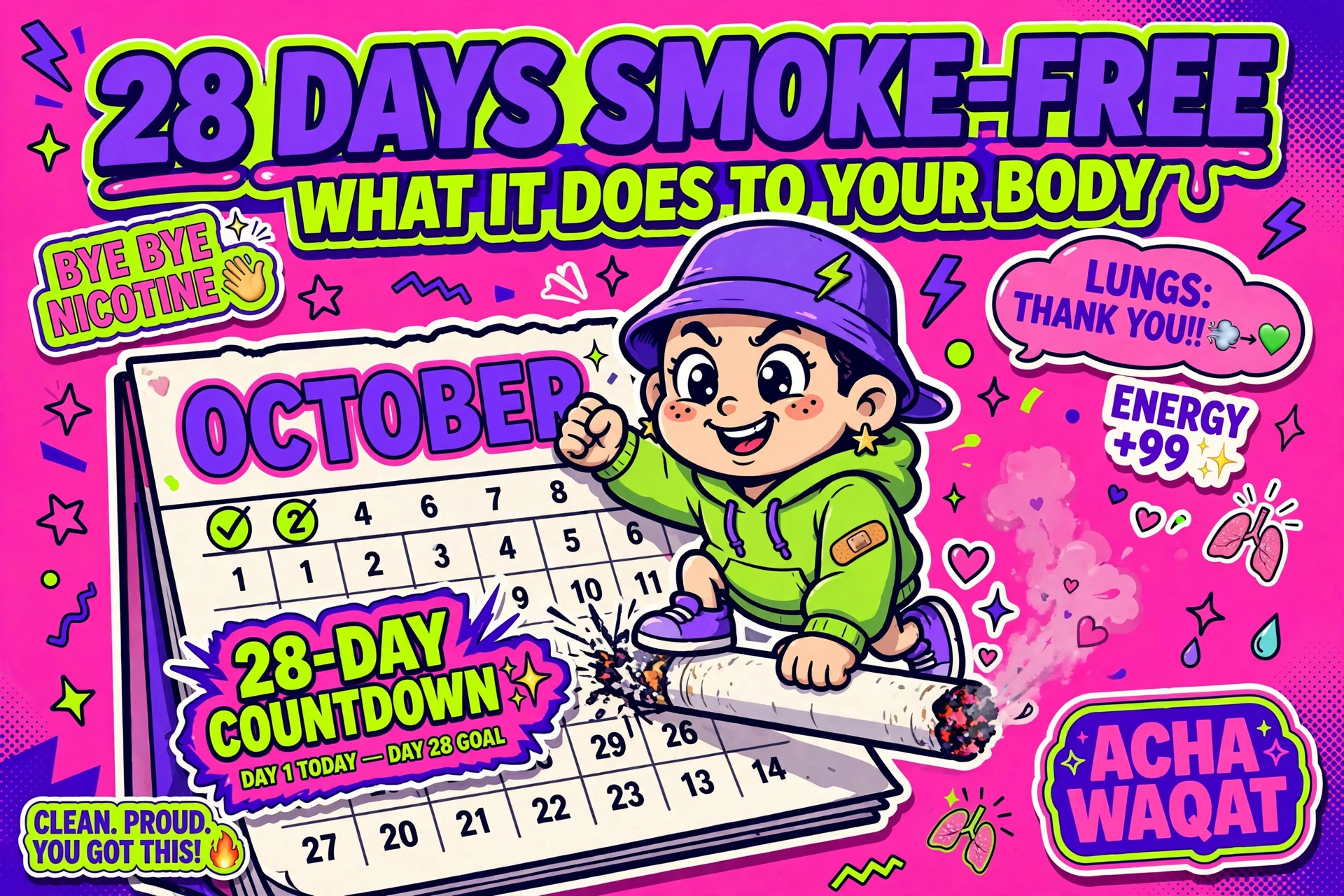
Short answer: Stoptober 2026 is the NHS annual quit-smoking campaign, which challenges people who smoke to stay smoke-free for 28 days, from 1 to 28 October. The NHS says someone who reaches 28 days smoke-free is five times more likely to quit for good, and the health gains begin within 20 minutes of the last cigarette: your pulse rate starts returning to normal, then oxygen levels recover, then taste and smell improve. This guide walks through what the NHS says happens to your body day by day and week by week, the free support tools on offer, and how to start your own 28-day clock even though October is nearly over.
Stoptober is past its halfway point, which sounds like bad news if you missed the start. It is not. The campaign officially runs from 1 to 28 October, but the science behind it does not care which date you begin. Twenty-eight smoke-free days are twenty-eight smoke-free days whenever they fall, and every quit attempt moves you closer to the last one. Here is what actually happens inside your body when you stop, and where to find free help that makes quitting easier.
What is Stoptober 2026?
Stoptober is the NHS annual quit-smoking campaign, run with the Department of Health and Social Care. It began in England in 2012, and since then millions of people across England have made a quit attempt as part of the challenge, according to the City of Wolverhampton Council’s Stoptober 2026 announcement. The idea is simple: instead of quitting alone, you quit alongside thousands of other people at the same time, with the NHS providing free tools, daily motivation and practical support.
The 2026 campaign follows the same format as every year. Smokers are challenged to go smoke-free for 28 days, officially from 1 to 28 October. NHS partners across the country, from integrated care boards to local councils, back the campaign each autumn with local stop-smoking services, pharmacy support and community events. As one NHS trust puts it: “Let’s quit smoking together.”
Why does a month-long challenge matter? Around 5.3 million people aged 18 and over smoked cigarettes in the UK in 2024, according to Office for National Statistics figures published in November 2025, with people aged 25 to 34 having the highest proportion of current smokers. Smoking remains one of the leading causes of preventable illness and death. A shared, time-limited challenge turns an abstract goal into a concrete one with a start date, a finish line and company along the way.
Why does Stoptober ask for 28 days smoke-free?
The 28-day target is not arbitrary. The NHS cites evidence showing that someone who reaches 28 days smoke-free is five times more likely to quit for good. Four weeks is long enough to break the daily rituals around smoking, get through the worst of the nicotine withdrawal and start feeling the physical benefits, which makes it far easier to keep going.
It also reframes the task. Quitting “forever” can feel overwhelming, especially if you have tried before. Quitting for 28 days feels doable, and the research suggests that most people who manage four weeks carry on. That is the whole psychology of Stoptober: make the first month achievable, and the rest follows more easily.
What happens to your body after your last cigarette?
The NHS Better Health quit-smoking guide sets out a timeline of what happens once you stop. The benefits start almost immediately and keep building for years. Here is the tour, in the NHS’s own words.
After 20 minutes
Check your pulse rate: it will already be starting to return to normal. Smoking raises your heart rate and blood pressure with every cigarette, and the moment you stop, your cardiovascular system begins to settle.
After 8 hours
Your oxygen levels are recovering, and the harmful carbon monoxide level in your blood will have reduced by half. Carbon monoxide from cigarette smoke binds to your red blood cells and blocks oxygen transport, so halving it in a single working day is a genuine, measurable change. As the NHS October reminder puts it, you may start to feel benefits this quickly even if you do not notice them.
After 48 hours
Your carbon monoxide levels have dropped to that of a non-smoker. Your lungs are clearing out mucus, and your senses of taste and smell are improving. Food starts to taste like more than ash, which is one of the first benefits quitters actually notice and comment on.
After 72 hours
If you notice that breathing feels easier, it is because your bronchial tubes have started to relax. Your energy will also be increasing. Nicotine withdrawal peaks around this point for many people, so it can feel like the hardest stretch, but your airways are already opening up.
After 2 to 12 weeks
Blood will be pumping through to your heart and muscles much better because your circulation will have improved. Walking, climbing stairs and exercise start to feel easier. This is the window where many people notice they can do more without getting out of breath, which is a good moment to build a gentle movement habit. If you want a concrete target, research on more than 11,000 adults found that walking over 100 minutes a day was linked to a substantially lower risk of chronic low back pain than walking under 78 minutes, so longer walks are a fine way to put your recovering lungs to work.
After 3 to 9 months
Any coughs, wheezing or breathing problems will be improving as your lung function increases by up to 10%. The smoker’s cough that you stopped noticing years ago finally fades, and your lungs keep clearing out the residue of years of smoke.
After 1 year
Your risk of heart attack will have halved compared with a smoker’s. This is the milestone where the cardiovascular payoff becomes dramatic. It is also a useful fact to keep in mind if heart health is on your mind: half of adults just above the “healthy weight” line carry hidden heart risk detectable in two overlooked blood markers, so quitting smoking is one of the most powerful things you can do for your arteries at any weight.
After 10 years
Your risk of death from lung cancer will have halved compared with a smoker’s. The long tail of quitting is real: the longer you stay smoke-free, the closer your risks move toward those of someone who never smoked. Given that around one in eight cancers globally is linked to an infection and many more to tobacco, cutting a major cancer risk factor in half is no small thing.
How do you join Stoptober if October is nearly over?
You start your 28 days now. The official campaign dates are 1 to 28 October 2026, but the evidence about 28 days smoke-free making you five times more likely to quit for good does not expire on the 28th. Stoptober’s own messaging this year stresses that it is never too late and that every quit attempt is a step forward, even if previous attempts have not worked.
Pick a quit date, even if that date is today, and count 28 days forward from there. The NHS free tools below do not check your calendar. They work in November just as well as they work in October.
What free help does the NHS offer to quit smoking?
You do not have to white-knuckle it. The NHS says there are more proven ways to stop than ever before, and most of them are free. Here are the main ones.
The free NHS Quit Smoking app
Available from the App Store and Google Play, the app lets you track your progress, get daily support and see how much money you are saving as the smoke-free days stack up. People who used it say the daily health achievements and the running savings total kept them going through the hard weeks.
Your Personal Quit Plan
Answer a few questions about your smoking habits online and the NHS builds you a personalised plan: tips to prepare for your quit date, an estimate of the money you could save, and strategies for handling triggers and cravings. It takes a few minutes and gives you something concrete to follow on day one.
Local Stop Smoking Services
Your local service offers personal support and advice on the medicines and aids that can help with cravings, from nicotine replacement therapy to prescription options. Support is free, and sessions can be one to one or in groups, in person or by phone. The NHS evidence is clear that quitting with support roughly doubles your chances compared with going it alone, which is why every Stoptober announcement points smokers toward their local service first.
Vaping as a quitting aid
Vaping is a proven, less harmful alternative for adult smokers who want to quit, and when combined with behavioural support it is one of the most effective ways to stop, according to local NHS stop-smoking services. The government-backed Swap to Stop scheme, described as a world first, provides a free vape starter kit and vape liquid along with 12 weeks of behavioural support from trained advisers at community venues. If you have tried quitting cold turkey before and it did not stick, this is the route the evidence points to.
What if you slip and smoke during your 28 days?
Then you are in excellent company. Most successful quitters needed several attempts before the one that stuck, and the NHS is explicit that every quit attempt is a step forward, even if previous attempts have not worked. A slip does not reset your body clock to zero: the carbon monoxide still cleared, the circulation still improved, and you still learned something about your triggers.
The practical move is to treat a slip as data, not failure. Note what triggered it, adjust your plan, and keep counting. And remember the NHS’s useful fact about cravings: each one only lasts up to 15 minutes. When one hits, distract yourself with a walk, some sugar-free gum or a few slow breaths, and it will pass.
The bottom line
Stoptober 2026’s challenge is 28 days smoke-free, and the reward the NHS points to is being five times more likely to quit for good. Your pulse steadies within 20 minutes, your carbon monoxide matches a non-smoker’s within 48 hours, your heart attack risk halves within a year, and your lung cancer death risk halves within a decade. Whether you start on 1 October or 19 October, the 28-day clock works the same way. Download the free NHS Quit Smoking app, build your Personal Quit Plan, or find your local Stop Smoking Service, and start counting.
Frequently asked questions
What is Stoptober 2026?
Stoptober 2026 is the NHS annual quit-smoking campaign, run with the Department of Health and Social Care. It challenges people who smoke to stay smoke-free for 28 days, officially from 1 to 28 October 2026. The campaign began in England in 2012 and has since prompted millions of quit attempts.
Why is Stoptober 28 days?
The NHS cites evidence that someone who reaches 28 days smoke-free is five times more likely to quit for good. Four weeks is long enough to break smoking rituals, move through nicotine withdrawal and start feeling the physical benefits.
Can I still join Stoptober if October is nearly over?
Yes. The 28-day clock starts whenever you do. Pick a quit date, count 28 days forward, and use the same free NHS tools: the Quit Smoking app, your Personal Quit Plan and your local Stop Smoking Service. The evidence on 28 smoke-free days applies whenever they fall.
What free support does the NHS offer to help me quit smoking?
The free NHS Quit Smoking app (App Store and Google Play) tracks your progress, savings and daily health gains; the online Personal Quit Plan tailors tips to your smoking habits; local Stop Smoking Services offer free one-to-one or group support plus advice on nicotine replacement and other aids; and the Swap to Stop scheme provides a free vape starter kit with 12 weeks of behavioural support.
How quickly will I feel better after quitting smoking?
According to the NHS, your pulse rate starts returning to normal after 20 minutes, carbon monoxide halves in your blood after 8 hours and matches a non-smoker’s after 48 hours, breathing eases after 72 hours, circulation improves within 2 to 12 weeks, lung function rises by up to 10% within 3 to 9 months, heart attack risk halves after a year, and the risk of death from lung cancer halves after 10 years.
Sources
- What could happen when you quit smoking? NHS Better Health: the full body-recovery timeline (20 minutes to 10 years) and the 15-minute craving fact.
- Let’s quit smoking together: NHS partners get behind Stoptober, Lincolnshire ICB: Stoptober 2026 dates (1 to 28 October), the 28-day challenge, and the “five times more likely to quit for good” evidence.
- Take Stoptober challenge and quit smoking for good, City of Wolverhampton Council: campaign began in 2012, millions of quit attempts, free NHS Quit Smoking app, Personal Quit Plan, and the Swap to Stop vape scheme.
- Begin your journey to a smoke free future this Stoptober, Westmorland and Furness Council: 28 days smoke-free and five times more likely to quit, 48-hour taste and smell improvement, one-year heart attack risk halved.
- NHS October reminder: quit smoking benefits in as little as 8 hours, Brit Brief: the NHS October 2026 reminder and ONS figures (5.3 million UK smokers in 2024, highest in ages 25 to 34).
- Stoptober 2026: how it works and the free help on offer, SpikeToday: campaign run by the NHS and the Department of Health and Social Care since 2012, Personal Quit Plan and local Stop Smoking Service details.
- “Just Overweight” but at Heart-Attack Risk: The Two Blood Markers Your Doctor Should Check, achawaqat.com: why quitting matters for heart risk at any weight.
- How Many Minutes of Walking Actually Protect Your Back? The 100-Minute Finding, achawaqat.com: the 11,194-adult study on daily walking volume.
- One in Eight Cancers Is Linked to an Infection, New Global Study Finds, achawaqat.com: the IARC analysis of infection-linked cancers.
This article is for general information only and is not medical advice. If you are trying to quit smoking, speak to your GP, pharmacist or local Stop Smoking Service about the options that suit you, especially if you are pregnant, have a heart condition or take regular medication.
