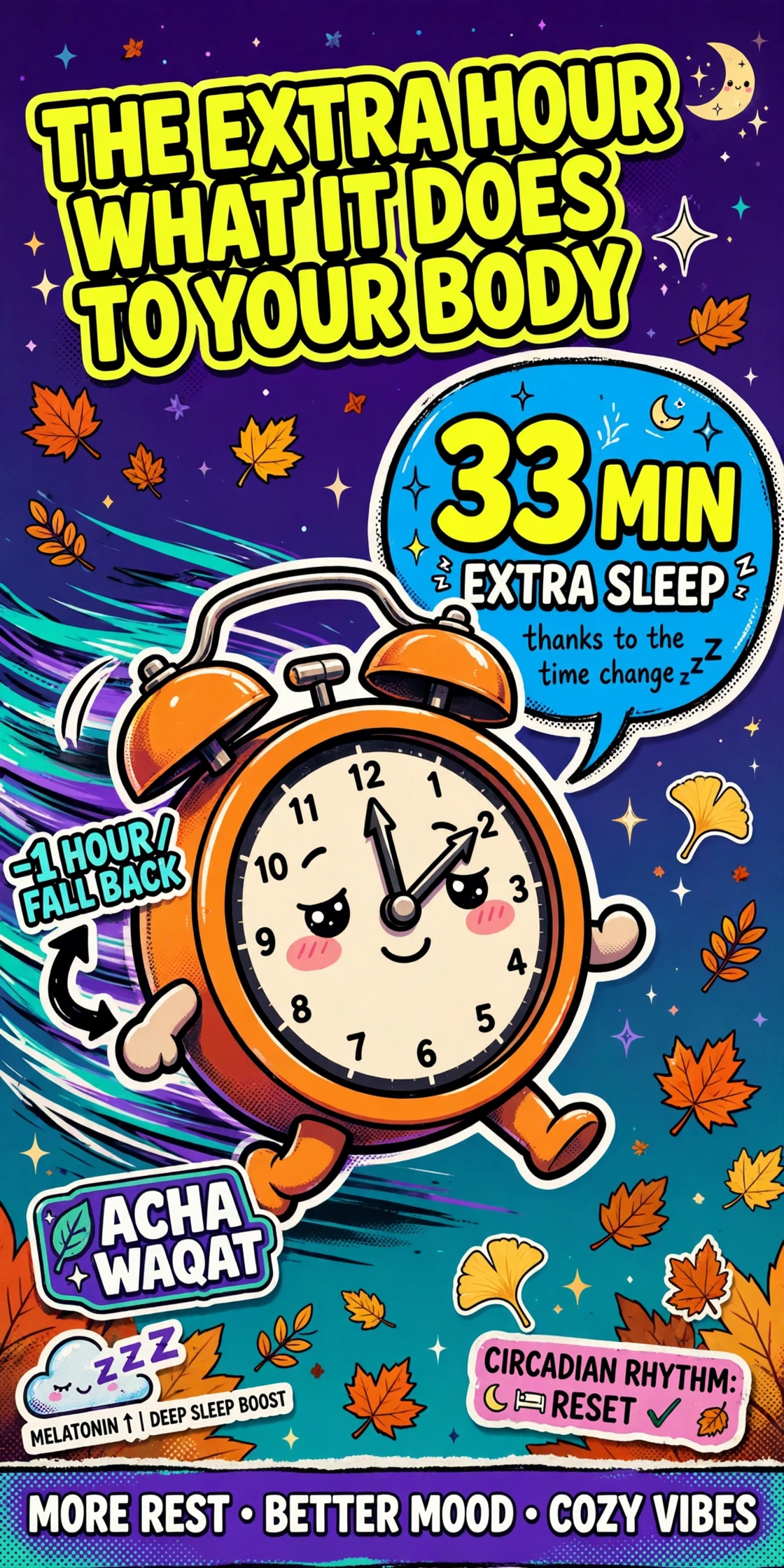
At 2am on Sunday 25 October 2026, the clocks go back one hour and the UK returns to Greenwich Mean Time. What happens to your health when the clocks go back turns out to be more interesting than an extra hour in bed: wearable data shows people actually sleep about 33 minutes longer that night, and a study of 683,809 people found fewer recorded anxiety, depression, sleep disorder and heart disease events in the week after the autumn change. This article pulls together the real evidence behind the extra hour, what the researchers think explains it, and how to get the benefit without the groggy aftermath.
When do the clocks go back in 2026?
The UK moves the clocks back on the last Sunday of October every year, and in 2026 that falls on 25 October, the earliest possible date. At 2am the clocks go back to 1am, so British Summer Time ends and Greenwich Mean Time begins. You gain an hour on Saturday night into Sunday morning, depending on how late you stay up.
The change is easy to forget about until your phone updates itself in the middle of the night. But the extra hour is not just a scheduling quirk. Researchers have spent years tracking what that hour does to sleep and health across whole populations, and some of the findings surprised even them.
You gain an hour, but you do not sleep the full hour
It is commonly thought that the clocks going back hands you an extra hour of sleep. It does not, at least not for most people. A University of Bristol-led study published in the Journal of Sleep Research tracked activity monitors worn by 11,780 UK Biobank participants aged 43 to 78 over the clock changes between 2013 and 2015.
On the Sunday the clocks went back, average sleep duration was only 33 minutes higher than the Sunday before, and 38 minutes higher than the Sunday after. People did not, or could not, bank the full extra hour. The researchers described the effect as substantial but short-lived.
There was also a difference between the sexes. Men tended to catch up on sleep on the weekdays after both clock changes, while women often slept less than before, possibly because insomnia and sleep difficulties are more common in women and are made worse by the disruption. That matters, because population averages hide real differences in how the change lands. Read more about what chronic poor sleep is linked to in our insomnia and stroke risk explainer.
The surprising week after: fewer health events in England
Here is the finding that surprised even the research team. A population-based retrospective cohort study in The BMJ analysed linked primary and secondary care records for 683,809 people in England who had a health event in the eight weeks surrounding the clock changes between 2008 and 2019.
In the week after the autumn clock change, the mean daily number of recorded events fell for five health conditions, compared with the control weeks around them:
- anxiety down 3%, from 17.3 to 16.7 events per day
- major acute cardiovascular disease down 2%, from 50.0 to 48.9 events per day
- depression down 4%, from 44.6 to 42.7 events per day
- psychiatric conditions in accident and emergency down 6%, from 3.5 to 3.3 events per day
- sleep disorders down 8%, from 5.4 to 4.9 events per day
There was little evidence of reductions in eating disorder diagnoses, road traffic injuries or self-harm, and little evidence of any short-term change after the spring clock change, when the UK loses an hour. See our piece on hidden heart disease risk and the two blood markers worth knowing.
Two important caveats come with these numbers. First, this was an observational study, so it shows an association, not proof that the clock change causes the drop. Second, the study measured demand for NHS services: diagnoses and presentations recorded in GP surgeries, hospitals and A&E, not necessarily every illness that happened in the population. A record in a GP surgery is not the same thing as an event that occurred in the community. The researchers were careful to frame their findings as fewer recorded health events in the week after the change.
What could explain it? Sleep and morning light are the prime suspects
The researchers suggest two possible explanations. The first is the extra sleep. On the night the clocks go back, people sleep about 33 minutes longer on average, and across a population of millions, even a single extra half hour of sleep could move the needle on recorded health events.
The second is the abrupt increase in morning sunlight. After the autumn change, mornings are suddenly brighter at the same clock time, which may help reset the body clock and lift mood. It is a plausible mechanism, but it is not proven, and the researchers call for more work to pin it down.
What makes the pattern worth taking seriously is the asymmetry. The autumn change, which gives the country a small sleep bonus, is linked to fewer recorded health events, while the spring change, which takes an hour away, shows little such pattern. If the extra hour were irrelevant to health, you would expect both changes to look the same.
The darker flip side: evening commutes get darker overnight
The price of the extra hour arrives on Sunday evening. In London, sunset jumps from about 5.48pm on Saturday 24 October to about 4.46pm on Sunday 25 October: the same evening commute, but an hour darker. That sudden shift is the part most people actually feel, and it calls for a few practical moves before the weekend.
- If you cycle or walk home after school or work, check that lights, reflectors and batteries are charged and working before Sunday, not after a near-miss on Monday.
- Drivers need to expect pedestrians and cyclists to be harder to see. The first week of darker evenings is the one that catches people out every year.
- Keep an eye on your mood. Shorter evenings mean less daylight overall, and some people find the darker weeks difficult. Sticking to a consistent wake time and getting outside in daylight, even for a short walk at lunchtime, can help.
How to bank the extra hour this Sunday
You do not need a complicated protocol. The evidence suggests the benefit comes from actually sleeping a little longer on the changeover night and settling into the new clock time quickly. That gives you a simple plan:
- Do not stay up to “use” the hour. The extra hour only helps if it becomes extra sleep. Go to bed at your usual time on Saturday night.
- Keep your wake time steady. Get up at your usual clock time on Sunday, then let the brighter morning do the resetting for you.
- Get morning light. Open the curtains when you wake, and get outside if you can. Morning light is the strongest signal your body clock gets.
- Cut caffeine by early afternoon on Saturday. The clock change is not the night to test a late coffee.
- Avoid a marathon lie-in. Sleeping two or three extra hours on Sunday morning can leave you groggy and make it harder to fall asleep on Sunday night. Around 30 to 60 minutes extra is the zone the wearable data suggests most people land in anyway.
- Reset manual clocks on Saturday night. Oven clocks, car dashboards and wall clocks do not update themselves, and waking up to the wrong time on Monday undoes the calm of the extra hour.
Who feels the change most?
Children can take a few days to adjust, especially to the earlier darkness. Keep bedtime routines anchored to the clock time rather than to how dark it looks outside, and shift them gradually in the days before Sunday if your children are sensitive to change.
Shift workers on night duty may work an extra hour or a shorter one depending on their rota, so check with your employer in advance rather than discovering it at 3am on Sunday morning. Older adults and anyone with a sleep disorder or dementia may find the transition harder than the average adult does.
For most people, the adjustment is over within days. But if low mood, poor sleep or exhaustion last well beyond the first week, speak to your GP rather than waiting for the next clock change. A seasonal pattern in your mood is exactly the kind of thing worth mentioning early. While you prepare for the season ahead, read our winter vomiting bug primer before norovirus finds you.
Frequently asked questions
Do we gain or lose an hour when the clocks go back?
You gain an hour. At 2am on Sunday 25 October 2026, the clocks go back to 1am. This is the autumn change: British Summer Time ends and Greenwich Mean Time begins.
Do people really sleep an extra hour when the clocks go back?
No. Wearable data from 11,780 UK Biobank participants showed average sleep on the autumn-change Sunday was only 33 minutes longer than the Sunday before, and 38 minutes longer than the Sunday after. On average, people banked about half of the extra hour.
Is the clock change good for your health?
The best evidence is mixed but interesting. A BMJ study of 683,809 people in England found fewer recorded anxiety, depression, sleep disorder and heart disease events in the week after the autumn clock change, possibly because of the extra sleep and the brighter mornings. The study was observational, so it does not prove cause and effect, and it measured NHS service demand rather than every illness in the community.
Does the clock change affect your heart?
There may be a small population-level effect. The BMJ study found that major acute cardiovascular disease events fell by about 2% in the week after the autumn clock change. That is a small association measured across millions of GP and hospital records, not a personal risk figure, so treat it as interesting rather than medical advice.
How long does it take to adjust when the clocks go back?
Most people adjust within a few days. The sleep researchers found the main effect was on the Sunday of the change itself, with smaller differences across the rest of the week. Keeping a consistent wake time and getting morning daylight helps the adjustment along.
Related reading
- Does Insomnia Increase Stroke Risk? What 1.3 Million People’s Data Shows
- “Just Overweight” but at Heart-Attack Risk: The Two Blood Markers Your Doctor Should Check
- The Winter Vomiting Bug Is Back: Norovirus, Explained Before It Finds You
Sources
- de Lange MA et al. Acute effects of daylight saving time clock changes on mental and physical health in England: population based retrospective cohort study. The BMJ 2025;391:bmj-2025-085962. https://www.bmj.com/content/391/bmj-2025-085962
- BMJ Group news summary: Autumn clock change linked to reduction in certain health conditions. https://bmjgroup.com/autumn-clock-change-linked-to-reduction-in-certain-health-conditions/
- de Lange MA et al. The effects of daylight saving time clock changes on accelerometer-measured sleep duration in the UK Biobank. Journal of Sleep Research 2024; DOI 10.1111/jsr.14335. https://www2.ukbiobank.ac.uk/publications/the-effects-of-daylight-saving-time-clock-changes-on-accelerometer-measured-sleep-duration-in-the-uk-biobank/
- Clocks go back 2026 UK: last Sunday in October rule (GOV.UK) and the 25 October 2026 date. https://www.thebritishbanner.co.uk/clocks-go-back-2026-uk/
This article is for general information only and is not medical advice. If you are worried about your sleep, mood or heart health, speak to your GP or call NHS 111.
