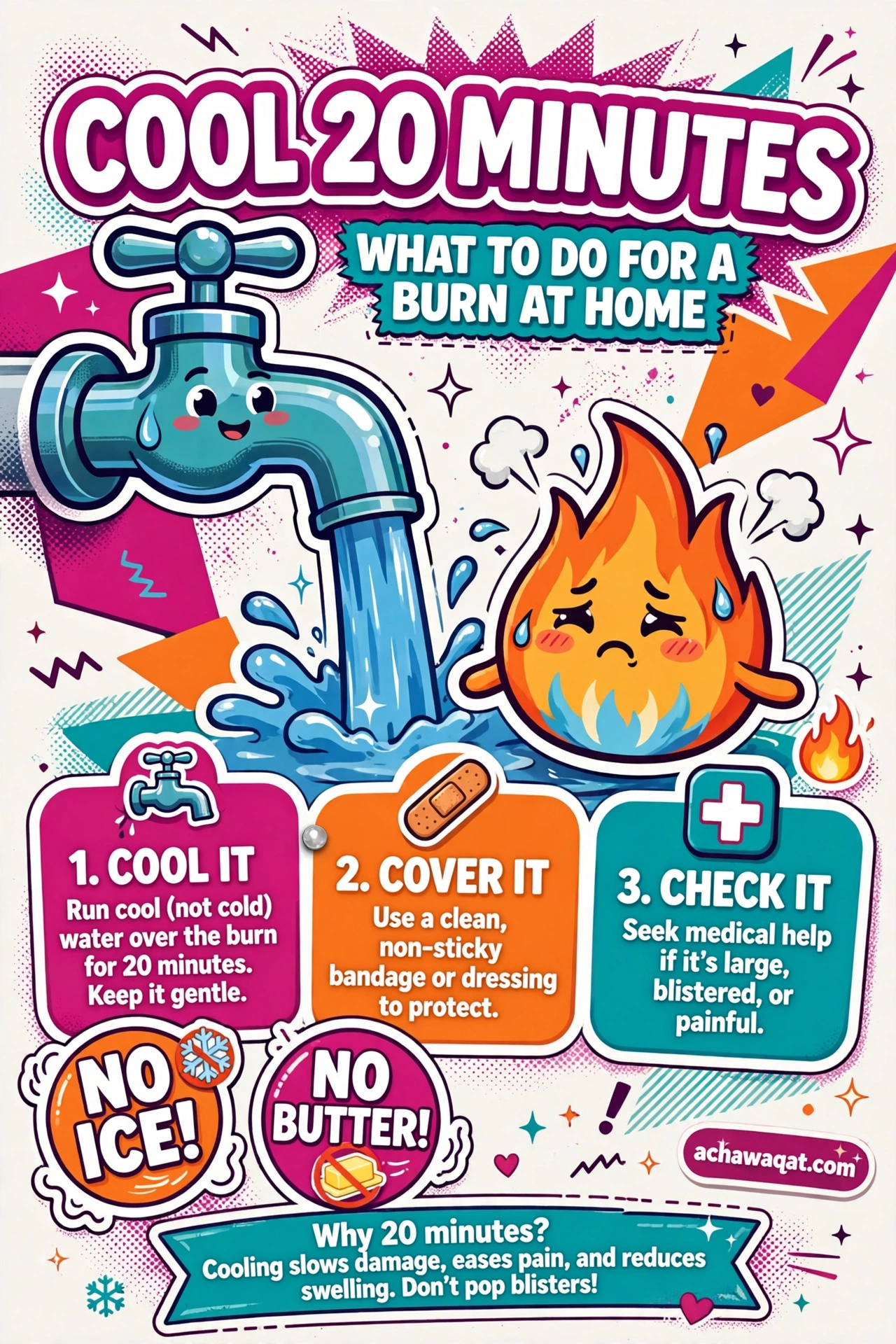
What to Do for a Burn at Home: The 20 Minutes That Decide How Well It Heals
Short answer: if someone gets a burn at home, follow three steps: cool the burn under cool running water for 20 minutes, call 999 or NHS 111 depending on its size and severity, then cover it loosely with cling film. What you do in the first 20 minutes decides how deep the damage goes and how well the skin heals.
Most burns and scalds happen at home: a splash of boiling water, a hot oven shelf, a candle knocked over, a bath that is too hot. The instinct to reach for butter, toothpaste or ice is strong, and every one of those instincts makes the injury worse. This guide explains what to do for a burn at home, based on the first-aid guidance the NHS and the British Burn Association recommend.
Cool, call, cover: the three steps that matter
The British Burn Association teaches a simple sequence, the three Cs: cool, call, cover. Birmingham Children’s Hospital’s burns team urges families to remember it, especially around Bonfire Night, because quick action can reduce the chance of long-term injury or scarring.
Step 1: Cool
Hold the burn under cool running water for 20 minutes. Do this as soon as possible, ideally straight away, but it is still worth doing within 3 hours of the injury. If there is no running water, use cool bottled water or a wet towel. While you cool, remove any clothing or jewellery near the burned area, but do not pull off anything that is stuck to the skin.
One important caution: when you are cooling a large burnt area, especially on a baby, a young child or an older person, be aware that prolonged cooling can lower body temperature. Keep the rest of the person warm with a blanket or layers of clothing, avoiding the injured area itself.
Step 2: Call
Call 999 or go to A&E if the burn is very large or deep, if there is white or charred skin of any size, if it is on the face, hands, feet, legs or genitals, or if it was caused by acid, a chemical or electricity. A practical rule from NHS guidance: any burn bigger than the injured person’s hand needs hospital assessment.
Get help from NHS 111, or from 111 online, if you are unsure what to do, if the burn has blistered, or if the injured person is a child under 10, has a medical condition such as diabetes or heart, lung or liver disease, or has a weakened immune system. If someone has breathed in smoke or fumes, they should also seek medical attention, even if the burn itself looks small, because coughing, a sore throat or difficulty breathing can appear later.
Step 3: Cover
Once the burn has cooled, lay cling film over it in a loose layer. Do not wrap the cling film around a limb, because swelling can make a tight wrap cause further injury. For burns on the hand, a clean clear plastic bag can be used instead. Covering protects the damaged skin and keeps air off the nerve endings, which eases pain.
Why the first 20 minutes matter so much
Heat does not stop damaging skin the moment the kettle is put down or the hand is pulled away from the oven. The burn keeps spreading into deeper layers of tissue while the skin stays hot. That is why NHS guidance is explicit: appropriate first aid, used as soon as possible, limits the amount of damage to your skin.
Twenty minutes of cooling feels long when someone is in pain, but it is the single most important thing you can do. It stops the burning process, reduces swelling and gives the skin its best chance of healing with minimal scarring. Starting late is still better than not starting: cooling within 3 hours of the injury still helps.
What never to put on a burn
Kitchen folklore is full of burn remedies, and almost all of them are harmful:
- Never use ice or iced water. Extreme cold damages the already injured skin and can deepen the burn. Cool running water only.
- Never use butter, toothpaste, creams or greasy substances. They trap heat in the tissue and can carry bacteria into damaged skin.
- Do not burst blisters. A blister is the body’s own sterile dressing. If a burn has blistered, seek medical attention rather than handling it yourself.
- Do not pull off clothing or jewellery stuck to the burn. Leave it for medical staff to remove.
- Do not apply creams or greasy substances while the skin heals, unless a clinician tells you to. Keep the area clean and covered.
How to tell how serious a burn is
Burns are assessed by which layers of skin are damaged. NHS guidance describes four main types:
- Superficial epidermal burn: only the outer layer is damaged. The skin is red, slightly swollen and painful, but not blistered. These usually heal in about a week without scarring.
- Superficial dermal burn: the outer layer and part of the layer beneath are damaged. The skin is pale pink and painful, and there may be small blisters. These normally heal in around 14 days, leaving minimal scarring.
- Deep dermal (partial thickness) burn: both layers are damaged. The skin looks red and blotchy, may be dry or moist, becomes swollen and blistered, and can be very painful or painless.
- Full thickness burn: all layers of skin are destroyed. The skin often looks burnt away, with the tissue underneath appearing pale or blackened. The remaining skin is dry and white, brown or black with no blisters, and the texture may be leathery or waxy. It may be painless.
The amount of pain is not a reliable guide to seriousness. Even a very serious burn can be relatively painless, because the nerve endings themselves have been destroyed. That is why the other signs matter more: white or charred skin, a burn larger than the person’s hand, or a burn on the face, hands, feet or genitals all mean hospital assessment, whatever the pain level.
Burns in children: hot drinks are the main danger
Many severe burns and scalds affect babies and young children. In the South West of England alone, three infants and children a week suffer serious scalds, and hot drinks are the main cause, according to NHS England’s burns specialists. A cup of tea knocked over a table edge can scald a toddler’s face, neck and chest in seconds.
Simple habits reduce the risk sharply:
- Keep hot drinks well away from young children, and never hold a hot drink while holding a child.
- Keep your child out of the kitchen whenever possible while cooking.
- Test the temperature of bath water with your elbow before putting a baby or toddler in.
- Keep matches, lighters and lit candles out of young children’s sight and reach.
- Turn saucepan handles inwards so they cannot be grabbed from the front of the cooker.
Bonfire Night is two weeks away: the #BeBurnsAware rules
Bonfire Night falls on Thursday 5 November, two weeks from today, and hospital burns teams see a predictable rise in injuries at this time of year. As temperatures drop, more accidental burns come from naked flames and tea lights, and fireworks add their own risks. Birmingham Children’s Hospital’s specialist Burns Centre, which treats more than 400 babies and young people for serious burns each year, urges families to #BeBurnsAware.
Their advice is straightforward. Families should attend public firework displays that are stewarded rather than setting off fireworks at home, because a managed display is by far the safest way to watch them. If fireworks are used at home, they should only be set off by a responsible adult, with children kept at a safe distance, and once a firework is lit nobody should ever go back to it. Sparklers should never be given to children under five; light them one at a time, and wear gloves to protect hands from sparks.
With the clocks going back this Sunday and the evenings turning dark, more households will be lighting candles and heaters too. Keep candles out of children’s reach, use a fire guard around open fires, and treat tea lights with the same caution as any open flame. Our guide to what the clock change does to your health explains why this dark-evenings stretch brings its own risks.
After the first aid: looking after the burn as it heals
Once the immediate first aid is done and you have decided whether medical help is needed, aftercare decides how smoothly the skin recovers:
- Keep the area clean. Before you touch a burn or its dressing, wash your hands with soap and water, as our guide to the winter vomiting bug explains why plain soap and water is the hand-cleaning method NHS guidance relies on.
- Do not burst any blisters, and do not apply creams or greasy substances to the healing skin.
- Use painkillers such as paracetamol or ibuprofen if needed, following the manufacturer’s instructions. Children under 16 should not be given aspirin.
- Raise the affected area when possible, as this helps reduce swelling.
Mild burns that affect only the uppermost layer of skin usually heal in about a week. Burns affecting the outer layer and some of the tissue beneath normally heal in around 14 days. Seek further medical advice from your GP or NHS 111 if the wound becomes painful or smelly, if you develop a temperature of 38C or higher, if the dressing becomes soaked with fluid, or if the wound has not healed after 2 weeks.
There is one longer-term rule worth knowing. During the first few years after a burn, the damaged skin is more sensitive to the sun. Keep it covered with cotton clothing, wear a peaked cap or wide-brimmed hat if the burn is on the face, and use total sun block (SPF 50) on the affected areas. It is especially sensitive during the first year.
Frequently asked questions
What is the first thing to do for a burn at home?
Get the person away from the heat source to stop the burning, then hold the burn under cool running water for 20 minutes. Remove clothing or jewellery near the area unless it is stuck to the skin. This is the single most effective thing you can do.
Should I put ice on a burn?
No. Never use ice, iced water, creams, butter, toothpaste or greasy substances on a burn. Ice damages the already injured skin, and creams and greasy substances trap heat and can introduce infection. Cool running water is the only thing to apply.
How long should I cool a burn for?
Cool the burn with cool running water for 20 minutes, starting as soon as possible. It is still worth cooling within 3 hours of the injury. If there is no running water, use cool bottled water or a wet towel.
Should I cover a burn with cling film?
Yes. After cooling, lay cling film over the burn in a loose layer; do not wrap it around a limb, because swelling can make a tight wrap harmful. For burns on the hand, a clean clear plastic bag can be used instead.
When should I call 999 for a burn?
Call 999 or go to A&E for burns that are very large or deep, any burn bigger than the injured person’s hand, burns that cause white or charred skin of any size, burns on the face, hands, feet, legs or genitals, and all chemical or electrical burns. Call 111 if you are unsure, if the burn has blistered, or if the injured person is under 10.
Should I pop a burn blister?
No. Do not burst blisters yourself, because this can lead to infection. Expert opinion is divided on how hospitals manage blisters, but the rule for home is clear: leave them alone, and if a burn has caused a blister, seek medical attention.
Sources
- NHS, Burns and scalds: what to do, when to call 999 and when to get help from NHS 111. https://www.nhs.uk/conditions/burns-and-scalds/
- NHS 111 Wales, Burns and scalds: overview, treatment, recovery and prevention. https://111.wales.nhs.uk/Burnsandscalds
- Birmingham Women’s and Children’s NHS Foundation Trust, Experts at Children’s Hospital offer advice to #BeBurnsAware this Bonfire Night. https://bwc.nhs.uk/news/experts-at-childrens-hospital-offer-advice-to-beburnsaware-this-bonfire-night-2425/
- NHS England South West, burns specialist issues fresh warning on the danger of hot drinks. https://www.england.nhs.uk/south/2024/10/16/burns-specialist-issues-fresh-warning-on-the-danger-of-hot-drinks-as-three-infants-and-children-a-week-suffer-serious-scalds-in-the-south-west/
- Kent Fire and Rescue Service, First aid for burns and scalds. https://www.kent.fire-uk.org/a-z/first-aid-burns-and-scalds-0
- South West Burns Clinical Network, First aid: cool, call, cover. https://www.southwest-burncare-network.nhs.uk/first-aid
Related reading
- The Clocks Go Back in Four Days: What the Extra Hour Does to Your Health
- The Winter Vomiting Bug Is Back: Norovirus, Explained Before It Finds You
Medical disclaimer: this article is for information only and is not medical advice. If you are unsure about a burn or scald, call NHS 111 or seek medical help. In an emergency, call 999.
