CHA2DS2-VASc Calculator
This CHA2DS2-VASc calculator estimates the annual stroke risk for people with atrial fibrillation and shows what the guidelines advise about blood thinners. Tick each condition that applies for an instant score and plain-language interpretation.
What your CHA2DS2-VASc calculator score means
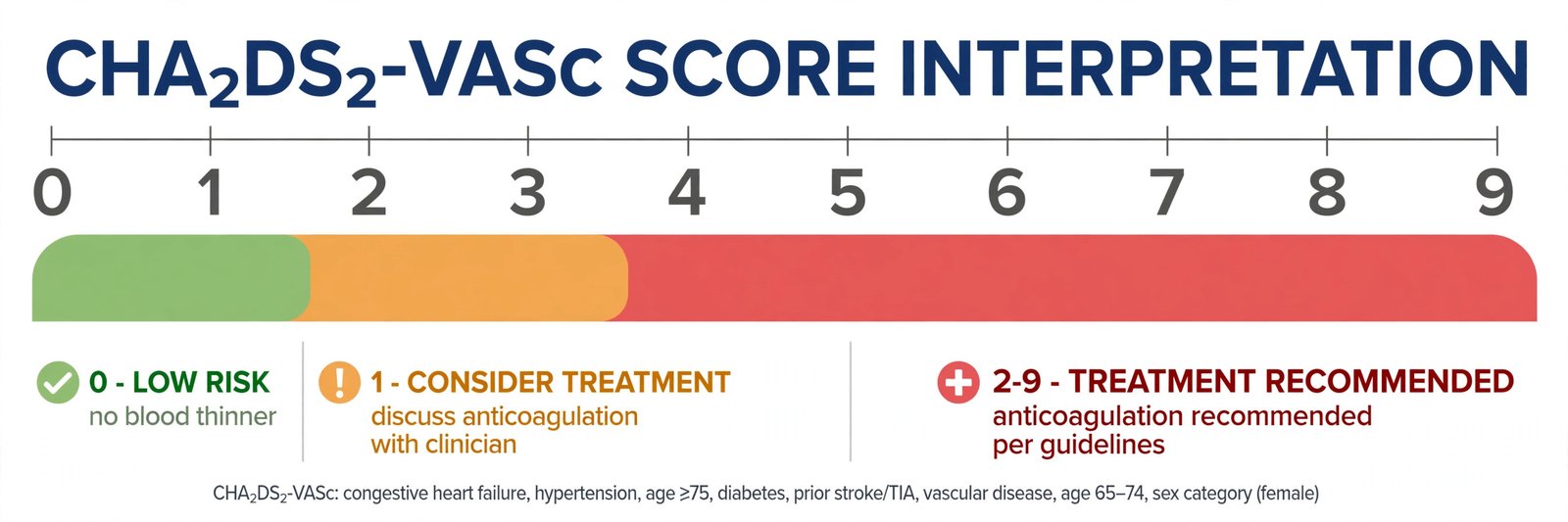
The score runs from 0 to 9. Each total maps to an approximate annual stroke rate from the validation studies and to a guideline recommendation about oral anticoagulation (blood thinners).
| Score | Stroke rate per year | Guideline advice |
|---|---|---|
| 0 (men) | 0% | No blood thinner needed |
| 1 (men) | 1.3% | Consider blood thinner |
| 2 | 2.2% | Blood thinner recommended |
| 3 | 3.2% | Blood thinner recommended |
| 4 | 4.0% | Blood thinner recommended |
| 5 | 6.7% | Blood thinner recommended |
| 6 | 9.8% | Blood thinner recommended |
| 7 | 9.6% | Blood thinner recommended |
| 8 | 6.7% | Blood thinner recommended |
| 9 | 15.2% | Blood thinner recommended |
For women, one point comes from female sex alone: a score of 1 based only on sex means low risk and no blood thinner, 2 means consider treatment, and 3 or more means treatment is recommended. The yearly rates are cohort averages, less precise at the highest scores where patient numbers were small.
How the score is calculated
Lip and colleagues introduced the CHA2DS2-VASc score in 2010 to refine stroke prediction in atrial fibrillation. Each letter is a risk factor, and the number after it is its points:
| Letter | Risk factor | Points |
|---|---|---|
| C | Congestive heart failure or left ventricular dysfunction | 1 |
| H | Hypertension | 1 |
| A2 | Age 75 or older | 2 |
| D | Diabetes mellitus | 1 |
| S2 | Prior stroke, TIA, or thromboembolism | 2 |
| V | Vascular disease (prior MI, peripheral artery disease, aortic plaque) | 1 |
| A | Age 65 to 74 | 1 |
| Sc | Sex category: female | 1 |
The points are added up to a maximum of 9. Compared with the older CHADS2 score, CHA2DS2-VASc adds vascular disease, the 65 to 74 age band, and female sex, and gives double weight to age 75 and above. This picks out truly low-risk patients more reliably, so fewer people take blood thinners they do not need.
Why atrial fibrillation causes strokes
In atrial fibrillation the upper chambers of the heart quiver rapidly instead of contracting in a coordinated squeeze. Blood then moves sluggishly and can pool, particularly in a small pouch off the left atrium called the left atrial appendage. Stagnant blood tends to clot, and a clot that breaks free can travel through the arteries to the brain, blocking blood flow and causing an ischaemic stroke.
Strokes caused by atrial fibrillation are, on average, more severe and more likely to be fatal or disabling than strokes from other causes, because the clots tend to be larger. This is the reason stroke prevention, rather than just symptom control, is a central goal of atrial fibrillation care. The risk is not the same for every patient, which is exactly what the CHA2DS2-VASc score is designed to sort out: it separates the minority who are at genuinely low risk from the majority who benefit from anticoagulation.
How clinicians use the score in practice
The score is only the first half of the decision. A clinician pairs it with an assessment of bleeding risk, most often the HAS-BLED score, and then has a shared-decision conversation with the patient. The general pattern from the guidelines is straightforward: a score of 0 in men (1 in women, from sex alone) means no anticoagulant; a score of 1 in men (2 in women) means the pros and cons of treatment should be discussed; a score of 2 or more in men (3 or more in women) means oral anticoagulation is recommended for most patients.
When anticoagulation is chosen, current guidelines generally prefer the direct oral anticoagulants (apixaban, rivaroxaban, dabigatran, edoxaban) over warfarin for non-valvular atrial fibrillation, because they are at least as effective with a lower risk of intracranial bleeding and need no INR monitoring. Warfarin remains the required choice for mechanical heart valves and moderate-to-severe mitral stenosis, where the newer drugs must not be used. Aspirin alone is no longer recommended for stroke prevention in atrial fibrillation: it is far less effective than anticoagulation and still carries a bleeding risk.
The score is not a one-time calculation. Risk factors change: birthdays move patients across the 65 and 75 thresholds, and hypertension, diabetes, heart failure, or vascular disease can develop later. Guidelines advise reassessing the score periodically, at least annually, so treatment keeps pace with the patient's actual risk.
Limitations
- The score is validated for non-valvular atrial fibrillation only. It does not apply to mechanical heart valves or moderate-to-severe mitral stenosis, which need warfarin regardless of score.
- Female sex alone is not treated as a reason for blood thinners: a woman whose only point is sex has a low risk.
- The yearly stroke rates are population averages without anticoagulation, not personal predictions.
- Bleeding risk must be weighed too. Clinicians often pair this score with the HAS-BLED bleeding score; high bleeding risk calls for caution, not for skipping stroke prevention.
- Starting, continuing, or stopping a blood thinner is a decision for you and your clinician together.
Frequently asked questions
What is the CHA2DS2-VASc score?
The CHA2DS2-VASc score estimates the annual risk of stroke in people with atrial fibrillation. It adds points for heart failure, hypertension, age, diabetes, prior stroke or embolism, vascular disease, and female sex, for a total of 0 to 9. European and American atrial fibrillation guidelines recommend its use.
What CHA2DS2-VASc score needs blood thinners?
Guidelines recommend oral anticoagulation for most men with a score of 2 or more and most women with a score of 3 or more. A score of 1 in men (or 2 in women) means anticoagulation should be considered and discussed. A score of 0 in men, or 1 in women where the only point is female sex, means no blood thinner is needed.
What is the difference between CHADS2 and CHA2DS2-VASc?
CHA2DS2-VASc extends the older CHADS2 score with three extra risk factors: vascular disease, age 65 to 74, and female sex, and it doubles the weight of age 75 or older. It finds truly low-risk patients more reliably, so fewer people take blood thinners they do not need.
Does a high CHA2DS2-VASc score mean I will definitely have a stroke?
No. The score gives the average annual stroke rate from the validation studies, for example about 2.2% per year for a score of 2. It is a population average, not a personal prediction, and effective anticoagulation lowers the risk substantially.
Can I take aspirin instead of a blood thinner?
Current guidelines do not recommend aspirin alone for stroke prevention in atrial fibrillation. It is far less effective than oral anticoagulation at preventing AF-related strokes and still carries a bleeding risk. If anticoagulation is advised, discuss the options with your clinician rather than substituting aspirin.
How often should the CHA2DS2-VASc score be recalculated?
At least once a year, and sooner if something changes. Ageing across the 65 or 75 thresholds adds points automatically, and newly diagnosed hypertension, diabetes, heart failure, vascular disease, or a stroke or TIA all change the score and may change the treatment recommendation.