HAS-BLED Score Calculator: Bleeding Risk in Atrial Fibrillation
The HAS-BLED score calculator estimates 1-year major bleeding risk for adults with atrial fibrillation who are taking, or considering, anticoagulation. It adds one point for each of nine clinical criteria (uncontrolled hypertension, abnormal kidney or liver function, prior stroke, bleeding history, labile INRs, age over 65, interacting drugs, and alcohol use), giving a score from 0 to 9. A score of 3 or more means high bleeding risk: review and correct every modifiable risk factor and schedule regular follow-up, but do not withhold anticoagulation on the score alone when stroke prevention is indicated.
Calculate the HAS-BLED score
Tick each criterion that applies. Nothing is required; a blank form simply scores 0.
What your HAS-BLED score result means
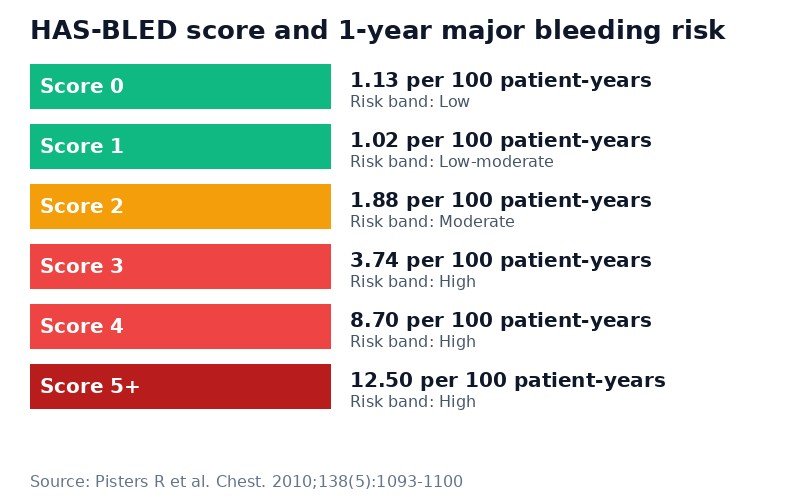
HAS-BLED was developed from Euro Heart Survey data and validated by Pisters and colleagues in 2010. The published 1-year major bleeding rates per 100 patient-years are:
| Score | Risk band | Major bleeds per 100 patient-years | Practical meaning |
|---|---|---|---|
| 0 | Low | 1.13 | Anticoagulate if stroke risk justifies it; routine review |
| 1 | Moderate | 1.02 | Anticoagulate if stroke risk justifies it; address modifiable factors |
| 2 | Moderate | 1.88 | Anticoagulate if stroke risk justifies it; address modifiable factors |
| 3 | High | 3.74 | Caution: correct modifiable factors and review regularly |
| 4 | High | 8.70 | Caution: correct modifiable factors and review regularly |
| 5 or more | High | 12.50 (score 5; higher scores too rare for stable estimates) | Caution: correct modifiable factors and review regularly |
How to use the score in practice
The main value of HAS-BLED is as a checklist. Many of its points are modifiable: blood pressure can be controlled, excess alcohol can be reduced, and NSAIDs or duplicate antiplatelets can often be stopped. A high score should therefore trigger action on these factors and closer follow-up, not automatic refusal of anticoagulation. The European Society of Cardiology AF guidelines make this explicit: a high bleeding risk score should prompt review and correction of modifiable factors, and net clinical benefit usually still favors anticoagulation when stroke risk is also high.
The nine components of HAS-BLED
Each letter of HAS-BLED is one clinical risk factor, and two of the letters carry two possible points, for a maximum of 9:
| Letter | Risk factor | Definition used in the score | Points |
|---|---|---|---|
| H | Hypertension | Uncontrolled, systolic above 160 mmHg | 1 |
| A | Abnormal renal function | Creatinine 200 micromol/L or higher, dialysis, or kidney transplant | 1 |
| A | Abnormal liver function | Cirrhosis, or bilirubin over twice normal with liver enzymes over three times normal | 1 |
| S | Stroke | Prior stroke, particularly ischaemic | 1 |
| B | Bleeding | Prior major bleeding or a predisposition such as anaemia | 1 |
| L | Labile INRs | Unstable anticoagulation control, time in therapeutic range below 60 percent (warfarin only) | 1 |
| E | Elderly | Age over 65 | 1 |
| D | Drugs | Concurrent antiplatelet or NSAID use | 1 |
| D | Alcohol | Excess alcohol use, generally 8 or more drinks per week | 1 |
Note the deliberate design: the factors a clinician can change (blood pressure, alcohol, interacting drugs, INR control) sit alongside the ones they cannot (age, prior stroke, organ damage). That is what makes the score a practical checklist rather than just a number.
HAS-BLED and CHA2DS2-VASc: the two scores used together
In practice these two scores are almost always calculated as a pair, because they answer the two halves of one question: CHA2DS2-VASc estimates the stroke risk of leaving atrial fibrillation untreated, and HAS-BLED estimates the bleeding risk of treating it. The art of the decision is comparing the two, and the comparison usually favors treatment: strokes prevented by anticoagulation tend to outnumber the bleeds it causes, especially since most bleeds are manageable while AF-related strokes are often disabling.
The scores deliberately overlap. Hypertension, prior stroke, and older age appear in both, which means the patients at highest stroke risk often score high on bleeding risk too. Guidelines are clear that this overlap must not become an excuse to undertreat: a high HAS-BLED score in a patient with a high CHA2DS2-VASc score calls for correcting every modifiable bleeding factor and watching closely, not for withholding stroke prevention. The one firm rule is that neither score decides anything alone; the decision is made with the patient, weighing both numbers together.
Limitations of HAS-BLED
- HAS-BLED was derived in patients on vitamin K antagonists. The labile INR item does not apply to direct oral anticoagulants, and the score is less precise in that population.
- Bleeding risk is dynamic. A score calculated today does not describe the same patient in a year; reassess at every review.
- The score does not capture every bleeding risk, such as recent surgery, falls risk, or some drug interactions; clinical judgment still applies.
- Very high scores (6 to 9) are rare, so the bleeding estimates at the top of the scale are less precise.
Frequently asked questions
What is a good HAS-BLED score?
A score of 0 is low bleeding risk, about 1.1 major bleeds per 100 patient-years. Scores of 1 to 2 are moderate risk. A score of 3 or more is high risk and means modifiable factors should be reviewed and corrected, though anticoagulation should not be denied on the score alone when it is indicated.
What does HAS-BLED stand for?
Hypertension (uncontrolled), Abnormal renal or liver function, Stroke, Bleeding history, Labile INRs, Elderly (over 65), and Drugs or alcohol use. Each letter is one point, for a maximum of 9.
Should anticoagulation be stopped if the HAS-BLED score is high?
No. A high score flags the need to correct modifiable bleeding risks and review the patient regularly. Guidelines do not recommend withholding anticoagulation based on the score alone when stroke prevention is warranted.
Does HAS-BLED apply to direct oral anticoagulants?
It was derived and validated in warfarin patients. For direct oral anticoagulants it is less precise, though it still usefully flags modifiable risk factors.
How often should the score be reassessed?
At every review, because risk factors such as age, blood pressure, alcohol use, and interacting medicines change over time.
Why do some HAS-BLED risk factors overlap with stroke risk factors?
Hypertension, prior stroke, and older age raise both stroke risk (CHA2DS2-VASc) and bleeding risk (HAS-BLED). This overlap is expected: the patients who most need stroke prevention often have the highest bleeding scores too. Guidelines say this must not lead to undertreatment; instead, correct every modifiable bleeding factor and monitor closely while continuing stroke prevention.
Clinical source: Pisters R, Lane DA, Nieuwlaat R, Crijns HJGM, Lip GYH. A novel user-friendly score (HAS-BLED) to assess 1-year risk of major bleeding in patients with atrial fibrillation. Chest. 2010;138(5):1093-1100. doi:10.1378/chest.10-0134