ASCVD Risk Calculator
This ASCVD risk calculator estimates your 10-year risk of heart attack or stroke with the pooled cohort equations, the same method recommended by the ACC/AHA cholesterol guidelines. Enter your numbers below and get an instant result with a plain-language interpretation.
What your ASCVD risk calculator result means
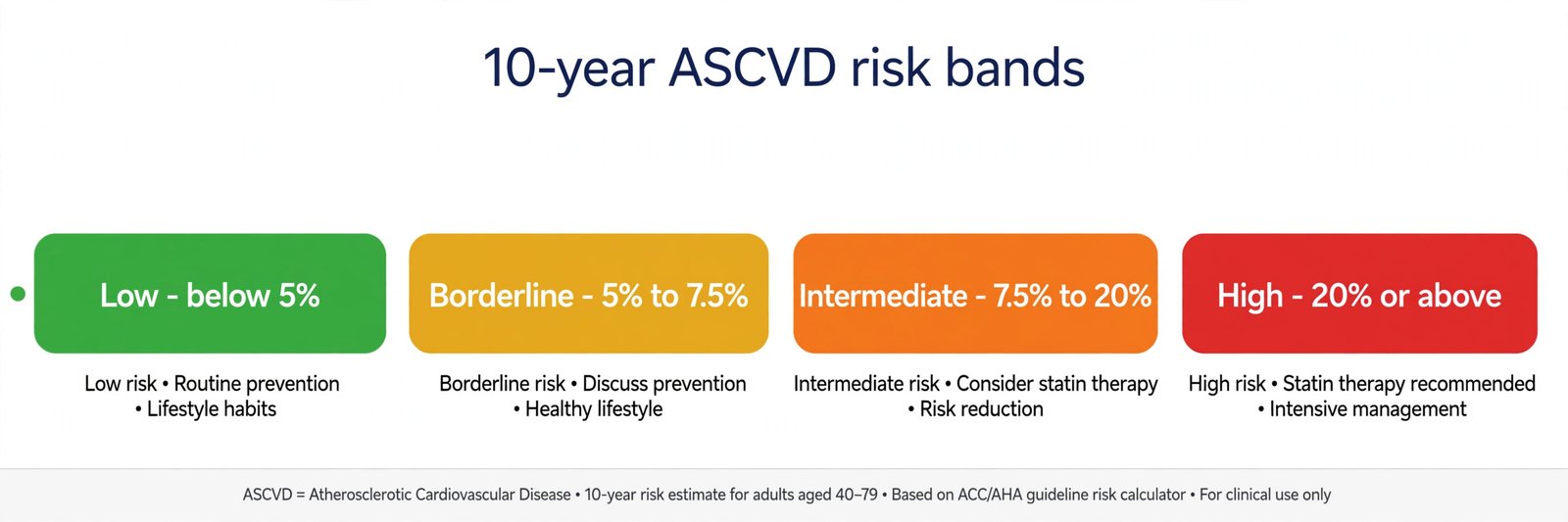
The calculator returns the estimated probability that you will have a first heart attack or stroke in the next 10 years. Guidelines group the result into four bands:
| 10-year risk | Band | What usually happens next |
|---|---|---|
| Below 5% | Low risk | Heart-healthy lifestyle; statin generally not recommended. |
| 5% to below 7.5% | Borderline risk | Lifestyle changes; clinician may consider risk enhancers or a coronary calcium scan. |
| 7.5% to below 20% | Intermediate risk | Clinician-patient discussion about starting a moderate-intensity statin. |
| 20% or higher | High risk | High-intensity statin usually recommended alongside lifestyle changes. |
These cutoffs come from the 2018 ACC/AHA Guideline on the Management of Blood Cholesterol. The "what happens next" column describes typical practice, not a prescription for you.
How the calculation works
The pooled cohort equations were derived from large US community cohorts and published by Goff and colleagues in 2013. For your sex and race group, the calculator takes the natural log of your age, cholesterol values and systolic pressure, multiplies each by its published coefficient, adds terms for smoking, diabetes and blood pressure treatment, subtracts the cohort mean, and converts the total into a 10-year probability. Separate equations exist for White men, African American men, White women and African American women. For the "Other" race option this page uses the White equations, which is the common fallback when no group-specific equation exists.
What the equations actually measure
ASCVD stands for atherosclerotic cardiovascular disease: the clinical events caused by plaque building up in artery walls. The pooled cohort equations predict a specific basket of first events over the next 10 years: coronary heart disease death, nonfatal heart attack, and fatal or nonfatal stroke. They were built by pooling four landmark American cohort studies (ARIC, CARDIA, the Cardiovascular Health Study, and Framingham) that together followed tens of thousands of adults for decades, which is why the equations carry weight in guidelines worldwide.
Nine inputs feed the calculation: age, sex, race group, total cholesterol, HDL cholesterol, systolic blood pressure, whether blood pressure is treated, smoking status, and diabetes. Each was chosen because it independently predicted events in the cohort data. Age dominates the result, which surprises many users: a 70-year-old with excellent numbers can outscore a 45-year-old smoker with high cholesterol, because age captures decades of cumulative arterial exposure that no single risk factor matches. The equations deliberately exclude some known risks, family history and kidney disease among them, which is why guidelines add those back as risk enhancers rather than rebuilding the formula.
For the full background on risk factors, risk bands, and what your result means, read our companion guide: ASCVD Risk Explained: Risk Factors, Categories and What Your Score Means.
Risk enhancers: when the number understates your risk
The 2018 ACC/AHA cholesterol guideline lists conditions that should push the decision toward treatment when the calculated risk is borderline or intermediate. A family history of premature heart disease (a father or brother affected before 55, a mother or sister before 65) is the classic one. Chronic kidney disease, metabolic syndrome, and persistently high triglycerides all signal extra risk the equations miss. For women, pregnancy complications count: preeclampsia and premature menopause (before 40) are recognized enhancers. Chronic inflammatory conditions such as rheumatoid arthritis, psoriasis, and lupus accelerate atherosclerosis, as does HIV infection.
When the decision is still unclear after considering enhancers, the guideline's tiebreaker is the coronary artery calcium (CAC) score from a CT scan. Calcium in the coronary walls marks established plaque: a score of zero argues strongly against starting a statin in most borderline and intermediate patients (with some exceptions, such as smokers and people with diabetes or strong family history), while a score of 100 or above, or above the 75th percentile for age and sex, favors treatment. The scan involves radiation and cost, so it is reserved for genuine uncertainty, not routine screening.
What actually lowers the number
The inputs that move are the ones worth acting on. Lowering LDL cholesterol with a statin is the best-proven lever: large trials show each 1 mmol/L (about 39 mg/dL) reduction cuts major vascular events by roughly a fifth, and the benefit scales with the starting risk, which is why high-risk patients gain the most in absolute terms. Controlling systolic blood pressure, quitting smoking, and managing diabetes each independently reduce events. Lifestyle measures, a Mediterranean-style eating pattern, regular aerobic activity, maintaining a healthy weight, and limiting alcohol, shift several inputs at once and remain the foundation at every risk level.
It is worth recalculating after meaningful change. A 55-year-old smoker with a systolic pressure of 150 who quits, gets pressure to 125, and starts a statin can watch a 15 percent risk fall into the single digits, which is both motivating and a concrete check that treatment is working. Guidelines suggest reassessing every 4 to 6 years in adults 40 to 75, and sooner after major changes in risk factors or treatment.
Limitations
- Validated only for adults aged 40 to 79 without known cardiovascular disease. Inputs outside the validated ranges (total cholesterol 130-320, HDL 20-100, systolic pressure 90-200) are not accepted by this calculator.
- Not for people with familial hypercholesterolemia, established heart disease, or prior stroke or TIA.
- The equations were derived mainly from White and African American cohorts, so accuracy is less certain for other groups.
- Risk enhancers such as family history of premature heart disease, chronic kidney disease, metabolic syndrome, persistently high triglycerides, or a high coronary calcium score can raise your true risk above the calculated number.
Frequently asked questions
What is the ASCVD risk calculator?
The ASCVD risk calculator estimates your 10-year risk of atherosclerotic cardiovascular disease, meaning heart attack or stroke. It uses the pooled cohort equations published by Goff and colleagues in 2013 and endorsed by the American College of Cardiology and American Heart Association.
What counts as high ASCVD risk?
A 10-year risk of 20% or higher is considered high risk. Risk from 7.5% to below 20% is intermediate, 5% to below 7.5% is borderline, and below 5% is low risk. These cutoffs come from the 2018 ACC/AHA cholesterol guideline.
Who should not use this calculator?
The pooled cohort equations are validated for adults aged 40 to 79 without known cardiovascular disease. They should not be used for people with familial hypercholesterolemia, existing heart disease, or prior stroke, and the equations were derived mainly from White and African American cohorts.
Does a high ASCVD score mean I need a statin?
Not automatically. Guidelines use the score as one input in a clinician-patient risk discussion that also weighs risk enhancers, coronary calcium scoring, and preferences. Never start or stop medication based on an online calculator alone.
What is a coronary artery calcium score and when is it used?
It is a CT-based measure of calcified plaque in the coronary arteries. Guidelines use it as a tiebreaker when the 10-year risk is borderline or intermediate and the treatment decision is uncertain: a score of zero generally argues against a statin, while a score of 100 or above favors one. It is not for routine screening because of radiation and cost.
How often should I recalculate my ASCVD risk?
Guidelines suggest every 4 to 6 years for adults aged 40 to 75, and sooner after major changes: quitting smoking, starting blood pressure or cholesterol treatment, or a new diabetes diagnosis. Recalculating after change shows whether treatment is working and can be motivating.