QTc Calculator
This QTc calculator corrects the QT interval for heart rate using four standard formulas: Bazett, Fridericia, Framingham, and Hodges. Enter the QT interval and heart rate from the ECG for all four QTc values and a plain-language interpretation.
| Formula | QTc (ms) |
|---|---|
| Bazett | |
| Fridericia | |
| Framingham | |
| Hodges |
What your QTc calculator result means
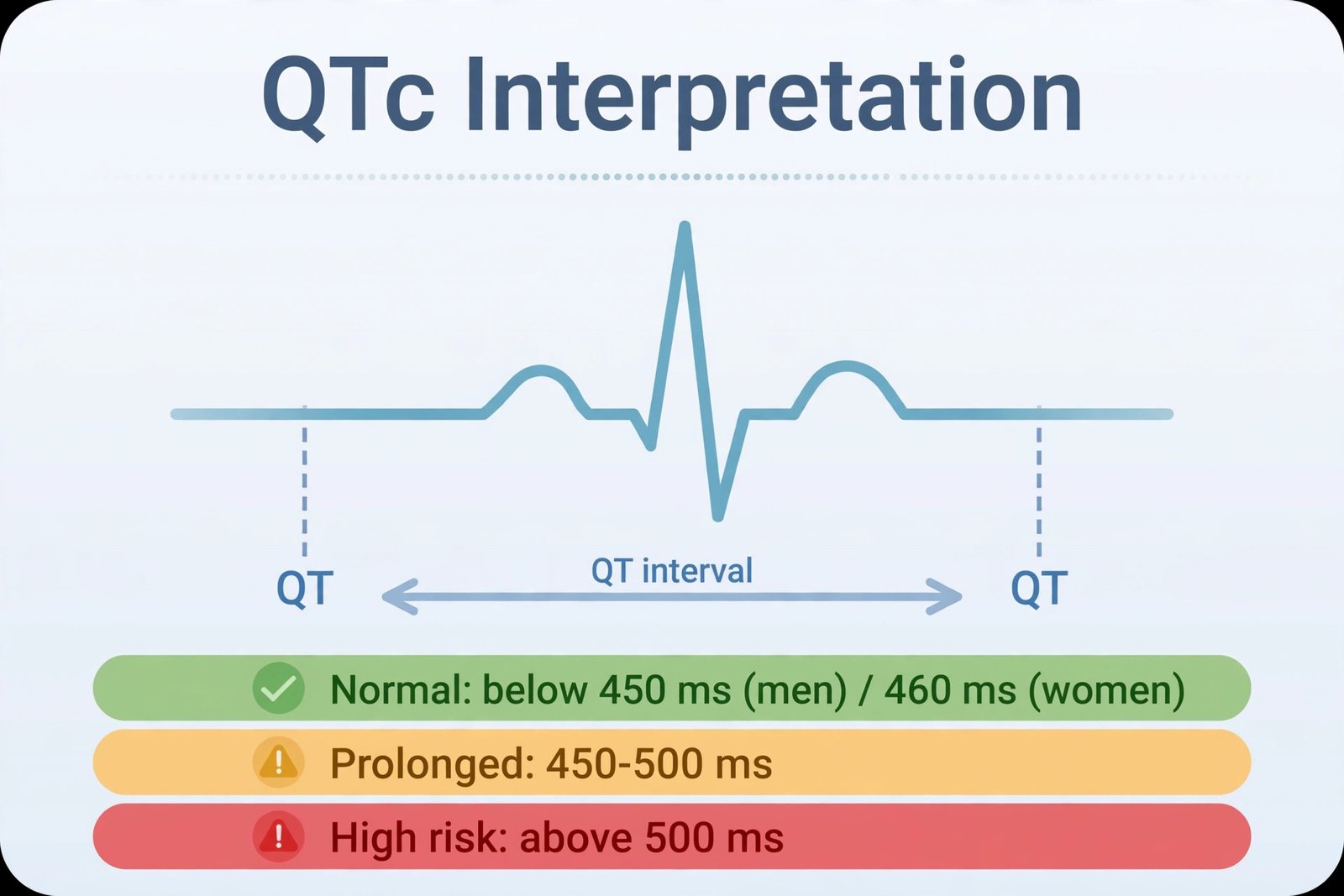
The interpretation below uses the Bazett value, the formula most ECG machines report. The AHA/ACCF/HRS recommendations treat a QTc of 450 ms or longer in men and 460 ms or longer in women as prolonged, and a QTc above 500 ms as a clearly elevated risk of torsades de pointes in either sex.
| QTc (Bazett) | Interpretation | What it means |
|---|---|---|
| Below 450 ms (men) / 460 ms (women) | Normal | Within the expected range. |
| 450 to 469 ms (men) / 460 to 479 ms (women) | Borderline prolonged | Worth a clinician review, especially with symptoms or QT-prolonging medicines. |
| 470 to 500 ms (men) / 480 to 500 ms (women) | Prolonged | Needs clinician review; check medicines and potassium/magnesium levels. |
| Above 500 ms (either sex) | High risk | Clearly elevated arrhythmia risk; seek prompt medical assessment. |
A QTc of 390 ms or shorter is considered unusually short by the same recommendations, and also deserves a clinician review.
The four QTc correction formulas
The QT interval shortens as the heart beats faster, so every formula adjusts the measured QT to its equivalent at 60 beats per minute (RR interval of 1 second). All four are shown because they disagree most at fast and slow heart rates.
| Formula | Equation (QT in ms, RR in seconds, HR in bpm) | Notes |
|---|---|---|
| Bazett (1920) | QTc = QT / square root of RR | Oldest and most widely used; over-corrects above about 100 bpm and under-corrects below 60 bpm. |
| Fridericia (1920) | QTc = QT / cube root of RR | More stable at fast heart rates; preferred in drug-safety studies. |
| Framingham | QTc = QT + 154 x (1 - RR) | Linear correction from the Framingham Heart Study; behaves well at moderate rates. |
| Hodges | QTc = QT + 1.75 x (HR - 60) | Linear correction based on heart rate rather than the RR interval. |
When the formulas disagree, the heart rate is usually the reason: at very fast or slow rates, trust Fridericia, Framingham, or Hodges more than Bazett.
Why a long QT interval is dangerous
The QT interval on an ECG represents ventricular repolarisation: the electrical reset of the heart's main pumping chambers after each beat. When repolarisation takes too long, the heart spends part of the next beat still electrically unstable. In that vulnerable window, a premature impulse can trigger a chaotic rhythm called torsades de pointes, a form of ventricular tachycardia in which the ECG complexes appear to twist around the baseline. Torsades often stops on its own, causing dizziness or fainting, but it can degenerate into ventricular fibrillation and sudden cardiac arrest.
The risk climbs with the QTc length, which is why 500 ms is treated as the red line: above it, the chance of torsades is high enough that clinicians act even in people who feel well. The danger is amplified by low potassium or magnesium, slow heart rates, and female sex, and by the combination of several QT-lengthening factors at once. This is also why a prolonged QTc is never interpreted in isolation: the ECG finding, the electrolytes, and the medicine list are reviewed together.
Medicines and conditions that lengthen the QT
A large share of prolonged QTc readings in hospitals are acquired, not inherited. Many common medicines block the heart's potassium channels as a side effect, including certain antiarrhythmics (sotalol, amiodarone), macrolide and fluoroquinolone antibiotics (azithromycin, moxifloxacin), some antipsychotics (haloperidol), the antidepressant citalopram, and the antiemetic ondansetron. The risk grows when two or more such drugs are combined, or when they are given to someone whose potassium or magnesium is already low.
Electrolyte disturbances lengthen the QT directly: low potassium is the classic culprit, with low magnesium and low calcium contributing. Correcting them is often the fastest way to shorten the QTc. The inherited form, congenital long QT syndrome, comes from gene variants affecting the heart's ion channels; it is suspected when the QTc is markedly prolonged, when fainting runs in the family, or when a young person has an unexplained cardiac arrest. Anyone starting a known QT-prolonging medicine with a borderline QTc should have the ECG rechecked, and clinicians routinely consult maintained lists of QT-prolonging drugs before prescribing.
Limitations
- This QTc calculator assumes a regular rhythm with a narrow QRS complex. It is unreliable in atrial fibrillation, bundle branch block, paced rhythms, or with a wide QRS, where the JT interval or a specialist correction is used instead.
- Correct QT measurement matters more than the formula: use the longest QT, usually in lead II or V5, and the tangent method when the T wave end is unclear.
- A single borderline QTc should be confirmed on a repeat ECG and reviewed with a clinician; medicines, low potassium, and low magnesium all lengthen the QT.
- This tool does not diagnose long QT syndrome and does not replace medical assessment.
Frequently asked questions
What is the QTc interval?
The QTc interval is the QT interval from an ECG corrected for heart rate. Because the QT shortens naturally as the heart beats faster, the raw QT cannot be compared between heart rates, so correction formulas adjust it to what it would be at 60 beats per minute.
Which QTc formula should I use: Bazett, Fridericia, Framingham or Hodges?
Bazett is the most widely used and the default in most ECG machines. Fridericia stays more accurate at fast heart rates and is preferred in drug-safety studies. Framingham and Hodges are linear corrections that behave well at moderate rates. This QTc calculator shows all four so you can compare them.
What is a normal QTc?
The AHA/ACCF/HRS recommendations consider a QTc of 450 ms or longer in men and 460 ms or longer in women to be prolonged. A QTc above 500 ms marks a clearly elevated risk of dangerous arrhythmia regardless of sex.
Does a prolonged QTc mean I will get an arrhythmia?
No. A prolonged QTc is a risk marker for torsades de pointes, not a prediction. Many people with a long QTc never have an arrhythmia, and the risk rises with the QTc length, low potassium or magnesium, and certain medicines. A prolonged result should be reviewed with a clinician.
My ECG machine already reports a QTc. Why use this calculator?
ECG machines report the Bazett value, which misreads at fast and slow heart rates, and automated QT measurement can be wrong, especially with flat or notched T waves. This calculator lets you enter a hand-measured QT and compare all four formulas, which is how a borderline machine reading gets a proper second opinion.
Which medicines lengthen the QT interval?
Many, across drug classes: certain antiarrhythmics, macrolide and fluoroquinolone antibiotics, some antipsychotics and antidepressants, and the antiemetic ondansetron, among others. The risk rises when several are combined or when potassium or magnesium is low. Never stop a prescribed medicine because of a QTc reading; have the ECG and medicine list reviewed together by your clinician.