Creatinine Clearance Calculator (Cockcroft-Gault)
This creatinine clearance calculator estimates kidney function using the Cockcroft-Gault equation: creatinine clearance (mL/min) equals (140 minus age) times weight in kg, divided by 72 times serum creatinine in mg/dL, multiplied by 0.85 for women. It is the standard equation for drug dosing: most renal drug labels were written against it. Enter age, sex, weight, and serum creatinine (in mg/dL or micromol/L) to get the estimated clearance plus the matching CKD stage.
Calculate creatinine clearance
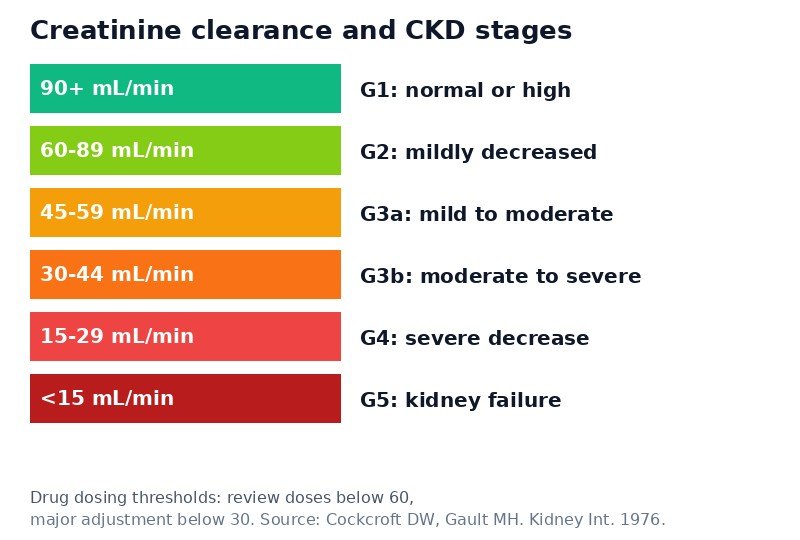
What your creatinine clearance result means
| Clearance (mL/min) | CKD stage | Practical meaning |
|---|---|---|
| 90 or above | G1 (with kidney damage) or normal | Kidney function normal or high; standard drug doses |
| 60 to 89 | G2 (with kidney damage) | Mildly decreased; normal for many older adults |
| 45 to 59 | G3a | Mild to moderate decrease; start checking drug doses |
| 30 to 44 | G3b | Moderate to severe decrease; many drugs need dose reduction |
| 15 to 29 | G4 | Severe decrease; specialist review, major dose adjustments |
| Below 15 | G5 | Kidney failure; dialysis planning, specialist care |
How the Cockcroft-Gault equation works
Cockcroft and Gault derived the equation in 1976 from measured creatinine clearances in 249 patients. Age and weight stand in for muscle mass, since creatinine comes from muscle: older age and lower weight mean less creatinine production. Women get a 0.85 multiplier because women on average have less muscle mass than men at the same weight. For SI units the equation is equivalent: clearance equals (140 minus age) times weight times 1.23 (men) or 1.04 (women), divided by creatinine in micromol/L.
For a full worked example and guidance on which body weight to use, read our companion guide: Creatinine Clearance Explained: the Cockcroft-Gault Equation.
Why creatinine clearance matters for drug dosing
The kidneys are the exit route for a large share of medicines. When clearance falls, drugs that the kidneys normally remove stay in the body longer, accumulate with repeated doses, and can reach toxic levels on a standard dose. This is why dose reduction in kidney impairment is a routine part of prescribing, and why pharmacists check renal function before dispensing many drugs.
The classic examples are antibiotics such as aminoglycosides and vancomycin, where both underdosing (treatment failure) and overdosing (kidney and ear damage) are dangerous. But the list is long: the direct oral anticoagulants apixaban, rivaroxaban, and dabigatran all carry renal dose cutoffs, metformin is restricted below certain clearance thresholds because of lactic acidosis risk, and allopurinol, gabapentin, and many chemotherapy agents need adjustment too. Crucially, the dose tables in drug labels were developed using Cockcroft-Gault estimates, which is why regulators and guidelines still point prescribers to this equation for dosing decisions even though newer kidney equations exist for diagnosis.
Creatinine clearance versus eGFR in detail
The two numbers answer different questions. Creatinine clearance from Cockcroft-Gault is an absolute rate in mL/min: how much blood this person's kidneys actually filter per minute. eGFR, usually from the CKD-EPI equation, is normalized to a standard body surface area of 1.73 m², which makes it comparable between a small woman and a large man but means it is not the person's true filtration rate unless they happen to match that body size.
For diagnosing and staging chronic kidney disease, eGFR is the standard: the KDIGO guidelines define CKD stages from it, and nephrologists track it over years. For drug dosing, creatinine clearance wins, because the drug label studies used it and because dosing needs the absolute rate, not the normalized one. A practical rule: screening and staging, use eGFR; prescribing a renally cleared drug, use Cockcroft-Gault. When the two disagree substantially, which happens most in very small or very large patients, the dosing number is the one that matters for the prescription.
What affects creatinine besides kidney function
Creatinine is a byproduct of muscle metabolism, so anything that changes muscle mass or creatinine handling changes the number without the kidneys changing at all. A heavily muscular person runs a higher creatinine at the same true filtration rate; a frail elderly person or someone with an amputation runs a lower one, which makes their kidney function look better than it is. This is the main reason the equation carries its age, weight, and sex terms, and also why it fails at the extremes.
Diet and supplements matter too: a large cooked-meat meal can transiently raise creatinine, and creatine supplements raise it more persistently. Several common drugs, including trimethoprim and cimetidine, block the kidney's tubular secretion of creatinine, raising the blood level without reducing actual filtration; the eGFR then looks worse than reality. Dehydration concentrates creatinine and lowers the estimate, which usually corrects with fluids. None of this invalidates the test, but it explains why a surprising result should be repeated and interpreted alongside the clinical picture, not alone.
Limitations
- The equation assumes steady-state creatinine. In acute kidney injury, creatinine is still rising and the formula overestimates function badly.
- It assumes average muscle mass. It overestimates in amputation, severe malnutrition, and the frail elderly, and underestimates in very muscular people.
- In pregnancy and in obesity the estimate is unreliable; clinical guidance recommends adjusted approaches.
- It is an estimate, not a measured clearance. A 24-hour urine collection measures clearance directly when precision matters.
Frequently asked questions
What is a normal creatinine clearance?
For healthy young adults, roughly 90 to 120 mL/min. Clearance falls by about 1 mL/min per year after age 40, so 60 to 89 can be normal for age in older adults. Below 60 warrants medical review; below 15 indicates kidney failure.
How accurate is the Cockcroft-Gault equation?
It is an estimate that assumes steady-state creatinine and average muscle mass, so it overestimates in acute kidney injury, pregnancy, and low muscle mass, and it can be off in obesity. It remains the reference for drug dosing because most drug labels were written against it.
What units does serum creatinine come in?
mg/dL in the United States, micromol/L in most other countries; 1 mg/dL equals 88.4 micromol/L. This calculator accepts either unit.
Creatinine clearance versus eGFR: which should I use?
Use creatinine clearance (Cockcroft-Gault) for drug dosing, since drug labels reference it. Use eGFR for diagnosing and staging chronic kidney disease and tracking kidney function over time.
Do I need actual body weight or adjusted body weight?
Use actual body weight for most patients. In obesity (BMI over 30), adjusted body weight is commonly used: ideal body weight plus 0.4 times the difference between actual and ideal body weight. Enter that adjusted value yourself if it applies.
Why does my eGFR differ from my creatinine clearance?
They are different measurements. eGFR is normalized to a standard body surface area (1.73 m²) for comparing kidney function between people, while Cockcroft-Gault creatinine clearance is your absolute filtration rate in mL/min. In very small or very large patients the two can differ substantially; for drug dosing, the creatinine clearance is the number the drug labels use.
Can dehydration change the result?
Yes. Dehydration concentrates the blood and raises creatinine, which lowers the estimated clearance. The effect usually reverses with rehydration. If a result is unexpectedly low and you were dehydrated, unwell, or had recently exercised heavily or eaten a large meat meal, repeat the test under normal conditions before drawing conclusions.
Clinical source: Cockcroft DW, Gault MH. Prediction of creatinine clearance from serum creatinine. Kidney Int. 1976;9(3):225-234. doi:10.1038/ki.1976.28