Calcium Creatinine Clearance Ratio Calculator
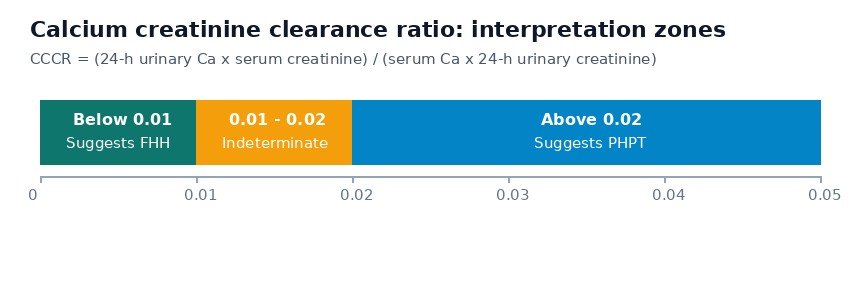
This calcium creatinine clearance ratio calculator computes the CCCR, the standard screening test for separating familial hypocalciuric hypercalcemia (FHH) from primary hyperparathyroidism. Enter the 24-hour urinary calcium and creatinine plus the simultaneous serum calcium and creatinine, in either conventional (mg) or SI (mmol) units. A ratio below 0.01 suggests FHH, above 0.02 suggests primary hyperparathyroidism, and values between fall in the inconclusive zone. The CCCR screens; it does not diagnose on its own.
Calculate the calcium creatinine clearance ratio
How the calcium creatinine clearance ratio works
The ratio compares how fast the kidneys clear calcium with how fast they clear creatinine: CCCR equals (24-hour urinary calcium times serum creatinine) divided by (serum calcium times 24-hour urinary creatinine). Because creatinine clearance stands in for the glomerular filtration rate, the ratio is effectively the fraction of filtered calcium that the kidneys excrete. In FHH, a faulty calcium-sensing receptor makes the kidneys reabsorb calcium avidly, so the fraction excreted is tiny (below 0.01). In primary hyperparathyroidism the kidneys still spill calcium, so the fraction is larger (above 0.02).
| CCCR | Interpretation | Next step |
|---|---|---|
| Below 0.01 | Suggests familial hypocalciuric hypercalcemia | Avoid parathyroid surgery; consider CASR gene testing and family screening |
| 0.01 to 0.02 | Inconclusive overlap zone | Repeat the collection, correct confounders, consider CASR testing |
| Above 0.02 | Suggests primary hyperparathyroidism | Standard PHPT workup; parathyroidectomy evaluation if criteria are met |
FHH versus primary hyperparathyroidism: why the distinction matters
On a routine blood test the two conditions look almost identical: raised calcium with a parathyroid hormone level that is normal or mildly elevated. But they are different diseases with opposite treatments. Familial hypocalciuric hypercalcemia is an autosomal dominant genetic condition caused by an inactivating variant in the CASR gene, which encodes the calcium-sensing receptor. The receptor is set too high, so the parathyroid glands and kidneys behave as if calcium were low when it is actually high. The hypercalcemia is lifelong, mild, and essentially harmless: people with FHH do not develop the bone loss, kidney stones, or fractures of hyperparathyroidism.
Primary hyperparathyroidism, by contrast, is usually caused by a single benign parathyroid adenoma secreting too much hormone, and it does damage over time: calcium leached from bone, stones formed in kidneys, and fractures. Its definitive treatment is surgical removal of the abnormal gland, which cures the great majority of cases. The tragedy the CCCR exists to prevent is operating on FHH: before reliable discrimination, patients with unrecognized FHH underwent parathyroid surgery that could not help them, sometimes losing all four glands and trading harmless hypercalcemia for lifelong hypoparathyroidism. A simple ratio that keeps a benign genetic condition out of the operating theatre is one of the highest-value tests in endocrinology.
Getting the 24-hour urine collection right
The CCCR is only as good as the urine collection behind it, and incomplete collections are the commonest cause of a misleading result. The method: choose a start time, discard that first morning void, then collect every drop for the next 24 hours including the final morning void at the same time next day. Keep the container cool throughout. Missed voids are the usual failure, and they are not always obvious.
Laboratories check completeness using the 24-hour creatinine excretion, which is remarkably constant because it reflects muscle mass: roughly 15 to 20 mg per kg of body weight per day in women and 20 to 25 mg per kg in men. A result far below the expected range means urine was lost and the collection should be repeated, not interpreted. Practical confounders deserve attention before the collection too: thiazide diuretics should be stopped if feasible, vitamin D should be replete, and the diet should be the patient's usual one, since extreme calcium restriction or loading shifts the numbers. When the collection is complete and confounders are handled, the ratio earns the trust the guidelines place in it.
Limitations
- Kidney function matters. The ratio is not validated in significant renal impairment; Christensen's study excluded plasma creatinine above 140 micromol/L.
- Drugs confound it. Thiazides lower urinary calcium (false FHH pattern); lithium and prolonged glucocorticoids alter calcium handling. Test off interfering drugs when feasible.
- Vitamin D deficiency lowers urinary calcium and can push the ratio down; replete vitamin D before judging the result.
- Collection errors are the commonest pitfall. An under-collected 24-hour urine underestimates both excretions and distorts the ratio; verify completeness with the expected creatinine excretion.
- It screens, it does not diagnose. The 0.01 to 0.02 zone is genuinely inconclusive, and even outside it the ratio guides rather than settles the diagnosis; CASR gene analysis is the definitive test for FHH.
Frequently asked questions
What is the calcium creatinine clearance ratio used for?
It is a screening test that helps distinguish familial hypocalciuric hypercalcemia (FHH), a benign genetic condition, from primary hyperparathyroidism (PHPT), which is usually treated surgically. The two look alike on blood tests, but parathyroid surgery does not help FHH, so telling them apart matters.
What CCCR value suggests FHH?
US and Australian guidelines use a CCCR below 0.01 as suggestive of FHH and above 0.02 as suggestive of primary hyperparathyroidism. Values between 0.01 and 0.02 fall in an inconclusive overlap zone and need further workup, often CASR gene testing.
Do I need a 24-hour urine collection for the CCCR?
Yes. The ratio needs 24-hour urinary calcium and creatinine together with simultaneous blood calcium and creatinine. Spot urine samples are not validated for this purpose, and an incomplete 24-hour collection is the most common reason for a misleading result.
Can medications affect the calcium creatinine clearance ratio?
Yes. Thiazide diuretics lower urinary calcium and can falsely push the ratio toward FHH; lithium raises calcium and alters handling; vitamin D deficiency lowers urinary calcium. The test should be done off interfering drugs where possible and with vitamin D replete.
Is the CCCR a diagnosis by itself?
No. It is a screening test with a known inconclusive zone. Christensen and colleagues showed the CCCR works well as an initial screen, with a two-step approach: CCCR first, then CASR gene analysis to confirm FHH when the clinical picture is uncertain.
What is the CASR gene test?
It is a blood test that looks for inactivating variants in the CASR gene, which encodes the calcium-sensing receptor. A pathogenic variant confirms familial hypocalciuric hypercalcemia and settles the diagnosis when the CCCR is inconclusive. Because FHH is autosomal dominant, a positive result also means first-degree relatives have a 50 percent chance of carrying it, so family screening is offered.
My CCCR is 0.015. What should happen next?
That sits in the 0.01 to 0.02 overlap zone, which is genuinely inconclusive. The usual next steps are to repeat the 24-hour collection carefully, correct any confounders such as thiazides or vitamin D deficiency, and consider CASR gene testing, especially if there is a family history of hypercalcemia. The decision belongs to your endocrinologist, not to the number alone.
Clinical sources: Christensen SE, Nissen PH, Vestergaard P, Heickendorff L, Brixen K, Mosekilde L. Discriminative power of three indices of renal calcium excretion for the distinction between familial hypocalciuric hypercalcaemia and primary hyperparathyroidism: a follow-up study on methods. Clin Endocrinol (Oxf). 2008;69(5):713-720. doi:10.1111/j.1365-2265.2008.03259.x; Eastell R, Brandi ML, Costa AG, et al. Diagnosis of asymptomatic primary hyperparathyroidism: proceedings of the Fourth International Workshop. J Clin Endocrinol Metab. 2014;99(10):3570-3579. doi:10.1210/jc.2014-1414.