Benzodiazepine Equivalence Calculator
This benzodiazepine equivalence calculator converts doses between benzodiazepines using the Ashton Manual equivalence table. Pick the drug and dose you are on, pick the drug you want to convert to, and the calculator returns the approximately equivalent dose in milligrams, along with each drug's half-life. It is used when switching drugs (for example before a diazepam-based taper), comparing potencies, or auditing prescribing. Equivalences are clinical approximations, so every converted dose should be confirmed by a clinician.
Convert a benzodiazepine dose
How the benzodiazepine equivalence calculator works
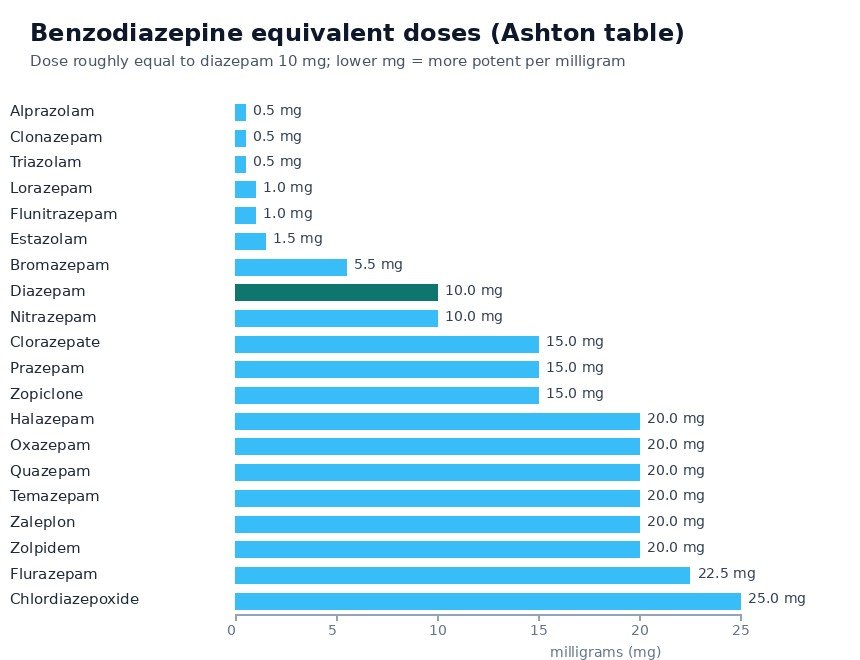
The table below is the Ashton Manual equivalence table: the dose of each drug that is approximately equal to diazepam 10 mg. The conversion is a simple ratio: equivalent dose equals your dose times the "from" drug's equivalent divided by the "to" drug's equivalent. For example, 1 mg of alprazolam converts to diazepam as 1 times 10 divided by 0.5, which is 20 mg of diazepam. Where the Ashton table gives a range, this calculator uses the midpoint (bromazepam 5.5, estazolam 1.5, flurazepam 22.5, prazepam 15).
| Drug (brand) | Equivalent to diazepam 10 mg | Half-life (hours) | Usual use |
|---|---|---|---|
| Alprazolam (Xanax) | 0.5 mg | 6-12 | Anxiety |
| Bromazepam (Lexotan) | 5-6 mg | 10-20 | Anxiety |
| Chlordiazepoxide (Librium) | 25 mg | 5-30 (active metabolite up to 200) | Anxiety, alcohol withdrawal |
| Clonazepam (Klonopin) | 0.5 mg | 18-50 | Seizures, anxiety |
| Clorazepate (Tranxene) | 15 mg | 36-200 (active metabolite) | Anxiety |
| Diazepam (Valium) | 10 mg | 20-100 (active metabolite up to 200) | Anxiety, tapering standard |
| Estazolam (ProSom) | 1-2 mg | 10-24 | Sleep |
| Flunitrazepam (Rohypnol) | 1 mg | 18-26 | Sleep |
| Flurazepam (Dalmane) | 15-30 mg | 40-250 | Sleep |
| Halazepam (Paxipam) | 20 mg | 30-100 | Anxiety |
| Lorazepam (Ativan) | 1 mg | 10-20 | Anxiety |
| Nitrazepam (Mogadon) | 10 mg | 15-38 | Sleep |
| Oxazepam (Serax) | 20 mg | 4-15 | Anxiety |
| Prazepam (Centrax) | 10-20 mg | 36-200 | Anxiety |
| Quazepam (Doral) | 20 mg | 25-100 | Sleep |
| Temazepam (Restoril) | 20 mg | 8-22 | Sleep |
| Triazolam (Halcion) | 0.5 mg | 2 | Sleep |
| Zaleplon (Sonata)* | 20 mg | 2 | Sleep |
| Zolpidem (Ambien)* | 20 mg | 2 | Sleep |
| Zopiclone (Imovane)* | 15 mg | 5-6 | Sleep |
* Z-drugs are chemically different from benzodiazepines but act on the same receptor and are listed in the Ashton table for the same purpose.
What your conversion result means
The result is the starting estimate for the target drug, not a prescription. The most common use is converting to diazepam before a taper: diazepam's long half-life and 2 mg tablets make it the standard drug for gradual withdrawal, as described in the Ashton Manual. If you are converting away from a short-acting drug (alprazolam, triazolam, oxazepam), expect the first few days on the new drug to need clinical adjustment, because half-lives differ and the equivalent dose is only approximate.
A useful rule of thumb from the chart: high-potency drugs (alprazolam, clonazepam, triazolam, lorazepam at 0.5 to 1 mg) need only a fraction of a milligram to match diazepam 10 mg, while low-potency drugs (chlordiazepoxide, flurazepam, oxazepam, temazepam at 15 to 25 mg) need a much larger milligram dose for the same effect. Milligrams alone never tell you how strong a drug is.
Half-life: the other half of the story
Equivalence tells you the matching dose, but half-life tells you how the drug behaves between doses, and the two together determine withdrawal. Short-acting benzodiazepines such as triazolam (about 2 hours), oxazepam (4 to 15 hours), and alprazolam (6 to 12 hours) wear off quickly, so blood levels swing between doses and interdose withdrawal, rebound anxiety and early-morning waking, is common. Intermediate drugs such as lorazepam and temazepam sit in the middle. Long-acting drugs such as diazepam, clonazepam, and clorazepate, especially those with active metabolites measured in days, decline smoothly and are far more forgiving.
This is the pharmacological logic behind the diazepam substitution taper described in the Ashton Manual: convert the current dose to its diazepam equivalent, then reduce in small steps over weeks to months, letting the long half-life smooth each cut. Two cautions travel with this method. First, the elderly and people with liver impairment clear long-acting drugs slowly, so the same taper schedule can accumulate; individual adjustment is needed. Second, half-life is not the whole story for every drug: lorazepam, oxazepam, and temazepam bypass the liver's oxidative pathway and are safer in liver disease despite shorter half-lives, which is why clinicians sometimes choose them in that setting regardless of taper convenience.
Limitations
- Approximations, not identities. The Ashton table itself states the figures are based on clinical experience, vary between individuals, and do not agree with every published table. Some sources give different equivalents for clonazepam in particular.
- Half-lives vary widely. The ranges shown are after a single dose; chronic use, age, liver function, and other drugs shift them. Active metabolites (diazepam, chlordiazepoxide, clorazepate, flurazepam, prazepam) can extend the effective duration to days.
- Never stop abruptly. Sudden withdrawal after sustained use can cause rebound anxiety, insomnia, seizures, or delirium. Tapers run over weeks to months and need medical supervision.
- Special populations differ. Older adults, people with liver disease, and those on interacting drugs (for example CYP3A4 inhibitors with alprazolam or triazolam) need individual dose adjustment beyond any table.
Frequently asked questions
What does benzodiazepine equivalence mean?
It is the dose of one benzodiazepine that produces roughly the same clinical effect as a reference dose of another, usually diazepam 10 mg. For example, 0.5 mg of alprazolam and 1 mg of lorazepam are each about equivalent to diazepam 10 mg. It is an approximation based on clinical experience, not an exact chemical identity.
Why switch to diazepam when tapering?
Diazepam has a long half-life (20 to 100 hours) with a long-acting active metabolite, so blood levels fall smoothly between doses and withdrawal symptoms stay steadier. It also comes in 2 mg tablets, which allows the small, gradual dose reductions that are hard to achieve with short-acting drugs like alprazolam or triazolam.
Are equivalence tables exact?
No. The Ashton table itself warns the figures are based on clinical experience, vary between individuals, and disagree with some other published tables. Half-lives also vary widely between people. Treat any converted dose as a starting estimate and adjust with a clinician.
Can I stop a benzodiazepine suddenly?
No. Abrupt withdrawal after sustained use can cause rebound anxiety and insomnia, and in severe cases seizures or delirium. Guidelines recommend a slow taper over weeks to months, usually reducing by about 10 percent or less per step, under medical supervision.
Do Z-drugs like zolpidem count in this table?
Zaleplon, zolpidem, and zopiclone are chemically different from benzodiazepines but act on the same GABA-A receptor sites, so the Ashton table lists approximate equivalents for them (20 mg zaleplon or zolpidem, 15 mg zopiclone to diazepam 10 mg). They carry their own dependence and withdrawal risks.
What is the Ashton Manual?
Benzodiazepines: How They Work and How to Withdraw, written by Professor Heather Ashton of Newcastle University and published in 2002, is the most cited guide to benzodiazepine withdrawal. It describes how the drugs act, why dependence develops, and the slow diazepam-substitution taper method. Its equivalence table is the source used by this calculator and by many NHS prescribing policies.
Does a longer half-life always mean an easier withdrawal?
Usually, but not always. Long half-lives smooth the fall in blood levels between doses, which is why diazepam is the taper standard. But in older adults and people with liver disease, long-acting drugs accumulate and oversedate, and drugs like lorazepam or oxazepam, which skip the liver's oxidative pathway, can be the safer choice despite shorter half-lives.
Clinical source: Ashton CH. Benzodiazepines: How They Work and How to Withdraw (The Ashton Manual). 2002, equivalence table. See also the NHS trust prescribing policy reproducing the table: Benzodiazepine and Z-drug prescribing, Appendix 1: Equivalent benzodiazepine doses (Northumberland, Tyne and Wear NHS Foundation Trust).