Serotonin Syndrome Risk Calculator
Check the Hunter criteria
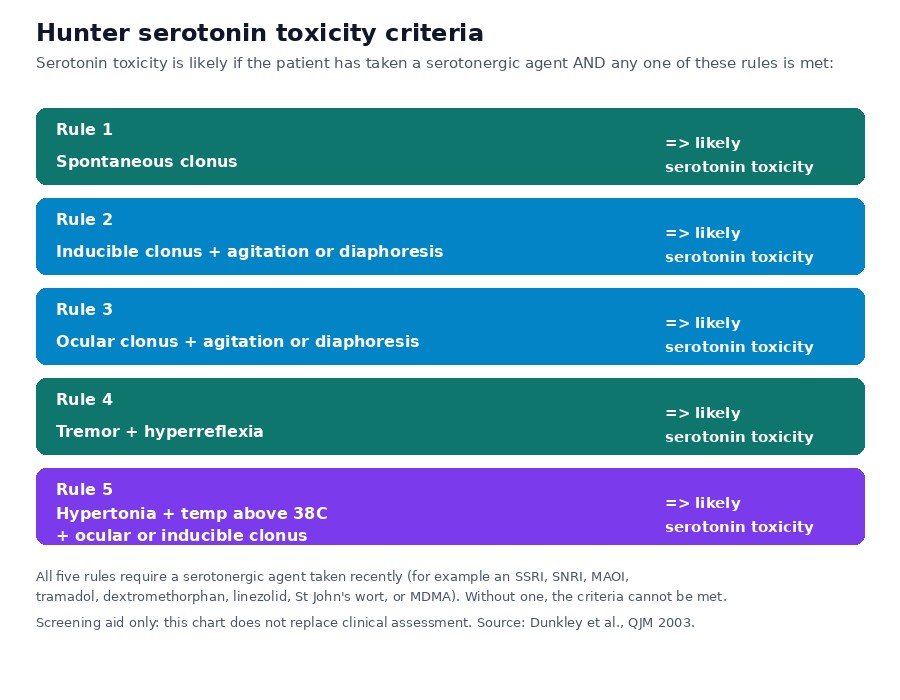
How the serotonin syndrome risk calculator applies the Hunter criteria
Serotonin syndrome is excess serotonin activity, usually after starting a serotonergic drug, raising a dose, or combining two of them. The Hunter serotonin toxicity criteria (Dunkley and colleagues, 2003) are the most validated bedside decision rules: in the original study of over 2,200 overdose patients they reached 84% sensitivity and 97% specificity, better than the older Sternbach criteria. Every rule below starts from the same gate: the patient must have taken a serotonergic agent. Without that, the criteria cannot be met.
| Rule | Sign combination | Meaning |
|---|---|---|
| 1 | Spontaneous clonus | Alone, it is enough: rhythmic muscle jerks without provocation are the most specific sign. |
| 2 | Inducible clonus plus agitation or diaphoresis | Clonus on ankle dorsiflexion, together with agitation or heavy sweating. |
| 3 | Ocular clonus plus agitation or diaphoresis | Sustained side-to-side eye movements crossing the midline, with agitation or sweating. |
| 4 | Tremor plus hyperreflexia | The combination that catches milder cases where clonus is not obvious. |
| 5 | Hypertonia plus temperature above 38°C plus ocular or inducible clonus | The severe-case rule: rigidity with fever and clonus. |
The calculator checks all five rules at once and tells you which one matched, so the result is traceable rather than a bare yes or no.
What your serotonin syndrome risk result means
Meets the Hunter criteria (serotonin toxicity likely). Treat this as a medical emergency. The usual next steps in care are stopping the serotonergic agents, supportive care for agitation, fever, and autonomic instability, and urgent hospital assessment. Benzodiazepines are often used for agitation and muscle overactivity; cyproheptadine is sometimes given, though evidence for it is limited. Do not restart the drugs without medical supervision.
Does not meet the Hunter criteria. None of the five sign combinations is present. That lowers the likelihood but does not fully exclude serotonin toxicity: clonus can be subtle, findings evolve over hours, and other toxidromes (anticholinergic toxicity, neuroleptic malignant syndrome, sympathomimetic overdose) can overlap. If the patient is deteriorating, clinical judgment overrules any screening tool.
The drug combinations that cause it
Single serotonergic drugs rarely cause the syndrome at therapeutic doses; the danger is in combinations and dose changes. The most feared pairing is a monoamine oxidase inhibitor (MAOI) with an SSRI or SNRI, which can precipitate severe toxicity even at modest doses, because the MAOI blocks serotonin breakdown while the other drug floods the synapse with it. The same logic makes MAOIs dangerous with tramadol, meperidine (pethidine), and dextromethorphan, all of which have serotonergic activity that prescribers sometimes overlook because they are filed mentally as a painkiller or a cough remedy.
Some culprits hide in plain sight. Linezolid, an antibiotic, is a weak MAOI and has triggered the syndrome when combined with SSRIs in hospital patients. St. John's wort, sold as a natural remedy, is serotonergic and interacts with prescription antidepressants. MDMA (ecstasy) releases large amounts of serotonin and causes severe cases, especially combined with MAOIs. This is why washout periods exist: after stopping an MAOI, guidelines advise waiting about two weeks before starting a serotonergic drug, and after stopping fluoxetine, about five weeks, because its active metabolite lingers far longer than the parent drug. Every new prescription or dose increase in a patient on a serotonergic agent deserves a medicine-list review first.
The severity spectrum: from mild to life-threatening
Serotonin syndrome is not one picture but a spectrum, and recognizing the mild end matters because it is the stage where stopping the drug prevents the severe stage. Mild cases look like agitation with tremor, restlessness, sweating, dilated pupils, and diarrhea, easily mistaken for anxiety or a stomach bug. Moderate cases add clear clonus, hyperreflexia, and temperatures climbing past 38 to 39 degrees. Severe cases show sustained muscle rigidity rather than clonus, temperatures above 41 degrees, and the complications of extreme hyperthermia: muscle breakdown flooding the kidneys with myoglobin, clotting system failure, and multi-organ collapse.
Management follows the severity. Every case starts with stopping the serotonergic agents, which alone resolves most mild presentations within a day since the drugs clear. Benzodiazepines control agitation and muscle overactivity; active cooling treats hyperthermia, and severe rigidity may need neuromuscular paralysis with ventilation in intensive care. Cyproheptadine, a serotonin blocker, is sometimes given, but the evidence for it is limited and it never substitutes for stopping the drugs and supportive care. The single most important intervention remains prevention: checking the medicine list before adding or raising any serotonergic agent.
Limitations of this screening tool
- It is a screening aid, not a diagnosis. Only clinical assessment can confirm serotonin syndrome.
- The criteria were developed in overdose patients at a toxicology service; they may perform differently in low-dose or chronic-use presentations.
- Clonus is easy to miss if you do not test for it deliberately, especially ocular clonus.
- The tool does not weigh dose, timing, or which serotonergic agents were combined; two agents carry more risk than one.
- Sedation, antipsychotics, or paralysis can mask the neuromuscular signs the rules depend on.
Frequently asked questions
Which drugs can cause serotonin syndrome?
The classic triggers are SSRIs, SNRIs, MAOIs, tricyclic antidepressants, tramadol, meperidine, dextromethorphan, linezolid, St. John's wort, and MDMA (ecstasy). The highest risk comes from combining two serotonergic agents, especially an MAOI with an SSRI or SNRI, or from a dose increase.
How quickly does serotonin syndrome appear?
It can begin within hours of starting a new serotonergic drug, increasing a dose, or adding a second serotonergic agent. Mild cases may look like the flu with tremor and diarrhea, while severe cases can progress to muscle rigidity, very high temperature, and collapse over the same day.
How is serotonin syndrome different from neuroleptic malignant syndrome?
Serotonin syndrome starts rapidly (hours) after a serotonergic drug and shows clonus, hyperreflexia, and agitation. Neuroleptic malignant syndrome develops over days after a dopamine-blocking drug such as an antipsychotic and shows lead-pipe rigidity, bradykinesia, and very high fever without prominent clonus. The drug history usually separates them.
Is clonus always present in serotonin syndrome?
Clonus is the most specific bedside sign and the backbone of the Hunter criteria, but mild cases may show only tremor with hyperreflexia, which is why the criteria accept that combination too. In a patient on a serotonergic agent, always test for inducible, spontaneous, and ocular clonus explicitly.
Can this calculator diagnose serotonin syndrome?
No. It applies the published Hunter decision rules to the findings you enter. A positive screen means urgent medical evaluation, not a confirmed diagnosis, and a negative screen does not overrule clinical judgment if the patient is deteriorating.
How long after stopping an MAOI is it safe to start an SSRI?
Guidelines advise waiting about two weeks after stopping an MAOI before starting a serotonergic drug, because the enzyme inhibition takes time to reverse. The reverse direction is slower: after stopping fluoxetine, wait about five weeks because its active metabolite norfluoxetine has a very long half-life. These washouts are a leading prevention strategy against the syndrome.
Clinical sources: Dunkley EJ, Isbister GK, Sibbritt D, Dawson AH, Whyte IM. The Hunter Serotonin Toxicity Criteria: simple and accurate diagnostic decision rules for serotonin toxicity. QJM. 2003;96(9):635-642. doi:10.1093/qjmed/hcg109; Boyer EW, Shannon M. The serotonin syndrome. N Engl J Med. 2005;352(11):1112-1120. doi:10.1056/NEJMra041867.