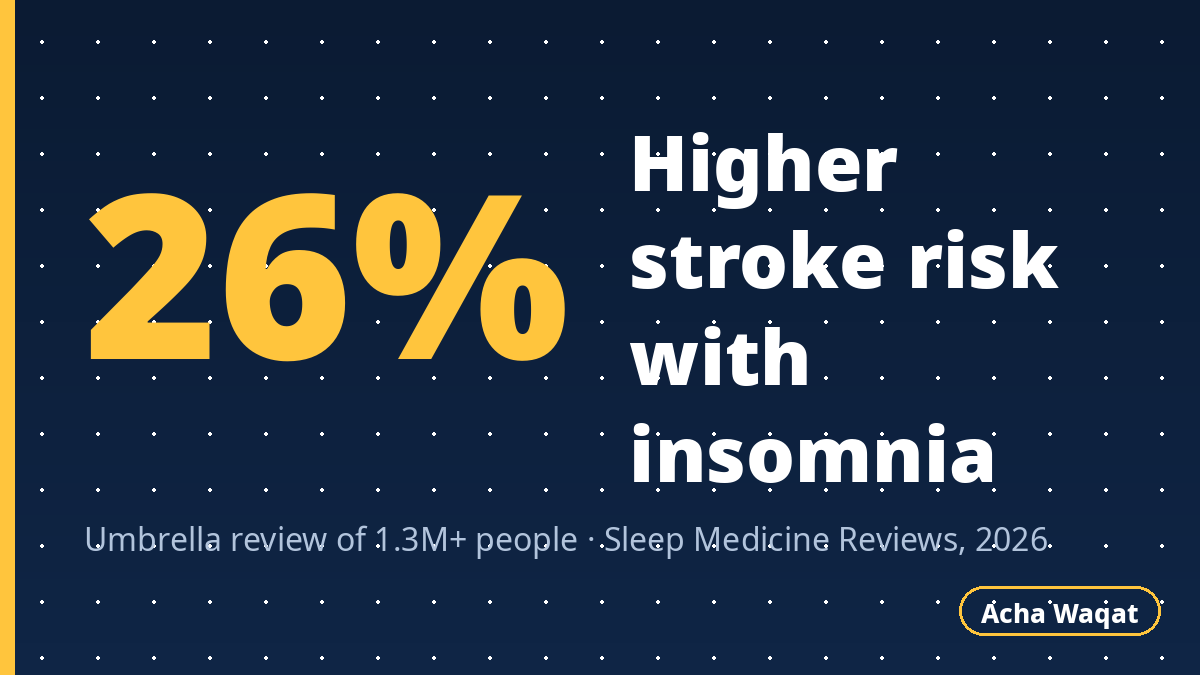
The short answer: yes, the link is real, but it is not proof of cause. A 2026 umbrella review pooling data from more than 1.3 million people found that adults with insomnia had a 26% higher risk of stroke than people who sleep well (hazard ratio 1.26; 95% confidence interval 1.05 to 1.53). The same review found 28% higher odds of hospital admission for any reason. The researchers stress that these are associations: the review does not show that insomnia causes stroke.
Insomnia is usually treated as a quality of life problem: the groggy mornings, the 3am ceiling staring, the short temper at work. A large new analysis suggests the story may be bigger than that. Presented by the European Academy of Neurology and published in Sleep Medicine Reviews, the review pulls together years of research and puts persistent sleeplessness in the same conversation as stroke, dementia and hospitalisation. Here is what it found, what it did not find, and what you should actually do about your own sleep.
Key terms in plain words
- Insomnia: repeated difficulty falling asleep or staying asleep, with impaired daytime functioning, despite having enough opportunity to sleep. An occasional bad night does not count.
- Hazard ratio (HR): a measure of how much more likely an event is in one group than another. HR 1.26 means a 26% higher likelihood over the study period.
- Umbrella review: a review that pools the results of existing systematic reviews. It sits near the top of the evidence ladder because it summarises whole bodies of research rather than single studies.
- Association: a statistical link between two things. It does not prove that one causes the other.
Does insomnia increase stroke risk?
According to the best available pooled evidence, yes, people with insomnia face a higher stroke risk than good sleepers. The headline figure comes from the new umbrella review led by neurologist Luca Vignatelli of the IRCCS Istituto delle Scienze Neurologiche di Bologna in Italy (Vignatelli et al., Sleep Medicine Reviews, 2026; DOI: 10.1016/j.smrv.2026.102372).
The researchers searched the medical databases MEDLINE and EMBASE through August 2025. They combined 16 existing systematic reviews with meta-analyses and added three new systematic reviews of their own, covering stroke, occupational injuries and hospitalisation. In total they examined seven health outcomes: dementia, stroke, depression, suicide, death, occupational injuries and hospital admission.
For stroke, the team identified nine eligible studies and pooled six of them in a meta-analysis covering more than 1.3 million participants. People with insomnia had a 26% higher risk of stroke (HR 1.26; 95% CI 1.05 to 1.53). The authors note that the size of the link varied substantially between studies, so the true figure for any one population could sit above or below that average.
For hospitalisation, five studies were examined and three entered the meta-analysis. People with insomnia had 28% higher odds of being admitted to hospital for any reason at all (odds ratio 1.28; 95% CI 1.14 to 1.43). Not for a specific diagnosis. Any reason.
Does the study prove insomnia causes stroke?
No, and the authors are explicit about this. An umbrella review can only show that two things travel together, not that one produces the other. People with insomnia may also have other health conditions or lifestyle factors that partly explain the higher risks, and the researchers could not fully rule that out.
Two caveats deserve a plain reading. First, the studies did not all define insomnia the same way, which makes pooling them messier. Second, the review gave only limited attention to sleep medication use, which matters because some sleep drugs carry their own health questions. The honest summary is this: the association is consistent and large-scale, but the causal chain is unproven.
There is also a transparency note worth knowing. One of the review’s authors disclosed ties to biopharmaceutical companies including Takeda, and the study was partly funded by Idorsia, Jazz Pharmaceuticals and Takeda. Funding does not invalidate findings, but it is right that you know it.
Is insomnia linked to dementia too?
The same review looked at dementia, and the picture is suggestive but less tidy than the stroke result. Most of the included reviews found an association between insomnia and all-cause dementia, though the finding was not consistent across every review. The evidence looked more consistent for Alzheimer’s disease, while findings for vascular dementia were mixed.
Two results were clearer. Insomnia was consistently identified as a predictor of depression and of suicidal behaviour across the reviews. And one result may reassure: insomnia was not identified as a predictor of earlier death. The signal in this research is more warning than death sentence.
On workplace injuries, the team could not run a meta-analysis because only two studies qualified. They saw an association with unintentional fatal injuries and commuting injuries, but judged the data insufficient to draw a conclusion.
“Insomnia deserves attention as a warning sign of the status of brain and mental health. These findings show that someone with insomnia has an increased risk for dementia or stroke.”
Luca Vignatelli, lead author, IRCCS Istituto delle Scienze Neurologiche di Bologna, via the European Academy of Neurology
How common is insomnia?
More common than most people assume. A previous meta-analysis cited in the coverage estimated that insomnia meeting international diagnostic criteria affects around 22% of the general population, roughly one adult in five. It is worse in women and approaches 30% in older age groups. That scale is exactly why a 26% relative risk increase matters at population level even while any one person’s absolute risk stays modest.
It helps to keep the distinction clear. Insomnia as studied here means a persistent pattern: trouble falling or staying asleep, plus daytime impairment, despite adequate opportunity. One rough night before a big meeting is not what the 1.3 million person dataset is describing.
Why might poor sleep raise stroke risk?
The umbrella review did not test mechanisms, so any explanation is provisional. But in sleep and cardiovascular research, the leading hypotheses are familiar ones: chronic short or fragmented sleep is associated with higher blood pressure, low-grade inflammation and disrupted glucose metabolism, all of which feed into stroke risk over years. None of that is proven to be the pathway here. Treat it as the plausible biology behind a statistical finding, not as established fact.
What actually helps chronic insomnia?
If this research prompts you to take your sleep seriously, that is the right response. Clinical guidelines recommend cognitive behavioural therapy for insomnia, known as CBT-I, as the first-line treatment for chronic insomnia. It is a structured programme, usually delivered over several weeks, that retrains the habits and thought patterns around sleep. It has stronger long-term evidence than sleeping tablets, which guidelines generally reserve for short-term use because of dependence and side effects.
Alongside or before formal treatment, the standard sleep hygiene steps are worth doing properly rather than half-heartedly:
- Keep a consistent sleep and wake time, including weekends.
- Make the bedroom dark, quiet and cool, and reserve the bed for sleep.
- Cut caffeine from the afternoon and alcohol in the evening; both fragment sleep even when they feel relaxing.
- Build a wind-down routine and dim the screens in the last hour before bed.
- If you cannot sleep after about 20 minutes, get up, do something calm in low light, and return when drowsy.
- Get daylight exposure in the morning, which steadies the body clock.
Study author Professor Stefan Seidel put the public health point plainly: “Sleep should be part of the conversation about brain health at every age. We need to raise awareness of insomnia and its treatment, and make sure sleep is included in health promotion programmes in our communities, schools and workplaces.”
When should I speak to a doctor about insomnia?
See your doctor if poor sleep happens three or more nights a week for three months or longer, if daytime functioning is clearly suffering, or if you snore loudly, gasp in the night or feel excessively sleepy despite time in bed, which can signal sleep apnoea rather than insomnia. Seek urgent help if sleeplessness comes with severe depression or thoughts of harming yourself.
A final sense of proportion. A 26% relative increase sounds alarming, but stroke remains uncommon in younger, healthy adults, so the absolute risk for any one person with insomnia is still low. The finding matters most as a population signal and as one more reason to treat persistent sleeplessness as a health issue worth addressing, not a badge of honour.
Frequently asked questions
Can one bad night of sleep cause a stroke?
There is no evidence for that. The research concerns chronic insomnia, a persistent pattern of poor sleep with daytime impairment, not isolated bad nights.
Is insomnia linked to dementia?
Possibly. Most reviews in the 2026 umbrella analysis found an association with all-cause dementia, with more consistent evidence for Alzheimer’s disease and mixed findings for vascular dementia. The link is less certain than the stroke finding.
What is the best treatment for insomnia?
Clinical guidelines recommend CBT-I, cognitive behavioural therapy for insomnia, as first-line treatment for the chronic form. Sleeping tablets are generally for short-term use only. Speak to your doctor about referral options.
How many hours of sleep do adults need?
Most health authorities suggest 7 to 9 hours for adults. Consistently getting far less, with daytime impairment, is the pattern linked to health risks in the research.
Does improving my sleep lower my stroke risk?
That has not been proven. The review shows an association, not that treating insomnia prevents stroke. Still, better sleep reliably improves blood pressure, mood and daytime functioning, which are worthwhile outcomes on their own.
Sources
- Vignatelli L et al. Insomnia as risk factor for brain, mental and general health consequences: an umbrella systematic review. Sleep Medicine Reviews. 2026. DOI: 10.1016/j.smrv.2026.102372
- European Academy of Neurology press release via Medical Xpress: Insomnia linked to higher risk of stroke
- News-Medical: Study links insomnia to higher stroke and hospitalization risks
- HealthDay via McKnight’s: Insomnia linked to increased risk for stroke, odds of admission
This article is for information only and is not medical advice. If you are worried about your sleep or your health, speak to a qualified clinician.
