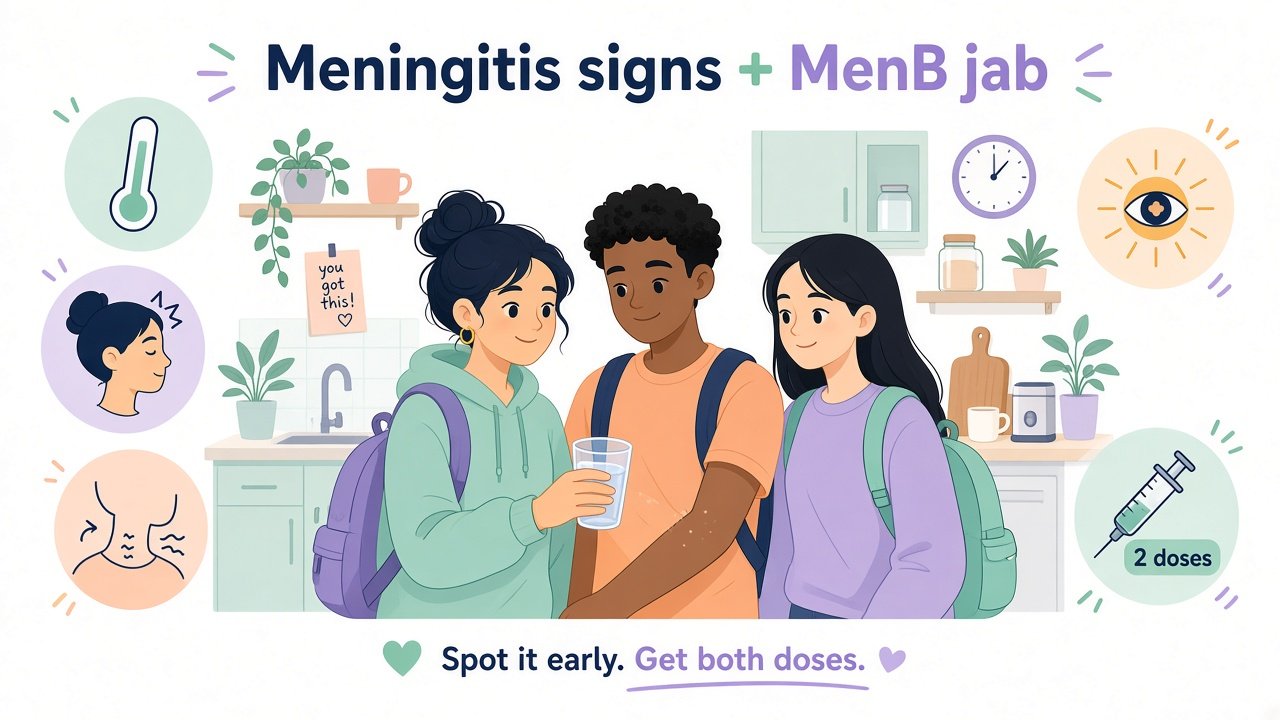
Meningitis symptoms usually come on suddenly: a high temperature, a severe headache that keeps getting worse, a stiff neck, dislike of bright light, vomiting, confusion or being very hard to wake, and sometimes a rash that does not fade when you press a glass against it. Early on it can feel like flu or a bad hangover, which is why it gets missed. If you think someone might have meningitis, get emergency help straight away and do not wait for the rash. For young adults starting university, the best protection is the vaccine. In England, a one-off MenB offer runs until March 2027, and two doses are needed.

Key terms in plain words
| Term | What it means |
|---|---|
| Meningitis | Infection of the protective layers that cover the brain and spinal cord. |
| Bacterial meningitis | The rarer but more serious type. It needs hospital treatment and can be fatal. |
| Viral meningitis | Usually milder and often gets better on its own within 7 to 10 days. |
| MenB | Meningococcal group B bacteria, a common cause of bacterial meningitis and sepsis in young people. Also the name of the vaccine against it. |
| Glass test | Pressing the side of a clear glass firmly on a rash. A meningitis rash does not fade under the glass. |
What are the first symptoms of meningitis?
The NHS lists these meningitis symptoms, which can appear in any order and not all at once:
- a high temperature (fever)
- very cold hands and feet
- a stiff neck
- joint and muscle pain
- a severe headache that is getting worse
- eye pain when looking at bright lights
- vomiting and diarrhoea
- confusion, or being very sleepy and difficult to wake
- seizures (fits)
- spots or a rash that does not fade when pressed with a glass
Babies and children under 5 may also refuse feeds, have a high-pitched unusual cry, feel stiff or floppy, or have a bulging soft spot on the top of the head.
Here is the tricky part. Some early symptoms look a lot like flu, a stomach bug or a hangover. During freshers’ weeks, that overlap is exactly why friends brush it off. If you want help telling common autumn viruses apart, read our guide on flu vs COVID vs cold vs RSV symptoms. But a worsening headache with a stiff neck, confusion or a non-fading rash is not a “sleep it off” situation.
What does a meningitis rash look like?
The rash often starts as small red pinpricks and then spreads quickly into red or purple blotches. Press the side of a clear glass firmly against it. If the rash does not fade, treat it as an emergency.
On brown or black skin the rash can be much harder to see. Check paler areas such as the palms, the soles of the feet, the roof of the mouth, the whites of the eyes and the inside of the eyelids.
Not everyone with meningitis gets a rash at all. A person can be very unwell before any spots appear, so never wait for the rash before getting help.
When should you get emergency help?
Get medical help immediately (in the UK, call 999 or go to A&E, and do not drive yourself) if an adult or child over 5:
- has a very high or very low temperature, feels hot or cold to the touch, or is shivery
- has a very painful headache
- is confused, has slurred speech or is not making sense
- has a stiff neck and cannot look at bright lights
- has a rash that does not fade when pressed
- has a first-ever seizure
The NHS also says to trust your instincts. Someone with meningitis might not have every symptom on the list. If they seem seriously unwell, act. Outside the UK, use your local emergency number.
In hospital, doctors check how sick the person is with tools such as the Glasgow Coma Scale and sepsis scores. Those are for clinicians, not for home use. At home, your job is simple: spot the warning signs and get help fast.
Why are university freshers at higher risk?
Meningitis spreads through close contact with people who carry the bacteria or viruses, often without being ill themselves. Kissing, sharing drinks or vapes, and living in the same home all count. First-year halls pack a lot of that into a few weeks.
The UK Health Security Agency (UKHSA) says students in their first year of university have around 7 times the risk of meningococcal disease compared with young people of a similar age who do not go to university. It also reported that three MenB outbreaks in England this year, in Kent, Dorset and Berkshire, caused 3 deaths, and some survivors face life-long health effects.
Who can get the MenB vaccine for young people in England?
In July 2026, England introduced a one-off MenB vaccination offer for young adults. According to the NHS, it is offered until March 2027 to young people who were born:
- between 1 September 2007 and 31 August 2008, or
- on or after 21 July 2001 and are starting university, or starting at some further education colleges and living in further education accommodation, for the first time in autumn 2026
You can book online through the NHS website or find a pharmacy that offers it. First doses are available until 31 December 2026 and second doses until 31 March 2027. You need two doses, given at least 28 days apart, to be protected.
Uptake so far is low. UKHSA’s first interim report found that only 26.6% of the school year 13 group (212,549 of 799,840 eligible) had their first dose by 20 September 2026. Coverage was 11.8% in the most deprived areas compared with 45% in the least deprived, and 21.9% in young men compared with 31.5% in young women.
Living outside England? MenB advice and eligibility differ from country to country. Check your national immunisation schedule or ask your GP or pharmacist whether you are covered.
Is meningitis treatable?
Yes, but speed matters. Bacterial meningitis is treated in hospital, usually for at least a week, with antibiotics and fluids given into a vein and sometimes oxygen. Viral meningitis often improves at home with rest, painkillers and anti-sickness medicine.
Bacterial meningitis can leave lasting problems such as hearing or vision loss, seizures, movement problems or memory difficulties, and it can be fatal. That is why both the vaccine and early help matter so much.
A quick plan for freshers
- Check whether you are eligible for the MenB vaccine and book dose one now.
- Put dose two in your calendar at least 28 days later.
- Learn the warning signs and the glass test, and tell your flatmates.
- If a friend is “just hungover” but getting worse, confused or hard to wake, check on them and get help.
- Keep a note of your local emergency number and the nearest A&E.
Sore throat and fever without these red flags is far more common and usually something else. Clinicians often use the Centor score to judge the chance of strep throat. You can browse our other free medical calculators too.
Frequently asked questions
Can you have meningitis without a rash?
Yes. Many people with meningitis never get a rash, or it appears late. Get help based on how unwell the person is, not on whether there are spots.
How fast does meningitis develop?
The NHS says symptoms develop suddenly. Someone can seem to have a mild bug and then get much worse quickly, so do not wait to see if it settles.
Is one dose of the MenB vaccine enough?
No. UKHSA says two doses are essential for protection, given at least 28 days apart.
Can you get meningitis more than once?
Yes. Because many different viruses and bacteria cause meningitis, it is possible to get it more than once.
Does the MenB vaccine protect against all meningitis?
No. It protects against meningococcal group B. Other vaccines in the routine schedule, such as MenACWY and pneumococcal vaccines, cover other causes. Even if you are vaccinated, still get help for warning signs.
Sources: NHS, Meningitis (nhs.uk/conditions/meningitis); UK Health Security Agency, “Over 212,000 get the first MenB dose but almost 75% missing out”, 1 October 2026 (gov.uk). This article is general health information and not a substitute for medical advice. If you think someone has meningitis, seek emergency care now.
