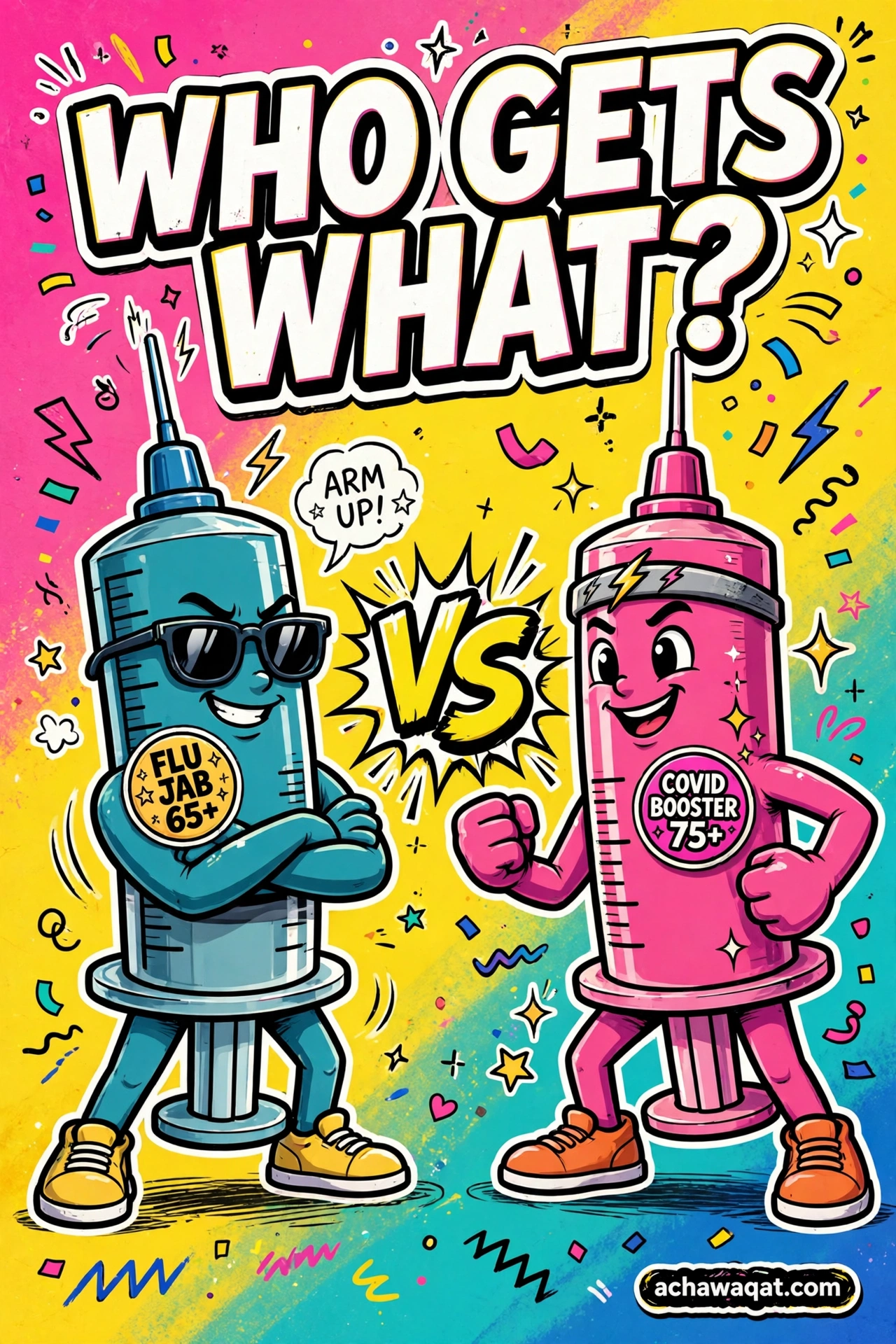
Quick answer: If you are aged 65 to 74 and otherwise healthy, the NHS offers you a free flu jab this winter but not a free Covid booster. The flu programme covers everyone aged 65 and over, while the autumn 2026 Covid booster goes only to people aged 75 and over, residents of care homes for older adults, and anyone aged 6 months and over who is immunosuppressed. Both programmes opened on 1 October 2026. Here is exactly who qualifies for what, and why the lists are different.
Every autumn, GP surgeries and pharmacies field the same confused question: “I have been invited for my flu jab, so where is my Covid booster?” The answer this winter is that the two lists were never the same, and in 2026 they differ more than most people realise. The flu list is broad. The Covid list is narrow. Knowing which list you are on saves a wasted trip and a frustrating phone call.
Who can get the free flu jab this winter?
The flu programme is the broad one. The NHS says you can get the free NHS flu vaccine this season if you:
- are aged 65 or over, including anyone who will turn 65 by 31 March 2027
- are aged 18 to 64 and have certain long-term health conditions
- are pregnant, at any stage of pregnancy
- live in a care home
- are the main carer for an older or disabled person, or receive a carer’s allowance
- live with someone who has a weakened immune system
- are aged 16 or over and rough sleeping, or staying in a homeless hostel or night shelter, a new addition for the 2026/27 season
- are a frontline health or social care worker, vaccinated through your employer
The long-term health conditions that qualify 18 to 64 year olds include breathing conditions such as asthma (if you use a steroid inhaler or tablets), COPD and cystic fibrosis; heart conditions such as coronary heart disease and heart failure; chronic kidney disease; liver disease such as cirrhosis or hepatitis; neurological conditions such as Parkinson’s disease, motor neurone disease, multiple sclerosis and cerebral palsy; a learning disability; diabetes and Addison’s disease; a weakened immune system caused by a condition such as HIV or by treatment such as chemotherapy or steroid medicine; spleen problems such as sickle cell disease or a removed spleen; and a body mass index of 40 or above. If you have a health condition and are unsure, the NHS advises speaking to your GP surgery or specialist.
Children are covered by a separate flu offer. Children aged 2 and 3 are invited through their GP, pupils from Reception to Year 11 are offered the nasal spray at school, and children from 6 months to 17 years with certain health conditions are eligible through their GP or hospital team. Pregnant women and children started being vaccinated from 1 September 2026; the main adult programme began on 1 October. The flu offer runs until 31 March 2027, with online booking closing on 30 March 2027, although the NHS advice is to get vaccinated as early in winter as you can.
Who is eligible for the Covid booster this autumn?
The autumn 2026 Covid programme is far more targeted. According to the UK Health Security Agency, ministers accepted the Joint Committee on Vaccination and Immunisation’s advice, and the free autumn booster is offered to:
- adults aged 75 and over
- residents in care homes for older adults
- individuals aged 6 months and over who are immunosuppressed
The eligibility is the same across England, Scotland, Wales and Northern Ireland. The vaccine is usually offered no earlier than around six months after your last Covid vaccine dose, and you can take up the offer even if you have never had a Covid vaccine before. Appointments opened on 1 October 2026.
The reason for the targeting is spelled out in the same UKHSA statement: the autumn programme “focuses on vaccinating those at highest risk of serious disease”. Surveillance from last autumn’s programme showed vaccine effectiveness of 47% in the three months after vaccination, and NHS England data recorded around 16,000 people admitted to hospital with the virus between October 2025 and January 2026. The booster is aimed squarely at the groups most likely to end up among those admissions.
The 10-year gap that causes most of the confusion
The single biggest mismatch is the age threshold: free flu from 65, free Covid booster from 75. That leaves a large group of people, aged 65 to 74 with no qualifying health conditions, who are invited for a flu jab but not for a Covid booster. If that describes you, you have not been overlooked; you are simply between the two thresholds.
Several other groups qualify for one jab but not the other:
- Carers and close contacts. Main carers, people receiving a carer’s allowance, and people living with someone with a weakened immune system qualify for a free flu jab. They do not qualify for a free Covid booster unless they are also aged 75 or over, or are immunosuppressed themselves.
- Frontline health and social care workers. Eligible for the flu vaccine through their employer. No equivalent Covid booster offer this autumn.
- Pregnant women. Eligible for the flu vaccine at any stage of pregnancy, and can receive it alongside the RSV vaccine from 28 weeks and the whooping cough vaccine. The Covid booster is not offered in pregnancy unless the woman is also immunosuppressed.
- Adults aged 18 to 64 with conditions such as asthma, diabetes or heart disease. Eligible for the free flu jab. Not eligible for the Covid booster unless the condition involves immunosuppression.
- School-age children. Offered the flu nasal spray at school. There is no general Covid booster offer for children this autumn, except for those who are immunosuppressed.
The groups that do qualify for both are older adults aged 75 and over, care home residents, and immunosuppressed people of any age from 6 months up. Everyone else sits on one list or neither.
Why do the eligibility lists differ?
The lists differ because each programme is calibrated to the people judged at highest risk of serious illness from that particular virus, and the thresholds are reviewed each year against fresh surveillance data. Flu sends a broader range of people to hospital each winter, so the flu offer stretches from age 65 and sweeps in carers, close contacts, frontline workers and pregnant women, whose vaccination also protects vulnerable people around them. The Covid booster has been narrowed to the groups where the risk of severe disease is concentrated: the very oldest adults and the immunosuppressed, in whom even a recent infection may not have left durable protection.
The thresholds move. Both programmes’ eligibility is reassessed annually, so a group included one year can fall outside the next, and mid-campaign updates are possible if new variant data changes the risk picture. The UKHSA publishes weekly surveillance through the winter, and uptake is tracked against each cohort. If you qualified last winter, check the current lists rather than assuming nothing has changed; the addition of people experiencing homelessness to the flu offer this season is proof that the lists do move.
Can you get the flu jab and the Covid booster at the same appointment?
Yes. The NHS confirms that the flu vaccine can be given at the same time as the COVID-19 vaccine and the shingles vaccine, usually in different arms. If you qualify for both this winter, having them together in one appointment is the recommended approach: it halves the number of clinic trips and there is no safety reason to separate them. When you book, tell the clinic you are eligible for both so they can prepare both doses.
The main reason people miss out on one of the two is not eligibility at all but assumption: they assume the invitation covers both, or that booking one books the other. The booking systems are separate, so confirm at the point of booking which vaccines your appointment covers.
How to book, and the deadlines
If you are eligible for an NHS flu vaccine, you can book online or in the NHS App, find a participating pharmacy, or contact your GP surgery. Some people are vaccinated through their maternity service, care home or employer instead. The NHS winter campaign in each region publishes local booking routes, including walk-in sites and community pharmacies for the Covid booster.
On timing: the Covid booster appointments began on 1 October 2026 and are usually offered around six months after your last Covid dose, so check the gap before booking. The flu programme runs to 31 March 2027, but waiting until spring defeats the purpose; protection takes up to two weeks to build, and winter viruses do not wait for the calendar.
Frequently asked questions
I am 68 and healthy. Why am I not offered a free Covid booster?
Because the two programmes use different age thresholds. The free flu jab starts at 65; the autumn 2026 Covid booster starts at 75. At 68 with no qualifying conditions, you sit in the flu cohort only. This is the intended design of the programme, not an administrative error.
Can I get both jabs in one visit?
Yes, if you are eligible for both. The NHS says the flu vaccine can be given at the same time as the COVID-19 vaccine, usually in different arms. Tell the clinic when booking that you qualify for both so both doses are ready.
I am a carer. Do I get both vaccines?
You qualify for the free flu jab as a main carer or carer’s allowance recipient. You qualify for the Covid booster only if you are also aged 75 or over, live in a care home, or are immunosuppressed yourself. Being a carer alone does not put you on the Covid list.
I am pregnant. Which winter vaccines can I have?
You can have the flu vaccine at any stage of pregnancy, from 1 September 2026, and the NHS says it can be given at the same time as the RSV vaccine (from 28 weeks) and the whooping cough vaccine. The Covid booster is offered in pregnancy only if you are also immunosuppressed.
When do I need to book by?
The flu programme runs until 31 March 2027, with online booking closing on 30 March 2027, but the NHS advises getting vaccinated as soon as you can to be protected through winter. Covid booster appointments opened on 1 October 2026; check that around six months have passed since your last Covid dose.
Related reading
For the full flu list on its own, see who can get a free NHS flu jab this winter. If you are expecting a baby, read about the RSV vaccine protecting newborns this winter. And for this week’s other health news, see the petrelintide phase 2 weight-loss results explained.
Sources
- NHS, Flu vaccine: eligibility, booking and side effects. https://www.nhs.uk/vaccinations/flu-vaccine/
- UK Health Security Agency, Who is eligible for the 2026 COVID-19 vaccine, or ‘autumn booster’? 9 September 2026. https://ukhsa.blog.gov.uk/2026/09/09/whos-eligible-for-the-2026-covid-19-vaccine-or-autumn-booster/
- NHS Leicester, Leicestershire and Rutland ICB, Winter flu and Covid-19 vaccination campaign launches to protect the most vulnerable, October 2026. https://leicesterleicestershireandrutland.icb.nhs.uk/winter-flu-and-covid-19-vaccination-campaign-launches-to-protect-the-most-vulnerable/
