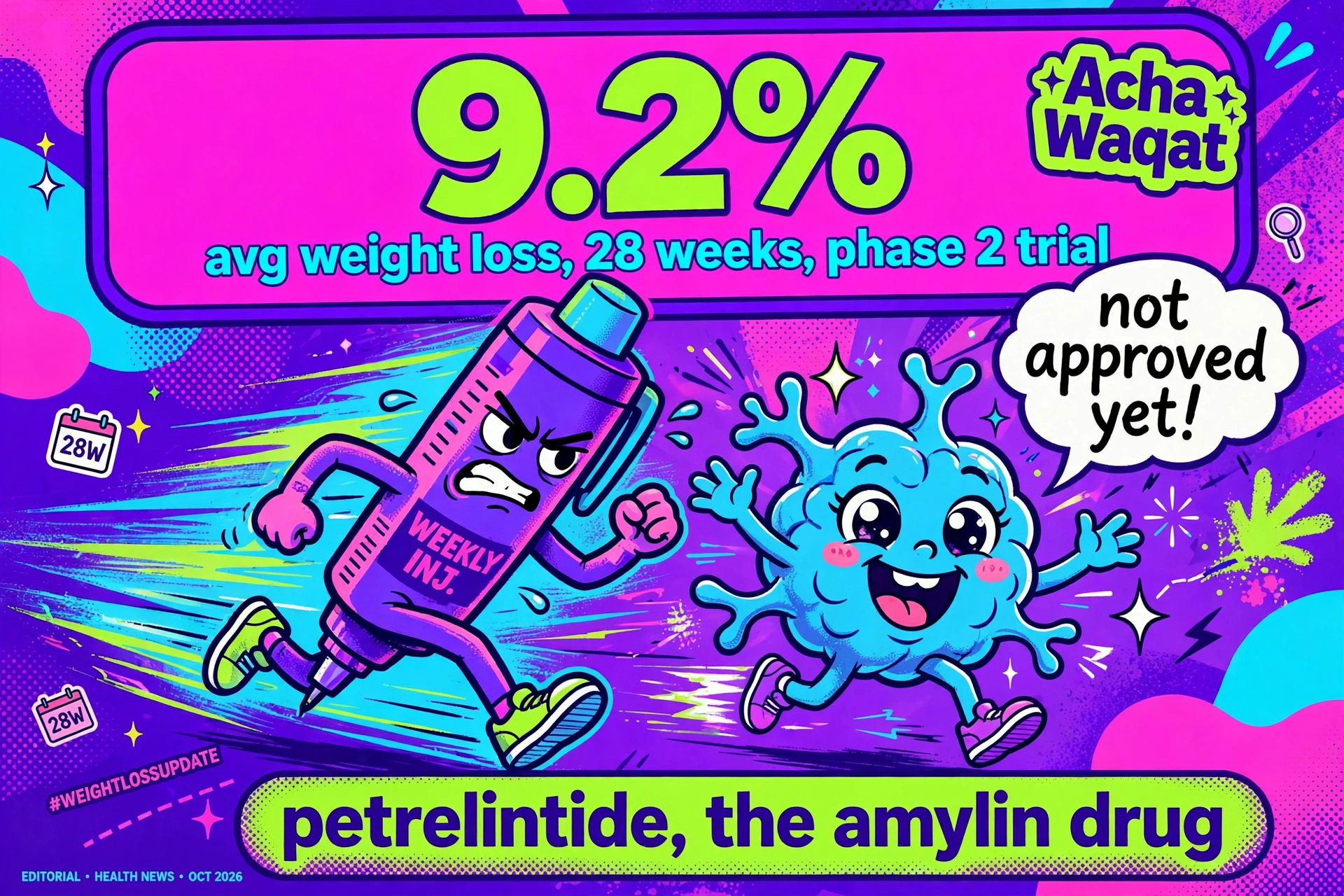
Short answer: Petrelintide is an investigational once-weekly injection that copies the gut hormone amylin, not GLP-1. On 7 October 2026, Zealand Pharma reported that its Phase 2 trial, ZUPREME-2, produced up to 9.2% average weight loss over 28 weeks in people with overweight or obesity and type 2 diabetes, versus 2.0% with placebo, and cut HbA1c by up to 0.65%. The drug is not approved anywhere yet and cannot be prescribed; large Phase 3 trials have only just started recruiting.
What is petrelintide?
Petrelintide is a long-acting human amylin analog made by Zealand Pharma, a Danish biotechnology company based in Copenhagen. It is given as a once-weekly injection under the skin and is being developed for chronic weight management.
To understand what it does, start with amylin itself. Amylin is a hormone made in the pancreas by the same beta cells that make insulin, and it is released alongside insulin after you eat. When amylin binds to its receptors in the brain, it helps you feel full sooner and restores sensitivity to leptin, the hormone that tells the brain the body has enough stored energy. Zealand Pharma designed petrelintide to be chemically stable at neutral pH so that it does not clump into fibrils, which also means it could one day be combined in a single injection with other weight-loss peptides.
The key point: petrelintide is not a GLP-1 drug. It does not mimic Ozempic or Wegovy. It works through the amylin pathway instead, which is why researchers describe it as a different tool rather than another version of the same one.
Why is everyone talking about amylin right now?
The interest in amylin has been building because the amylin approach already has evidence behind it. Novo Nordisk is developing CagriSema, a weekly injection that pairs its amylin analog cagrilintide with semaglutide, the active ingredient in Ozempic and Wegovy. In its REDEFINE 2 trial in 1,206 adults with type 2 diabetes and overweight or obesity, CagriSema produced 15.7% average weight loss over 68 weeks versus 3.1% for placebo. And in the REIMAGINE 2 trial, which compared CagriSema directly against semaglutide in adults with type 2 diabetes, CagriSema achieved 14.2% average weight loss versus 10.2% for semaglutide alone over 68 weeks. Both results suggest the amylin component adds a real extra effect beyond the GLP-1 drug on its own. CagriSema was submitted to the US FDA in December 2025 and the company expects a decision in the final three months of 2026, but it is not yet approved either.
Earlier, a Phase 2 trial of cagrilintide on its own (Enebo and colleagues, The Lancet, 2021) showed about 10.8% average weight loss at the highest dose over 26 weeks, compared with 3.0% for placebo. That was the first serious signal that amylin drugs could work as standalone weight-loss treatments, and it is the backdrop against which the petrelintide results land.
Zealand Pharma has also partnered with Roche. In 2025 the two companies signed an exclusive collaboration to co-develop petrelintide, and a Phase 2 trial combining petrelintide with Roche’s GLP-1/GIP dual agonist enicepatide (CT-388) is planned for the second half of 2026. The industry is clearly betting that amylin will matter, either on its own or in combination.
What did the ZUPREME-2 trial actually test?
ZUPREME-2 was a randomised, double-blind, placebo-controlled Phase 2b trial conducted at multiple centres in the United States. It enrolled 220 people with overweight or obesity and type 2 diabetes, with an average body mass index of 36.3 kg/m2 and an average HbA1c of 8.0% at the start.
Participants were assigned to one of three once-weekly petrelintide doses or placebo. Doses were increased every fourth week over a 16-week escalation period, followed by a maintenance period up to week 28, with follow-up continuing to week 38. Everyone in the trial was taking metformin, with or without an SGLT2 inhibitor, and was also asked to follow a reduced-calorie diet and increase physical activity. In other words, the drug was tested as an add-on to the standard lifestyle and medication base, not instead of it.
The primary endpoint was the percentage change in body weight from baseline to week 28. Secondary endpoints included the share of participants losing at least 5% and 10% of body weight, changes in waist circumference, HbA1c, inflammation markers, fasting glucose and fasting lipids.
What were the results?
The trial met its primary endpoint. All three petrelintide doses produced statistically significant and clinically meaningful weight loss compared with placebo:
- Average weight loss across the three doses ranged from 7.4% to 9.2% of starting body weight at week 28, using the efficacy estimand, versus 2.0% with placebo. The headline 9.2% figure is the best of the three dose groups, not the average across everyone on the drug.
- Results were largely consistent under the treatment regimen estimand, which counts everyone as randomised even if they stopped treatment, rather than estimating the effect as if everyone had stayed on it. That matters because the stricter analysis is usually closer to what happens in real life.
On blood sugar, participants on petrelintide achieved a placebo-adjusted HbA1c reduction of 0.61 to 0.88 percentage points across the three doses. In the headline figures, HbA1c fell by up to 0.65% on petrelintide while rising by 0.23% on placebo. That combination, meaningful weight loss plus better blood sugar control, is exactly what Zealand Pharma and its chief medical officer highlighted in the announcement, because weight loss that worsens diabetes would be of little use to this patient group.
The full results have not yet been published in a peer-reviewed journal. The company says they will be presented at an upcoming scientific conference, so for now the detailed breakdowns, including the shares reaching 5% and 10% weight loss, are still to come.
How safe was it?
No unexpected safety signals were observed. The most commonly reported side effects were gastrointestinal, meaning nausea, vomiting or diarrhoea, and the vast majority were mild and occurred during the dose-escalation period. That pattern is familiar from GLP-1 drugs, where gut side effects are also front-loaded.
The number to note is discontinuation due to gut side effects: 1.9% of participants on petrelintide stopped treatment for that reason, versus 1.7% on placebo. Those rates are strikingly low and essentially identical to placebo, which Zealand Pharma presents as evidence of a favourable tolerability profile. The company also said the safety profile confirms the findings of ZUPREME-1, its earlier 42-week Phase 2 trial in people with overweight or obesity without type 2 diabetes.
Two caveats apply. First, 220 people followed for 28 weeks is enough to spot common problems but not rare ones; rare side effects only show up in much larger trials, which is precisely what Phase 3 is for. Second, topline results are company announcements, not peer-reviewed papers. The independent scrutiny happens when the full data are presented and published.
How does petrelintide compare with the weight-loss drugs we already have?
Context helps here. The best-known current option, semaglutide 2.4 mg (Wegovy), produced 14.9% average weight loss over 68 weeks in the STEP 1 trial in people without diabetes, versus 2.4% on placebo. In people with type 2 diabetes, the STEP 2 trial showed 9.6% with semaglutide.
Petrelintide’s 9.2% at 28 weeks sits below those numbers, but a fair comparison is not really possible yet. The ZUPREME-2 trial was shorter (28 weeks versus 68), smaller, and used a different population (people with type 2 diabetes, in whom weight loss is typically harder to achieve). Longer and larger trials may show the effect grows with time, as it has for other weight-loss drugs, or it may not. That is what Phase 3 must establish.
The more interesting comparison may be petrelintide plus a GLP-1 rather than petrelintide instead of one. Zealand Pharma explicitly describes the drug as a future monotherapy and a combination agent, and its development plans include the Roche combination trial. The CagriSema data, where adding the amylin component lifted weight loss from 10.2% to 14.2% in people with diabetes, is the template everyone is looking at.
What happens next?
Zealand Pharma and Roche have already started the Phase 3a programme for petrelintide, consisting of three trials:
- ZUPREME-3, in people with overweight or obesity without type 2 diabetes
- ZUPREME-4, in people with overweight or obesity and type 2 diabetes
- ZUPREME-5, in people with overweight or obesity and established cardiovascular disease
Together the three trials are expected to enrol about 7,000 participants, and the company says the first participants have already started treatment. These trials will run against placebo and will be the basis of any future regulatory applications.
What this means in practice is that petrelintide is years away from any pharmacy shelf. Phase 3 trials in obesity typically run for well over a year each, and regulatory review takes further time. Nobody can be prescribed petrelintide today, and any website or social media account claiming to sell it should be treated as a scam.
Should you ask your doctor about it?
Not yet, at least not with the expectation of getting it. There is nothing a GP can prescribe today based on these results. What the results do change is the conversation about what is coming: amylin-based drugs are now firmly in the pipeline alongside GLP-1s, and people who struggle with current options have reason to follow the Phase 3 programme.
If you are considering weight-loss treatment now, the evidence-backed options remain the approved medicines, such as GLP-1 and GLP-1/GIP drugs, discussed with a doctor who can weigh benefits, side effects, supply issues and cost for your situation. Lifestyle treatment, reduced-calorie eating and more physical activity, remains the foundation every trial adds to rather than replaces.
This article is for information only and is not medical advice. Drug trial results in early phases often look better than the final approved picture, and some drugs never make it past Phase 3.
Frequently asked questions
What is petrelintide?
Petrelintide is an investigational long-acting amylin analog given as a once-weekly injection. It is being developed by Zealand Pharma in partnership with Roche for chronic weight management in people with overweight or obesity, with or without type 2 diabetes. It is not approved in any country.
Is petrelintide the same as Ozempic?
No. Ozempic and Wegovy contain semaglutide, which mimics the gut hormone GLP-1. Petrelintide mimics a different hormone, amylin, which is released by the pancreas alongside insulin after eating and acts on separate brain pathways to reduce appetite. The two drugs work through different mechanisms.
How much weight did people lose in the ZUPREME-2 trial?
Across the three petrelintide doses, average weight loss at 28 weeks ranged from 7.4% to 9.2% of starting body weight, compared with 2.0% for placebo. All participants also followed a reduced-calorie diet and increased their physical activity, and were taking metformin with or without an SGLT2 inhibitor.
Did petrelintide help with blood sugar?
Yes. Participants achieved a placebo-adjusted HbA1c reduction of 0.61 to 0.88 percentage points across the doses. The headline figure was an HbA1c fall of up to 0.65% on petrelintide while the placebo group’s HbA1c rose by 0.23%.
What are the side effects of petrelintide so far?
The most common side effects were mild gastrointestinal effects, mostly during the dose-escalation period. Only 1.9% of participants stopped treatment because of gut side effects, compared with 1.7% on placebo. Rare or long-term side effects cannot be ruled out until larger trials are complete.
When might petrelintide be available?
Not for years, if it gets approved at all. The Phase 3 programme (ZUPREME-3, ZUPREME-4 and ZUPREME-5) is enrolling about 7,000 participants, and these trials take a long time to run. Full Phase 2 results are expected to be presented at a scientific conference before then.
Sources
- Zealand Pharma company announcement No. 54 / 2026, 7 October 2026: https://www.globenewswire.com/news-release/2026/10/07/3376750/0/en/zealand-pharma-announces-positive-phase-2-zupreme-2-topline-results-for-amylin-analog-petrelintide-in-people-with-overweight-or-obesity-and-type-2-diabetes.html
- ZUPREME-2 trial record: https://clinicaltrials.gov/study/NCT06926842
- Wilding JPH et al., Once-Weekly Semaglutide in Adults with Overweight or Obesity (STEP 1), New England Journal of Medicine, 2021, DOI: 10.1056/NEJMoa2032183
- Davies M et al., Semaglutide 2.4 mg once a week in adults with overweight or obesity, and type 2 diabetes (STEP 2), The Lancet, 2021
- Enebo LB et al., Safety and efficacy of cagrilintide for the treatment of overweight and obesity (Phase 2), The Lancet, 2021
- Novo Nordisk REDEFINE 2 headline results, 10 March 2025, via Drugs.com: https://www.drugs.com/history/cagrisema.html
- Novo Nordisk REIMAGINE 2 results, February 2026: https://www.drugs.com/clinical_trials/cagrisema-demonstrated-superior-hba1c-reduction-1-91-points-weight-loss-14-2-adults-type-2-diabetes-22290.html
- NHS, Obesity: treatment (lifestyle and medication options)
Further reading on Acha Waqat: how GLP-1 weight-loss drugs may affect mental health, what vaccine trial studies show about the shingles vaccine and dementia risk, and autumn health guidance on MMR and travel. The primary source for the trial data is the Zealand Pharma announcement.
