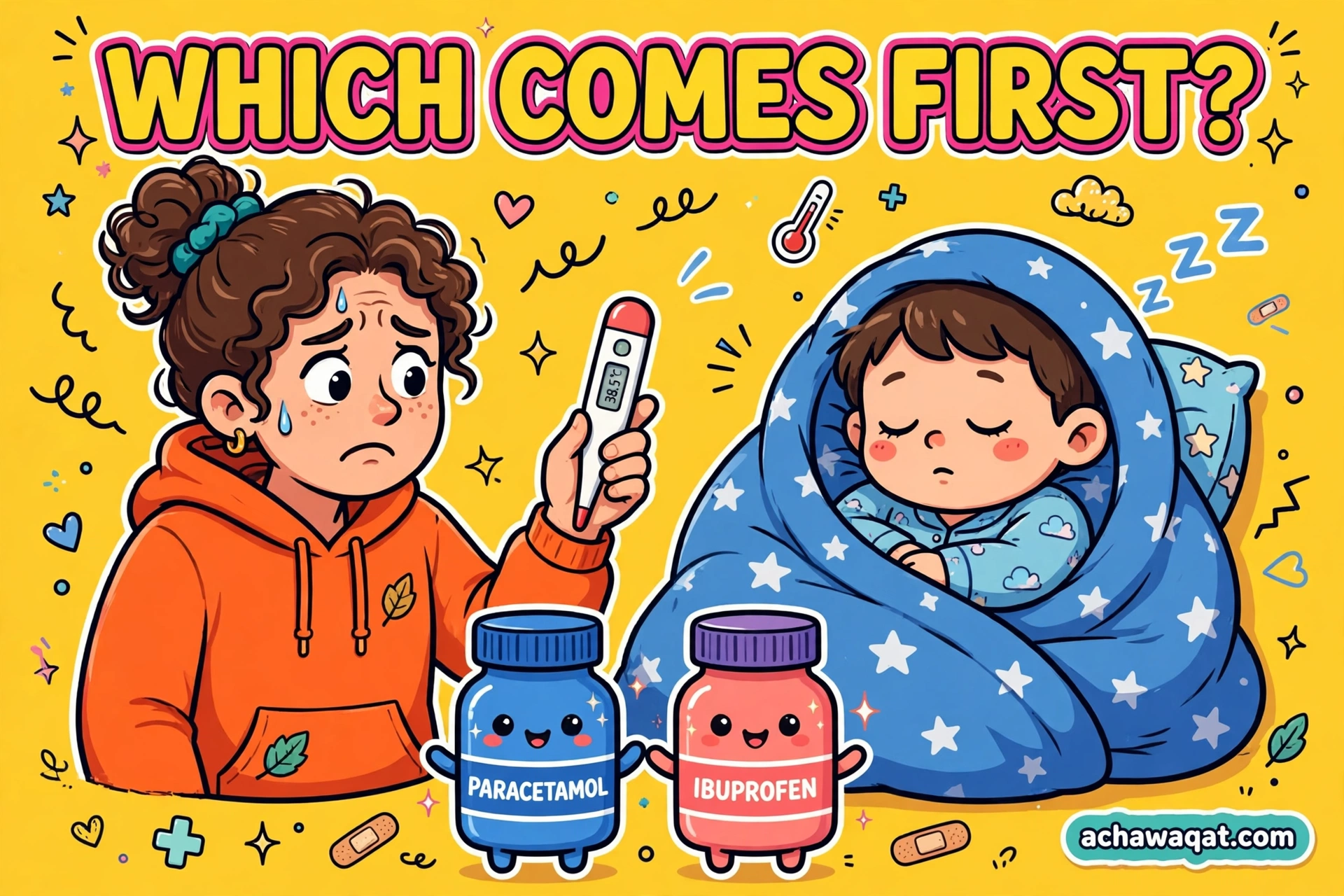
Paracetamol or Ibuprofen for a Child with a Fever: Which Comes First?
Either medicine can come first. What matters is that you never give paracetamol and ibuprofen at the same time, and that you treat your child’s distress, not the number on the thermometer. If the first medicine has not helped by the time the next dose falls due, NHS trust guidance says you may then try the other one. That is the whole rule, and it is simpler than the worry that usually surrounds it.
What counts as a fever in a child?
A fever is a body temperature of 38°C or above. All three NHS children’s hospitals whose guidance this article draws on agree on that threshold: Alder Hey Children’s Hospital, North Tees and Hartlepool, and University Hospitals Plymouth. A fever is a natural response that helps the body fight infection, and most fevers in children are caused by viral infections such as coughs, colds, flu or stomach bugs. Almost all children recover quickly and without problems.
One exception matters straight away. If your baby is under 3 months old and has a fever, seek medical advice straight away rather than managing it at home. Both North Tees and Plymouth state this plainly, and it is the one age rule to memorise.
Why you treat distress, not the temperature
The main reason to give medicine is to make your child feel better, not to force the thermometer back to 37°C. Alder Hey puts it directly: when your child is irritable or cranky, you may want to give some medicine. Plymouth says the same thing from the other side: if your child is their normal self, happy and playing, the medicines are not required.
This matters because fever itself is not the enemy. It is a sign that the body is fighting an infection. Bringing the temperature down does not cure the infection, and a child who is comfortable, drinking and alert does not need medicine just because the thermometer reads high. Watch the child, not the number.
Paracetamol first, or ibuprofen first?
Neither NHS trust guidance says one medicine must come first. North Tees states it most clearly: you may give either paracetamol or ibuprofen first. The choice depends on your child and the situation, not on a fixed order.
Paracetamol is the usual starting point for most families. It suits most children, it is sold under familiar brand names such as Calpol, and it is the medicine most parents already have in the cupboard. It lowers temperature and eases aches, and it is the safer default when you are unsure.
Ibuprofen, sold as Nurofen or Brufen, also lowers temperature and eases pain, and it has the added property of reducing inflammation. That can make it a good choice for a child who is also in pain, for example with a sore throat or an earache. But it comes with two cautions that paracetamol does not. Use it cautiously if your child is not drinking well or not passing urine well, because dehydration and ibuprofen are a poor combination. And never give ibuprofen to a child with chickenpox: Alder Hey notes that some studies have suggested an association with more severe skin reactions.
So the practical answer is this. If your child is drinking normally and has no chickenpox, either medicine is a reasonable first choice. If your child is dehydrated, off their drinks, or has chickenpox, start with paracetamol and ask a pharmacist before using ibuprofen at all.
How staggering works in practice
Staggering means giving one medicine, waiting to see whether it helps, and only bringing in the other medicine if your child is still distressed when the next dose falls due. It does not mean giving both medicines together, and it does not mean doubling up.
North Tees words the rule precisely: paracetamol and ibuprofen should never be given at the exact same time, but you may give either one first and then, if your child has not improved by the time the next dose of the chosen medicine is due, consider using the other medicine. Plymouth agrees: current guidance does not recommend giving both at the same time, but rather staggering doses if the first medicine does not appear to have worked. Alder Hey adds that alternating the two can help provide symptom relief for longer.
In practice, that looks like this. Give one medicine at the dose on the packet. Give it time to work. If your child is still uncomfortable when the next dose is due and you want to switch, give the other medicine instead of repeating the first. Keep a note of what you gave and when, because alternating two medicines is exactly how doses get confused at 3am. A phone note with the medicine name and the time is enough.
The dosing rules that keep it safe
Always follow the instructions on the packet or bottle for your child’s age and weight, and never exceed the maximum number of doses. Alder Hey gives the headline limits: paracetamol no more than four times in 24 hours, ibuprofen no more than three times in 24 hours. Those limits apply to each medicine separately, so alternating does not let you give more of either one.
Three habits keep staggering safe. First, read the packet every time, because children’s products vary by age band and strength, and adult tablets are never a substitute. Second, write down each dose with the time, so a second adult or a bleary-eyed parent does not repeat it. Third, ask your pharmacist if you are unsure about anything, including whether a medicine suits a child with asthma, kidney problems or another condition. Pharmacists give this advice free and without an appointment, and North Tees points parents to them explicitly.
When ibuprofen is the wrong choice
Ibuprofen is not suitable for every feverish child. Skip it, or check with a pharmacist first, in these situations:
- Your child has chickenpox. Alder Hey is explicit: ibuprofen should not be given, because of the possible link with more severe skin reactions.
- Your child is not drinking well or is passing very little urine. Alder Hey advises caution here, since dehydration raises the risk of side effects.
- Your child has vomited recently and cannot keep fluids down, which points back to the dehydration caution and to seeking advice.
- You are unsure about the right product or dose for your child’s age. The packet and the pharmacist settle this in minutes.
Paracetamol has fewer such cautions, which is one reason it is the usual first choice. But it is not risk free either: too much paracetamol harms the liver, which is why the four-doses-in-24-hours limit matters and why you should check that other products you are using do not already contain it.
Why aspirin is never an option
Never give aspirin to a child with a fever. All three trusts state this without qualification, and Alder Hey explains why: in rare cases aspirin can cause Reye’s syndrome in children who have flu or chickenpox, a serious illness that can lead to death. Because it can be hard to tell which infection a child has in the early stages, the safe rule is simple: no aspirin for children, ever, for fever.
Comfort measures that help without medicine
Medicine is only part of fever care, and the simple measures help whether or not you give a dose:
- Offer small drinks often, and keep breastfeeding if your baby is still nursing. Fluids matter more than any medicine.
- Dress your child in light clothing and remove layers if they feel hot. Never wrap a feverish child up, and never sponge them with tepid or cold water: North Tees warns that sponging causes shivering, which can push the temperature higher.
- Keep the room comfortable, not hot, and let your child rest in their cot rather than being held constantly.
- Check on your child regularly through the day and night to make sure they are not getting worse.
These measures will not break a fever on their own, and they are not meant to. Their job is comfort, same as the medicine.
When to call 111 or 999
Most fevers settle at home, but some signs mean you should get medical help promptly. Call NHS 111 or your GP if your child is not drinking, is not passing much urine, has persistent vomiting, is drowsy, seems generally more unwell, is breathing fast, or has a fever lasting more than five days even if nothing else worries you.
Call 999 or go to an emergency department immediately if your child is difficult to wake, is refusing to drink, is vomiting repeatedly, is bothered by light, has blue lips, is very irritable or has an unusual cry, becomes very pale, develops a rash that does not fade when you press a glass against it, finds it hard to breathe, has a stiff neck, or has a seizure for the first time. The rash check is the tumbler test: press a clear glass firmly against the rash, and if the spots do not fade, treat it as an emergency. On dark skin, check paler areas such as the palms, the soles of the feet and inside the eyelids.
Above all, trust your own judgement. Every trust leaflet says some version of the same thing: you know your child best, and if you are worried, that alone is a good reason to call.
Frequently asked questions
Should I give paracetamol or ibuprofen first for my child’s fever?
Either can come first. NHS trust guidance says you may give either paracetamol or ibuprofen first, and the choice depends on your child: paracetamol is the usual default, while ibuprofen is best avoided if your child has chickenpox or is not drinking well.
Can I alternate paracetamol and ibuprofen for my child?
Yes, by staggering rather than combining. Give one medicine first, and if your child has still not improved by the time the next dose falls due, you may give the other medicine instead. Alder Hey notes that alternating can provide symptom relief for longer, but you must never give both at the same time.
Can I give paracetamol and ibuprofen at the same time?
No. North Tees and Plymouth both state that the two medicines should never be given at the exact same time. Stagger them instead, and keep a written note of each dose and time.
How many doses can my child have in a day?
Follow the packet for your child’s age and weight. As a headline guide from Alder Hey, paracetamol should be given no more than four times in 24 hours and ibuprofen no more than three times in 24 hours, with each limit applying to that medicine separately.
Why should I not give ibuprofen for chickenpox?
Some studies have suggested an association between ibuprofen use during chickenpox and more severe skin reactions, so Alder Hey advises against it. Use paracetamol instead and ask a pharmacist if you are unsure.
When should I worry about my child’s fever?
Seek advice if your child is not drinking, is drowsy, has a fever lasting more than five days, or seems more unwell. Call 999 straight away for a rash that does not fade under a glass, a stiff neck, difficulty waking, blue lips, breathing difficulty, or a first seizure. Babies under 3 months with a fever need medical advice immediately.
Sources
- Alder Hey Children’s NHS Foundation Trust, Fever (PIAG 64, last reviewed 12 March 2026): fever defined as above 38°C, treat to relieve distress, alternating guidance, ibuprofen limits and chickenpox caution, aspirin and Reye’s syndrome warning.
- North Tees and Hartlepool NHS Foundation Trust, Fever in Children (PIL1376): never give both medicines at the same time, either may come first, pharmacist advice, never aspirin, guidance based on NICE Guideline NG143 (fever in under 5s).
- University Hospitals Plymouth NHS Trust, Fever (paediatrics leaflet): medicine only when the child is distressed, stagger rather than combine, under-3-months rule, fever over five days.
- National Institute for Health and Care Excellence, NG143: Fever in under 5s, assessment and initial management.
Related reading
- Half-Term Starts Monday: The Medicine Cabinet Checklist Worth Doing Today (stock paracetamol and ibuprofen before you need them, and check the expiry dates)
- Who Can Get a Free NHS Flu Jab This Winter? The 2026 Eligibility List Explained (flu is a common cause of childhood fever, and the jab is free for many families)
- The Winter Vomiting Bug Is Back: Norovirus, Explained Before It Finds You (fever with vomiting and diarrhoea, and the 48-hour rule)
Medical disclaimer: this article is general information, not medical advice for your child. Doses, age limits and suitability vary by product and by child, so always follow the packet instructions and ask a pharmacist, your GP or NHS 111 if you are unsure. If you are worried about your child, seek medical help promptly.
