Vancomycin AUC Dosing Calculator
This vancomycin AUC dosing calculator builds an AUC-guided starting regimen: it estimates creatinine clearance by Cockcroft-Gault, derives vancomycin clearance and half-life by the Matzke method, gives the weight-based loading dose for serious infections, and selects a maintenance dose and interval aimed at a 24-hour AUC of 400 to 600 (assuming an MIC of 1 mg/L), reporting the predicted AUC of the rounded regimen it recommends.
What your result means
The result panel leads with the maintenance regimen and its predicted AUC24. For a 70 kg, 55-year-old man, 175 cm, serum creatinine 1.0 mg/dL, the calculator reports creatinine clearance 82.6 mL/min, ke 0.0730 per hour, volume of distribution 49.0 L, vancomycin clearance 3.58 L/h and half-life 9.5 hours. The loading dose is 1,400 to 1,750 mg (20 to 25 mg/kg). For a target AUC of 500, the daily dose needed is 1,789 mg, given as 1,000 mg every 12 hours (2,000 mg/day after rounding to the nearest 250 mg per dose), for a predicted AUC24 of 559, inside the 400-600 target. A 70 kg patient with creatinine 2.5 mg/dL (CrCl about 33.1 mL/min) gets 750 mg every 24 hours instead, with a predicted AUC24 of about 481 and a half-life near 22 hours.
How the vancomycin AUC calculator works
Four equations chain together. First, creatinine clearance by Cockcroft-Gault: CrCl = (140 - age) x weight / (72 x SCr), times 0.85 for women, using adjusted body weight (ideal + 0.4 x (actual - ideal)) when actual weight exceeds 120 percent of ideal by the Devine formula. Second, the Matzke elimination rate: ke = 0.00083 x CrCl + 0.0044 per hour. Third, volume of distribution Vd = 0.7 L/kg of actual body weight, giving vancomycin clearance Cl = ke x Vd in L/h and half-life t1/2 = 0.693 / ke. Fourth, the daily dose for the target: daily dose = target AUC x Cl, split into the interval's doses and rounded to the nearest 250 mg per administration, after which the predicted AUC24 is recomputed from the rounded regimen so you see what the patient actually gets.
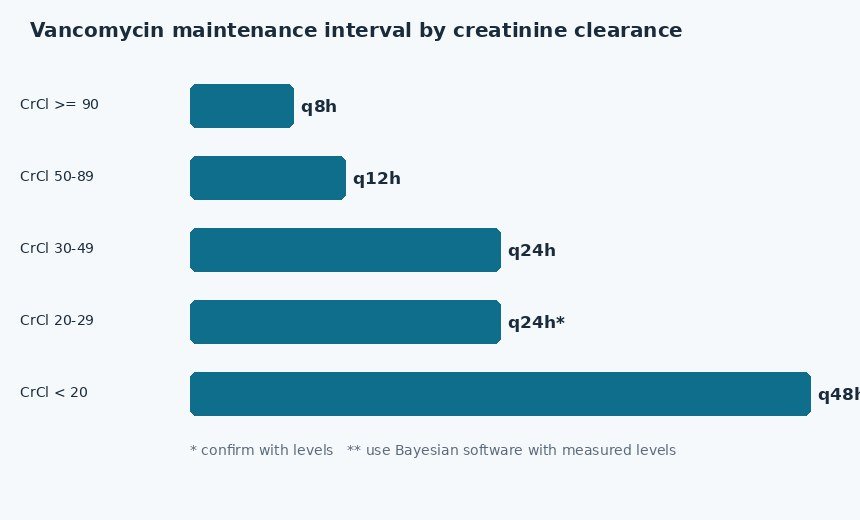
The interval follows renal function: every 8 hours at CrCl 90 or above, every 12 hours at 50 to 89, every 24 hours at 30 to 49, every 24 hours at 20 to 29 with a level-monitoring flag, and every 48 hours below 20 with a strong recommendation for Bayesian software rather than this table. Because the dose is sized to the AUC rather than fixed at mg/kg, the predicted AUC lands inside 400-600 across the bands instead of overshooting in renal impairment.
Why AUC replaced trough-only monitoring
For years the surrogate target was a trough of 15 to 20 mcg/mL, assumed to deliver an AUC/MIC above 400. The problem, shown repeatedly in practice, was that troughs in that band frequently corresponded to AUCs above 600, and the excess exposure drove acute kidney injury without improving cure rates. The 2020 revised consensus guideline (Rybak et al.) therefore made AUC-guided monitoring the recommendation: target AUC24/MIC 400 to 600 assuming an MIC of 1 mg/L, which covers over 90 percent of MRSA isolates, and use Bayesian software with one or two measured levels to compute each patient's true AUC. Trough-only monitoring remains acceptable only where Bayesian tools are unavailable, with a lower trough target of 10 to 15 mcg/mL.
This calculator sits at the start of that workflow: it produces the evidence-based initial regimen (the nomogram step), and the guideline's monitoring step, levels plus Bayesian estimation, takes over from there. It does not replace measured levels, and it says so in the result for low-clearance patients where the one-compartment assumptions are weakest.
The loading dose: 20 to 25 mg/kg
For serious MRSA infections, a loading dose of 20 to 25 mg/kg of actual body weight (capped at 3,000 mg) gets concentrations into the therapeutic range on day one instead of waiting for accumulation over several half-lives. For a 70 kg adult that is 1,400 to 1,750 mg; for a 100 kg adult, 2,500 mg (under the cap). The infusion must run no faster than 1 g per hour: faster infusions trigger histamine-mediated red man syndrome, flushing and itching of the face, neck and upper body that is rate-related rather than allergic. A loading dose is not needed for mild infections, and it should not be given when renal function is changing rapidly, because the maintenance that follows it cannot be predicted.
Interval selection across renal function
Vancomycin is cleared almost entirely by the kidneys, so the half-life stretches from 6 to 7 hours at normal function to over 24 hours in severe impairment, and the interval must stretch with it. The calculator's bands mirror the published nomograms: at CrCl above 95, a 70 kg patient typically receives 750 mg every 8 hours; at 75 to 84, 1,000 mg every 12 hours; at 55 to 64, 750 mg every 12 hours; below 45, once-daily dosing takes over. Rather than copying a fixed table, the calculator sizes each band's dose to the chosen target AUC, then rounds per administration to the nearest 250 mg, which is why its regimens track the nomograms while keeping the predicted AUC inside 400-600.
| CrCl (mL/min) | Interval | How the dose is set |
|---|---|---|
| 90 and above | Every 8 hours | Target AUC x clearance, split 3 ways |
| 50-89 | Every 12 hours | Target AUC x clearance, split 2 ways |
| 30-49 | Every 24 hours | Target AUC x clearance, once daily |
| 20-29 | Every 24 hours | Same, with level-monitoring flag |
| Below 20 | Every 48 hours | Use Bayesian software with measured levels |
When to draw levels
For AUC-guided monitoring, levels are drawn at steady state, usually before the fourth dose: a trough 30 minutes before the next infusion, optionally plus a peak 1 to 2 hours after the infusion ends. A single trough fed into Bayesian software is enough for a usable AUC estimate; two levels tighten it. Recheck after any change in renal function, after adding nephrotoxins (aminoglycosides, amphotericin, IV contrast, NSAIDs), and if therapy extends beyond a few days. Rising creatinine on vancomycin should trigger an immediate level and a dose hold review, not the next scheduled dose.
Limitations of this calculator
- It gives a starting regimen only. The guideline prefers Bayesian AUC estimation from measured levels for the individual patient, especially with unstable renal function, critical illness, or morbid obesity.
- Cockcroft-Gault is invalid in acute kidney injury, where creatinine is changing; use clinical judgment and levels instead.
- It assumes an MIC of 1 mg/L. If the isolate's MIC is 2 mg/L, an AUC of 400-600 no longer achieves the target ratio and alternative therapy should be considered.
- The Matzke one-compartment parameters are population averages; individual ke and Vd vary, and the critically ill often have larger volumes of distribution.
- It does not cover dialysis, continuous renal replacement therapy, or pediatrics, all of which need specialist dosing.
Frequently asked questions
What is the target AUC for vancomycin?
The 2020 vancomycin consensus guideline targets a 24-hour AUC to MIC ratio of 400 to 600, assuming an MIC of 1 mg/L for MRSA. An AUC below 400 risks treatment failure; above 600 the risk of kidney injury rises. Bayesian software using measured levels is preferred for individual patients; this calculator gives the evidence-based starting regimen.
What is the vancomycin loading dose?
For serious MRSA infections, 20 to 25 mg/kg of actual body weight as a single loading dose (capped at 3,000 mg), infused at no more than 1 g per hour to avoid red man syndrome. For a 70 kg adult that is 1,400 to 1,750 mg. A loading dose is not needed for mild infections or when renal function is unstable.
How is vancomycin clearance estimated?
This calculator uses the Matzke method: elimination rate constant ke = 0.00083 x creatinine clearance + 0.0044 (per hour), volume of distribution 0.7 L/kg, and clearance = ke x Vd. Because vancomycin is cleared almost entirely by the kidneys, clearance tracks creatinine clearance closely.
Why did guidelines move from troughs to AUC monitoring?
Trough-only monitoring (15-20 mcg/mL) was a surrogate for the AUC, but targeting high troughs pushed many patients above an AUC of 600 and increased kidney injury without better cure rates. AUC-guided dosing achieves the same efficacy target with lower, safer exposures, and the 2020 guideline made AUC/MIC 400-600 the recommended target.
What vancomycin interval should be used in kidney failure?
The interval stretches as creatinine clearance falls: roughly every 8 hours at normal clearance, every 12 hours at 50-89 mL/min, every 24 hours at 30-49, and every 24-48 hours below 30, always confirmed with levels. In practice, one measured level and Bayesian software set the exact interval for unstable or very low clearance.
When should vancomycin levels be drawn?
For AUC-guided monitoring, draw one or two levels after the third or fourth dose at steady state (a trough 30 minutes before the next dose, and optionally a peak 1-2 hours after the infusion ends). Feed them into Bayesian dosing software to compute the true AUC and adjust the regimen; recheck after any renal function change.
Sources
AUC target and monitoring: Rybak MJ et al. Therapeutic monitoring of vancomycin for serious MRSA infections: a revised consensus guideline and review. Clin Infect Dis. 2020. doi:10.1093/cid/ciaa303. Pharmacokinetic method: Matzke GR et al. Pharmacokinetics of vancomycin in patients with various degrees of renal function. Antimicrob Agents Chemother. 1984;25:433-437. doi:10.1128/aac.25.4.433.