Gentamicin Dosing Calculator
This gentamicin dosing calculator plans three regimens: the Hartford extended-interval method (one large daily dose with the interval set by kidney function), traditional multiple-daily dosing with weight-based intervals, and low-dose synergy dosing for endocarditis. It derives Devine ideal body weight, applies the 40% adjusted weight correction in obesity, estimates creatinine clearance with Cockcroft-Gault, and reports the peak and trough targets for each method.
What your result means
The result panel starts with the three numbers every aminoglycoside decision depends on: the Devine ideal body weight, the dosing weight actually used, and the Cockcroft-Gault creatinine clearance. Below that comes the regimen for the chosen method. For a 55-year-old man weighing 70 kg, 175 cm tall, with a serum creatinine of 1.0 mg/dL, the calculator reports an ideal body weight of about 70.6 kg, a dosing weight of 70 kg, a creatinine clearance of about 82.6 mL/min, and an extended-interval dose of 490 mg every 24 hours at 7 mg/kg, with a target peak above 20 mcg/mL and a target trough below 1 mcg/mL. For a 60-year-old woman weighing 65 kg, 160 cm tall, with a creatinine of 1.4 mg/dL, the report is an ideal body weight of about 52.4 kg, an adjusted dosing weight of about 57.4 kg, a creatinine clearance of about 38.8 mL/min, and 402 mg every 48 hours, because clearance below 60 stretches the interval. Her traditional option would be about 86 mg every 24 hours. The panel also flags when extended-interval dosing is not recommended at all (clearance below 20 mL/min) and when the Hartford nomogram applies to a supplied random level.
How the gentamicin dosing calculator works
Every aminoglycoside regimen is a kidney-function decision wearing a weight disguise, because gentamicin is eliminated almost entirely by glomerular filtration. The calculator therefore builds its answer in three steps: which weight to dose on, how fast the kidneys clear drug, and which regimen that clearance permits.
Step one is the dosing weight. Gentamicin distributes into extracellular fluid and lean tissue, not adipose tissue, so dosing an obese patient on total body weight overestimates the distribution space and invites toxicity. The calculator computes Devine ideal body weight, IBW = 50 + 0.91 x (height in cm - 152.4) for men and 45.5 + 0.91 x (height in cm - 152.4) for women, then applies the standard correction: if actual weight exceeds 120% of ideal, the dosing weight becomes IBW + 0.4 x (actual - IBW), the adjusted body weight. Within 120% of ideal, actual weight is used; below ideal weight, actual weight is used too, since there is nothing to correct for.
Step two is creatinine clearance by Cockcroft-Gault, CrCl = (140 - age) x dosing weight / (72 x serum creatinine), multiplied by 0.85 for women. The dosing weight goes into the equation, not total body weight, because the same obesity logic applies. A stable creatinine over the past few days matters: the estimate assumes steady-state renal function, and a rising creatinine means the clearance is already lower than the number on screen.
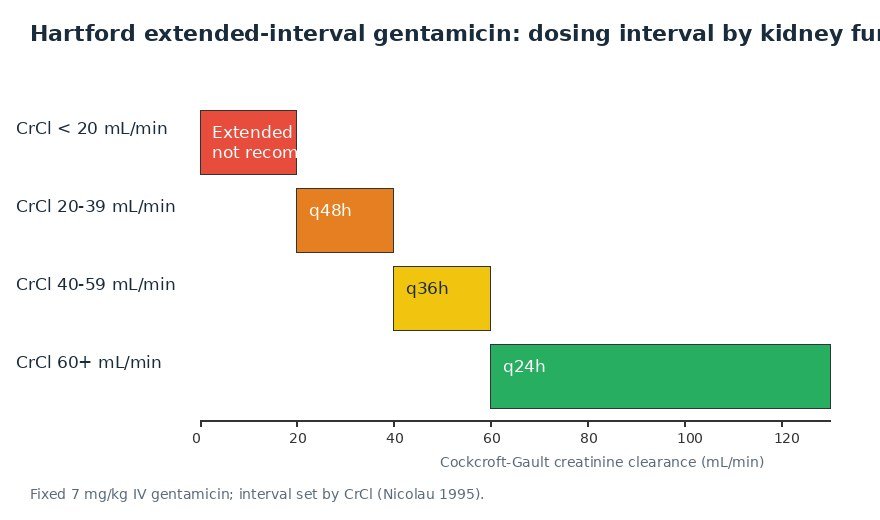
Step three is the regimen. The extended-interval option multiplies the dosing weight by the chosen per-kilo dose (5, 6 or 7 mg/kg; 7 is the Hartford standard) and sets the interval from clearance: every 24 hours at 60 mL/min or above, every 36 hours at 40 to 59, every 48 hours at 20 to 39, and not recommended below 20. The traditional option uses 1.5 mg/kg per dose with intervals of every 8 hours at 90 or above, every 12 hours at 60 to 89, every 24 hours at 30 to 59, individualised below 30. Synergy dosing gives 1 mg/kg every 8 hours (or equivalently 3 mg/kg once daily) alongside the partner antibiotic.
Extended-interval (Hartford) dosing: the default for most adults
The Hartford method, reported by Nicolau and colleagues in 1995 after 2,184 adult patients at Hartford Hospital, keeps the dose fixed at 7 mg/kg and varies only the interval with kidney function: 60 mL/min or above every 24 hours, 59 to 40 every 36 hours, 39 to 20 every 48 hours. Its logic is pharmacodynamic. Aminoglycoside killing is concentration-dependent: the higher the peak relative to the organism's minimum inhibitory concentration, the more bacteria die. A large once-daily dose drives the peak high, typically 20 to 30 mcg/mL, and the long drug-free interval lets the trough fall below 1 mcg/mL, which is thought to reduce nephrotoxicity and ototoxicity compared with sustained exposure. The post-antibiotic effect, continued bacterial suppression after the drug level falls below the MIC, covers the drug-free tail.
The calculator offers 5 and 6 mg/kg alongside 7 because other protocols exist: the Urban and Craig nomogram uses 5 mg/kg in patients without renal dysfunction, and some centres use 6 mg/kg as a middle ground for less severe infections. The cystic fibrosis population is dosed differently again (around 10 mg/kg once daily) and is outside this calculator's scope. For most hospitalised adults with gram-negative infections, 7 mg/kg is the reference.
Hartford monitoring is deliberately simple: one random level drawn 6 to 14 hours after the infusion starts, plotted on the Hartford nomogram, tells you whether the chosen interval is right. If the level plots above the 48-hour line, the drug is clearing too slowly and the dose is held and reassessed. This calculator accepts that random level and reminds you of the nomogram rule, but it does not plot the nomogram itself; the interval decision and a repeat trough still belong to the clinical team.
Traditional multiple-daily dosing: who still gets it
Traditional dosing, lower doses more often, survives for the patients the Hartford studies excluded. That exclusion list matters: creatinine clearance below about 20 to 30 mL/min, rapidly changing renal function, pregnancy, ascites, and burns over 20% of body surface all change distribution or elimination in ways the nomogram was never validated against. For these patients the calculator gives 1.5 mg/kg per dose with the interval stretched by clearance: every 8 hours at 90 mL/min or above, every 12 hours at 60 to 89, every 24 hours at 30 to 59, and individualised, with level-guided adjustment, below 30.
The level targets differ because the pharmacodynamics differ. Traditional dosing aims for a peak of 5 to 10 mcg/mL and a trough below 2 mcg/mL, drawn as a peak 30 minutes after a 30-minute infusion ends and a trough immediately before the next dose, usually around the third or fourth dose once steady state is reached. The narrower peak-to-trough swing is the point of splitting the dose: continuous high peaks are unnecessary for efficacy with this regimen and simply add toxicity risk.
Synergy dosing for endocarditis
Synergy dosing is a different job entirely. In endocarditis caused by susceptible gram-positive organisms, a small aminoglycoside dose is added to a cell-wall-active drug, a beta-lactam or a glycopeptide, because the combination kills more than either drug alone. The calculator gives 1 mg/kg every 8 hours, or 3 mg/kg once daily as the extended-interval equivalent. The targets are a peak of 3 to 4 mcg/mL and a trough below 1 mcg/mL. Synergy courses are typically short, days rather than weeks, because the toxicity clock still runs and the point of synergy is to finish quickly.
Peak and trough targets: what the levels should look like
| Method | Target peak (mcg/mL) | Target trough (mcg/mL) |
|---|---|---|
| Extended interval (Hartford) | Above 20 (expected 20-30) | Below 1 |
| Traditional (multiple daily) | 5-10 | Below 2 |
| Synergy (endocarditis) | 3-4 | Below 1 |
The trough is the safety number and the peak is the efficacy number, and they are drawn for different reasons. A trough that fails to clear tells you drug is accumulating and toxicity risk is rising, even when the patient feels fine; it is the earliest warning you get. A low peak tells you the dose is underpowered for the infection. When either is off, the fix is not to nudge the dose blindly but to recheck renal function, confirm exact draw times (a peak drawn late or a trough drawn early is a different number wearing the same label), and adjust the interval or the dose accordingly.
Ototoxicity and nephrotoxicity: what monitoring is for
Nephrotoxicity is the commoner and the more reversible of the two: creatinine typically begins rising after 5 to 7 days of therapy, and it usually improves when the drug stops, though not always completely. Ototoxicity is less common and the more feared, because it can be permanent: vestibular damage shows as dizziness and imbalance, cochlear damage as tinnitus and high-frequency hearing loss that the patient may notice only when it is advanced. Risk climbs with higher troughs, longer courses, older age, and concurrent nephrotoxins or ototoxins such as loop diuretics, amphotericin B, vancomycin, or cisplatin.
Sensible monitoring therefore has three strands: creatinine and ideally a baseline and periodic audiometry or at least symptom enquiry, drug levels on the schedule above, and a daily review of whether the drug is still needed. Aminoglycosides are usually de-escalated or stopped as soon as culture results allow, because every extra day is toxicity risk with diminishing benefit.
Limitations of this calculator
- Population estimates, not the patient: Cockcroft-Gault, Devine ideal weight and the interval bands are population tools. Measured levels and clinical review remain the standard for final dosing.
- Cockcroft-Gault assumes stable creatinine and average muscle mass. In acute kidney injury, extremes of muscle mass, the elderly with low creatinine from sarcopenia, or rapidly changing renal function, a measured creatinine clearance is preferable.
- The Hartford nomogram was not validated in pregnancy, ascites, burns over 20% of body surface, rapidly changing renal function, or clearance below 20 mL/min; this calculator flags the low-clearance case but cannot screen the others.
- Only gentamicin is covered. Tobramycin follows similar principles; amikacin uses different per-kilo doses and is outside this calculator.
- Targets assume susceptible organisms and standard infections. Resistant organisms, central nervous system penetration, and critically ill patients with expanded volumes of distribution may need infectious-diseases input beyond any calculator.
- This calculator is for adults only and does not cover paediatric dosing, which follows different rules.
Frequently asked questions
What is the Hartford method of gentamicin dosing?
The Hartford method gives one large daily dose of gentamicin (7 mg/kg of dosing weight) and stretches the interval according to kidney function: every 24 hours when creatinine clearance is 60 mL/min or above, every 36 hours at 40 to 59, and every 48 hours at 20 to 39. It was validated by Nicolau and colleagues in 2,184 adult patients and aims for a high peak to maximise bacterial killing with a low trough so the drug washes out between doses.
What peak and trough should gentamicin levels show?
With extended-interval dosing, the target peak is above 20 mcg/mL (typically 20 to 30) and the trough should be below 1 mcg/mL. With traditional multiple-daily dosing, the target peak is 5 to 10 mcg/mL and the trough below 2 mcg/mL. For endocarditis synergy dosing the targets are a peak of 3 to 4 mcg/mL and a trough below 1 mcg/mL. A trough that fails to clear is the earliest warning of accumulating drug.
When is extended-interval gentamicin not appropriate?
Extended-interval dosing is generally avoided when creatinine clearance is below 20 mL/min, and the Hartford nomogram was not validated in pregnancy, ascites, burns over 20% of body surface, rapidly changing renal function, or for synergy dosing in endocarditis. In these patients traditional multiple-daily dosing or synergy dosing with closer level monitoring is used instead.
Why does this calculator adjust body weight before dosing gentamicin?
Gentamicin distributes mainly into extracellular fluid and lean tissue, not fat, so dosing an obese patient on total body weight overestimates the distribution space and risks toxicity. The calculator uses Devine ideal body weight, then applies adjusted body weight (ideal plus 40% of the excess) when actual weight exceeds 120% of ideal. Below ideal weight, actual weight is used.
When should gentamicin levels be drawn?
For extended-interval dosing, a single random level drawn 6 to 14 hours after the start of the infusion is plotted on the Hartford nomogram to set the interval; a trough before the next dose should be below 1 mcg/mL. For traditional dosing, draw a peak 30 minutes after a 30-minute infusion ends and a trough just before the next dose, usually around the third or fourth dose at steady state. Record exact draw times relative to the dose on every requisition.
What are the signs of gentamicin toxicity?
The two classic toxicities are nephrotoxicity, seen as a rising creatinine usually after 5 to 7 days of therapy, and ototoxicity, which can be vestibular (dizziness, imbalance) or cochlear (tinnitus, high-frequency hearing loss) and may be irreversible. Risk climbs with higher troughs, longer courses, older age, and concurrent nephrotoxins or ototoxins such as loop diuretics, amphotericin B, or vancomycin.
Related adult dosing calculators
Sources: Nicolau DP, Freeman CD, Belliveau PP, Nightingale CH, Ross JW, Quintiliani R. Experience with a once-daily aminoglycoside program administered to 2,184 adult patients. Antimicrob Agents Chemother. 1995;39(3):650-655. Stanford Health Care Aminoglycoside Dosing Guideline: Hartford and Urban-Craig nomogram methods, dosing by indication, and exclusion criteria. Weight and renal equations follow the Devine ideal body weight and Cockcroft-Gault methods as presented in standard clinical pharmacokinetics references.