Aminoglycoside Dosing Calculator
This aminoglycoside dosing calculator plans gentamicin, tobramycin or amikacin regimens two ways: the Hartford extended-interval (once-daily) nomogram, or the traditional Sawchuk-Zaske pharmacokinetic method with peak and trough levels. Enter the patient's weight, height, sex and creatinine clearance below.
What your result means
The calculator first works out which weight to dose on. It computes ideal body weight from height and sex (Devine formula), then checks whether actual weight exceeds 120% of ideal. If it does, it uses an adjusted body weight, ideal plus 40% of the excess, because aminoglycosides distribute poorly into fat and total weight would overdose an obese patient. The result panel shows all three weights so you can see exactly what the dose is based on.
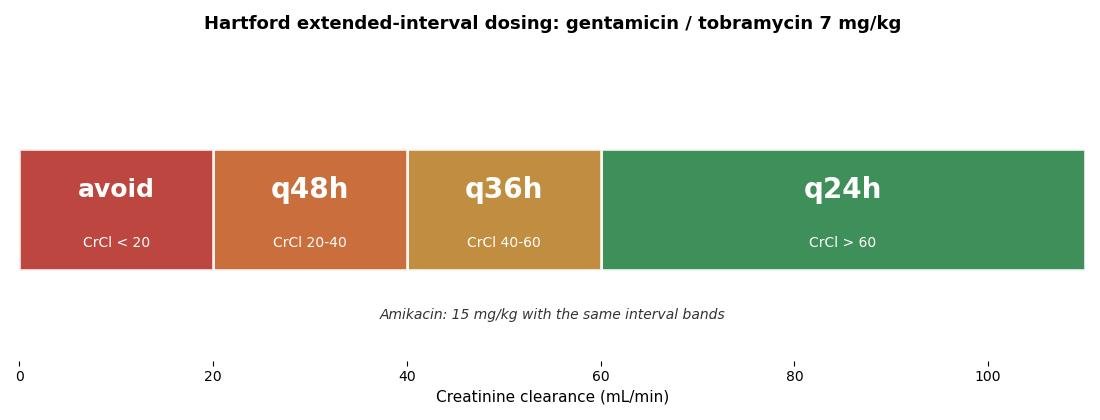
For extended-interval dosing the headline numbers are the single dose and the interval: 7 mg/kg for gentamicin or tobramycin, 15 mg/kg for amikacin, with the interval stretching from 24 to 36 to 48 hours as creatinine clearance falls. If you enter a random level drawn 6 to 14 hours after the first dose, the calculator reminds you to plot it on the Hartford nomogram: a level landing on or near the nomogram line means choosing the longer interval. For traditional dosing you get the volume of distribution, the elimination rate constant, the half-life, and the maintenance dose with its interval, plus patient-specific kinetics when you supply a measured peak and trough.
How the calculation works
Weight comes first. Ideal body weight uses the Devine equations: 50 kg plus 2.3 kg per inch over five feet for men, 45.5 kg plus 2.3 kg per inch over five feet for women. The 40% correction for obesity (adjusted = ideal + 0.4 x (actual - ideal)) is the standard compromise for hydrophilic drugs that do not enter adipose tissue well. Underweight patients are dosed on actual weight; nobody gets dosed below what they weigh.
The Hartford method exploits how aminoglycosides kill. They are concentration-dependent killers with a post-antibiotic effect: a high peak does the work, and bacteria stay suppressed even after levels fall. That pharmacodynamic profile is what makes a single large daily dose logical, giving a high peak for efficacy and a long drug-free trough for the kidneys and ears to recover. Nicolau and colleagues validated the approach in a once-daily program covering 2,184 adult patients, and it has been the default for most indications since.
The traditional Sawchuk-Zaske method is pure pharmacokinetics. It models the patient with two numbers: volume of distribution (about 0.27 L/kg of dosing weight) and the elimination rate constant, estimated from creatinine clearance as kel = 0.01 + 0.0024 x CrCl. From kel comes the half-life (0.693/kel), and from both comes the dose needed to hit the target peak and the interval that keeps the trough safe. When you feed in a real measured peak and trough, the calculator stops estimating and derives the patient's own kel and volume of distribution from the two levels, which is the whole point of therapeutic drug monitoring. Need the creatinine clearance first? Use our creatinine clearance (Cockcroft-Gault) calculator.
Extended interval or traditional: choosing the method
For most adult infections in patients with stable kidneys, extended-interval dosing wins on every axis: equal or better efficacy, less nephrotoxicity in trials, one level to draw instead of two, and simpler nursing. Traditional dosing survives for the situations where the Hartford assumptions break down. Endocarditis is the classic one: the synergy with a beta-lactam that cures enterococcal endocarditis depends on sustained aminoglycoside exposure, not a daily pulse. Pregnancy, dialysis, creatinine clearance below about 20 mL/min, ascites, and major burns all distort volume of distribution or clearance enough that the nomogram cannot be trusted, and traditional dosing with measured levels is the safer path.
Amikacin deserves a special note. It is reserved for resistant organisms, particularly where gentamicin and tobramycin modifying enzymes are suspected, and its doses run higher: 15 mg/kg extended-interval, or about 5 mg/kg per traditional dose, with higher target peaks (typically 20 to 30 mcg/mL) and troughs kept below 8. Do not extrapolate gentamicin targets to amikacin.
Monitoring, levels and toxicity
Level timing is everything. A traditional peak is drawn 30 minutes after a 30-minute infusion ends (roughly one hour after an intramuscular dose); the trough comes 30 minutes before the next dose. An extended-interval level is a single sample 6 to 14 hours after the start of the first infusion, plotted on the nomogram by hours post-dose. A mistimed level is worse than no level, because it generates false confidence, so the requisition must record the exact draw time relative to the dose.
The two toxicities to respect are nephrotoxicity and ototoxicity. Kidney injury is common, usually reversible, and usually announced by a rising creatinine a few days into therapy, which is why creatinine gets checked every two to three days on treatment. Ototoxicity is the one that keeps pharmacists awake: cochlear damage causes permanent sensorineural hearing loss, vestibular damage causes lasting imbalance, and neither reliably reverses when the drug stops. Risk climbs with duration beyond a week, high troughs, concurrent loop diuretics or vancomycin, pre-existing hearing loss, and renal impairment. Any tinnitus, hearing change or vertigo on therapy deserves immediate review, not reassurance.
Limitations of this calculator
- For clinician and pharmacist use. Doses must be checked against the local antimicrobial protocol before prescribing.
- Uses estimated creatinine clearance; in unstable renal function or extremes of muscle mass, a measured clearance is preferable.
- The Hartford nomogram is not validated for endocarditis, pregnancy, dialysis, CrCl below 20 mL/min, ascites or major burns.
- Target ranges shown are typical for serious infections; local guidelines and the specific indication may set different targets.
- Does not replace therapeutic drug monitoring: measured levels, interpreted by someone who knows the draw times, remain the standard for course adjustment.
Frequently asked questions
What is the Hartford nomogram for aminoglycosides?
The Hartford nomogram guides once-daily (extended-interval) aminoglycoside dosing. A single drug level drawn 6 to 14 hours after the first dose is plotted against time since the infusion started, and the position on the nomogram sets the interval at 24, 36 or 48 hours. It was validated in a once-daily program treating over two thousand adult patients (Nicolau and colleagues, 1995).
When should extended-interval aminoglycoside dosing be avoided?
Extended-interval dosing is generally avoided in endocarditis, pregnancy, significant renal impairment (creatinine clearance below about 20 mL/min), dialysis, ascites, major burns, and other situations with markedly altered volume of distribution. Traditional multiple-daily dosing with peak and trough monitoring is preferred there.
Why is adjusted body weight used for aminoglycoside dosing in obesity?
Aminoglycosides distribute poorly into adipose tissue, so dosing on total body weight in obesity would overdose the patient. When actual weight exceeds 120% of ideal body weight, an adjusted weight (ideal plus 40% of the excess) better reflects the drug's distribution space.
What are the target levels for gentamicin and tobramycin?
With traditional multiple-daily dosing, typical targets are a peak of 5 to 10 mcg/mL and a trough below 2 mcg/mL for serious infections. With extended-interval dosing, a single random level 6 to 14 hours after the dose is plotted on the Hartford nomogram instead of chasing a peak and trough.
What are the main toxicities of aminoglycosides?
Nephrotoxicity and ototoxicity. Kidney injury is usually reversible if caught early through creatinine monitoring. Ototoxicity can affect hearing (cochlear) or balance (vestibular) and is often irreversible, which is why prolonged courses need audiologic vigilance and drug-level monitoring.
How do you calculate the elimination rate for the Sawchuk-Zaske method?
The traditional method estimates the elimination rate constant as kel = 0.01 + 0.0024 times creatinine clearance in mL/min, with volume of distribution around 0.27 L/kg of dosing weight. When measured peak and trough levels are available, the calculator derives the patient's own kel and volume of distribution from the two levels instead.
Related adult dosing calculators
Sources: Nicolau DP, et al. Experience with a once-daily aminoglycoside program administered to 2,184 adult patients. Antimicrob Agents Chemother. 1995. Urban AW, Craig WA. Daily dosage of aminoglycosides. Curr Clin Top Infect Dis. 1997. Sarubbi FA, Hull JH. Amikacin serum concentrations. Ann Intern Med. 1978. Aminoglycoside Dosing Calculator. ClinCalc.