Carbamazepine TDM Calculator
This carbamazepine TDM calculator adjusts the daily dose from a measured steady-state serum concentration. It uses proportional dose adjustment and applies a 10 to 20 percent correction for autoinduction, the self-accelerating metabolism that makes carbamazepine unlike most other drugs. Enter the current dose, the measured level and the target below.
What your result means
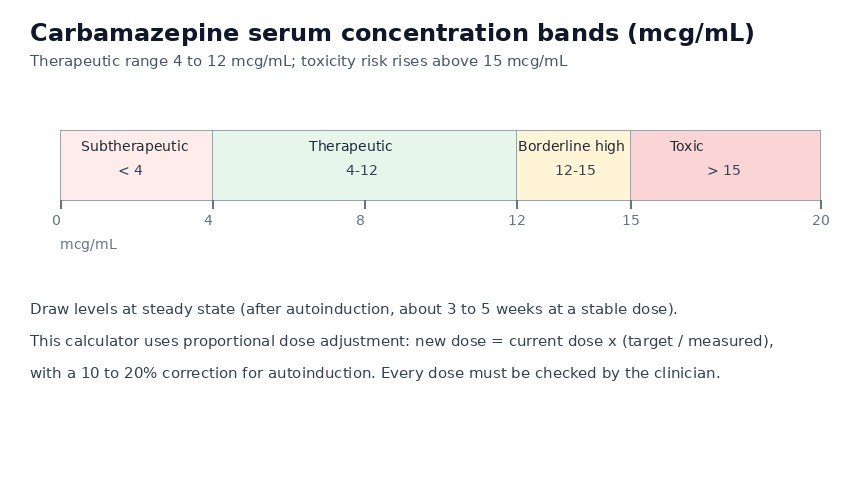
The headline number is your measured concentration, placed in one of four bands. Subtherapeutic means below 4 mcg/mL: seizures or mood symptoms may break through, so assess symptom control before raising the dose rather than chasing a number. Therapeutic, 4 to below 12 mcg/mL, means continuing the current dose is reasonable if the patient is seizure-free or stable and tolerating treatment. Borderline high, 12 to below 15 mcg/mL, calls for watching: nystagmus, double vision, dizziness or mild ataxia suggest the level is too high for that patient even inside the nominal ceiling, and a reduction is worth considering. Toxic, 15 mcg/mL and above, means reducing the dose, checking for new interacting drugs, and asking directly about symptoms of toxicity.
The calculator then shows two dose estimates. The linear estimate is the plain proportional answer: current dose multiplied by target divided by measured. With 800 mg/day and a measured level of 5 aiming at 8, that gives 1,280 mg/day. The autoinduction-adjusted dose is the one to act on: 10 to 20 percent more when the dose is going up, 10 to 20 percent less when the dose is going down, because carbamazepine clearance moves with the dose itself. So the 1,280 mg/day linear answer becomes about 1,472 mg/day after adjustment, with a working range of roughly 1,408 to 1,536 mg/day shown in the adjustment note.
How the calculation works
Carbamazepine follows roughly linear pharmacokinetics over the usual dosing range, which justifies the proportional adjustment at the heart of therapeutic drug monitoring: new dose = current dose x (target concentration / measured concentration). If the measured level is 5 and the target is 8, the dose scales by 8/5, or 1.6 times. This is the same proportionality used across TDM practice: at steady state, concentration rises and falls in proportion to the dose, provided clearance stays constant.
Clearance does not stay constant with carbamazepine, which is why the calculator applies the autoinduction correction. Raising the dose induces the metabolizing enzymes further, so the level rises less than proportionally and plain proportional scaling undershoots the dose needed; the calculator multiplies the increase by 1.15 and shows the 10 to 20 percent window (1.10 to 1.20 of the linear answer) so the clinician can pick within it. Lowering the dose de-induces the enzymes, so the level falls less than proportionally and plain scaling overshoots; the calculator multiplies by 0.85 and shows the 0.80 to 0.90 window. These corrections are a practical rule of thumb for a drug whose clearance is dose-dependent, not a substitute for rechecking the level after the change.
The validation is strict where it matters. The measured concentration must be above zero, because dividing by zero produces a meaningless infinite dose; the previous version of this page allowed zero through. All three of dose, measured level and target are required, and the target is constrained to the 4 to 12 mcg/mL therapeutic range. If the time at the current dose is under 3 weeks, a steady-state warning appears: autoinduction may not be complete, and the level is still drifting, so any adjustment now is built on moving ground.
Autoinduction: why carbamazepine dosing is unusual
Carbamazepine induces cytochrome P450 3A4, the major isoform that converts it to its 10,11-epoxide metabolite, so the drug accelerates its own clearance over the first weeks of therapy. According to the FDA-approved product label, autoinduction is completed after 3 to 5 weeks of a fixed dosing regimen. The numbers are striking: initial half-life values range from 25 to 65 hours, decreasing to 12 to 17 hours on repeated doses. In practice this means a level drawn in the first week or two on a starting dose will fall substantially by week four or five without any change in dosing, and a patient who looked therapeutic early on may need a dose increase once autoinduction completes.
Every dose change restarts the clock. Increasing or decreasing the dose shifts enzyme induction again, so levels should be rechecked only after the new regimen has had several weeks to settle, not days. The metabolite matters too: about 40 percent of the drug is converted to carbamazepine-10,11-epoxide, which is as pharmacologically active as the parent compound, and it is cleared by microsomal epoxide hydrolase. Anything that inhibits that enzyme, notably valproic acid, lets the active epoxide accumulate and can cause neurotoxicity at an apparently acceptable total level.
Carbamazepine is 76 percent bound to plasma proteins, leaving roughly a quarter free and active. The CSF to serum ratio of about 0.22 mirrors that free fraction. This matters because the laboratory reports the total level, and anything that changes binding, low albumin or a displacing drug like valproic acid, makes the total misleading while the free concentration climbs. In such situations the free level, where available, is the more honest guide.
Drug interactions that move carbamazepine levels
Three groups of interactions dominate carbamazepine monitoring. Enzyme inducers, phenytoin, phenobarbital and rifampin among them, increase carbamazepine clearance and push levels down; the calculator flags this combination so the lower-than-expected level is interpreted correctly. Valproic acid works the other way and is the trickiest partner: it inhibits carbamazepine metabolism, displaces it from protein binding so the free fraction rises, and inhibits epoxide hydrolase so the active 10,11-epoxide accumulates. The clinical trap is a "normal" total level with a toxic patient.
The reverse direction matters just as much. Inhibitors of CYP3A4 raise carbamazepine levels, and the product label names macrolide antibiotics such as erythromycin and clarithromycin, certain azole antifungals, verapamil, diltiazem and grapefruit juice among the agents to watch. These are common co-prescriptions: a course of clarithromycin for a chest infection can push a stable patient into toxicity within days. Carbamazepine also induces the metabolism of many other drugs, including combined oral contraceptives, warfarin and some antiretrovirals, so starting or stopping carbamazepine forces a review of the whole medication list, not just the level.
When to draw the level and what it represents
A carbamazepine level is only interpretable at steady state. That means after autoinduction has completed, about 3 to 5 weeks at a stable dose, and after any dose change has had a similar settling period. Drawing too early produces a falsely reassuring high level that then drifts down, or a falsely low one if drawn before absorption is complete. The trough, drawn immediately before the next scheduled dose, is the standard: it is the most reproducible point in the dosing interval and the one the therapeutic range was built around.
Formulation changes the timing. Per the product label, the suspension peaks at about 1.5 hours, conventional tablets at 4 to 5 hours, and extended-release tablets anywhere from 3 to 12 hours. Switching formulations on the same total daily dose can therefore change the peak-to-trough swing, and a level drawn at a different point in the interval after a switch is not comparable to the old one. Keep the formulation, the timing and the assay constant, and treat a single out-of-range level as a reason to repeat and review, not to reflexively change the dose.
Limitations of this calculator
- Proportional adjustment assumes linear pharmacokinetics; carbamazepine is only approximately linear, and the 10 to 20 percent autoinduction correction is a practical rule of thumb, not a validated nomogram. Always recheck the level after a change.
- The calculator works on the total level. It does not estimate the free concentration or the 10,11-epoxide level, both of which can drive toxicity when binding or epoxide clearance is altered (notably with valproic acid or low albumin).
- The therapeutic range is a population guide. Some patients need levels outside 4 to 12 mcg/mL for control, and sensitive patients can show toxicity inside it. Treat the patient, not the number.
- HLA-B*1502 (and HLA-A*3101) screening must happen before the first dose in at-risk patients; this calculator does not assess hypersensitivity risk.
- Carbamazepine can cause hyponatremia and serious blood dyscrasias; monitoring includes sodium and blood counts, not just drug levels.
- Not for overdose management: after intentional overdose, absorption is delayed and prolonged, peak levels may not appear for 6 to 24 hours, and there is enterohepatic recycling. Overdose needs emergency care.
Frequently asked questions
What is the therapeutic range for carbamazepine?
The generally accepted therapeutic range for total carbamazepine in plasma is 4 to 12 mcg/mL, the same for adults and children according to the FDA-approved product label. Individual patients may need levels above or below this range for seizure control, and toxicity can occasionally appear within it, so the range guides rather than dictates treatment.
Why did my carbamazepine level fall a few weeks after starting the same dose?
Carbamazepine induces its own metabolism (autoinduction), which is complete after about 3 to 5 weeks of a fixed dosing regimen. The half-life falls from 25 to 65 hours initially to 12 to 17 hours on repeated doses, so a level drawn in the first week will drift downward by week four or five on the same dose. This is why levels should be rechecked after autoinduction completes.
When should a carbamazepine level be drawn?
Draw the level at steady state, after autoinduction has completed (about 3 to 5 weeks at a stable dose), as a trough immediately before the next dose. After any dose change, wait until autoinduction re-equilibrates before rechecking. Peak times vary by formulation: about 1.5 hours for the suspension, 4 to 5 hours for conventional tablets, and 3 to 12 hours for extended-release tablets.
What does valproic acid do to carbamazepine levels?
Valproic acid inhibits carbamazepine metabolism, displaces carbamazepine from plasma protein binding, and inhibits the enzyme that clears the active 10,11-epoxide metabolite. The result can be neurotoxicity from the free drug and the epoxide even when the total carbamazepine level looks normal, so free levels and clinical signs matter more than the total number in this combination.
What carbamazepine level is toxic?
Levels above about 15 mcg/mL warrant dose reduction, and the risk of serious toxicity climbs with higher concentrations. Signs include nystagmus, double vision, ataxia, drowsiness, confusion, coma, seizures and QRS widening on the ECG. Suspected toxicity is an emergency and needs urgent clinical assessment, not a calculator.
Is genetic testing needed before starting carbamazepine?
The FDA label carries a boxed warning: patients of Asian ancestry should be tested for the HLA-B*1502 allele before starting carbamazepine because of the risk of Stevens-Johnson syndrome and toxic epidermal necrolysis. HLA-A*3101 is associated with the same risk in other populations. Testing is done before the first dose, never after a reaction has started.
Related adult dosing calculators
Sources: Carbamazepine extended-release tablets, FDA-approved product label (DailyMed): therapeutic range 4-12 mcg/mL, autoinduction complete after 3-5 weeks, half-life 25-65 h falling to 12-17 h, CYP3A4 metabolism, 76% protein bound. Carbamazepine Toxicity, StatPearls (NCBI Bookshelf): toxicity risk and clinical features.