Valproic Acid Level Calculator
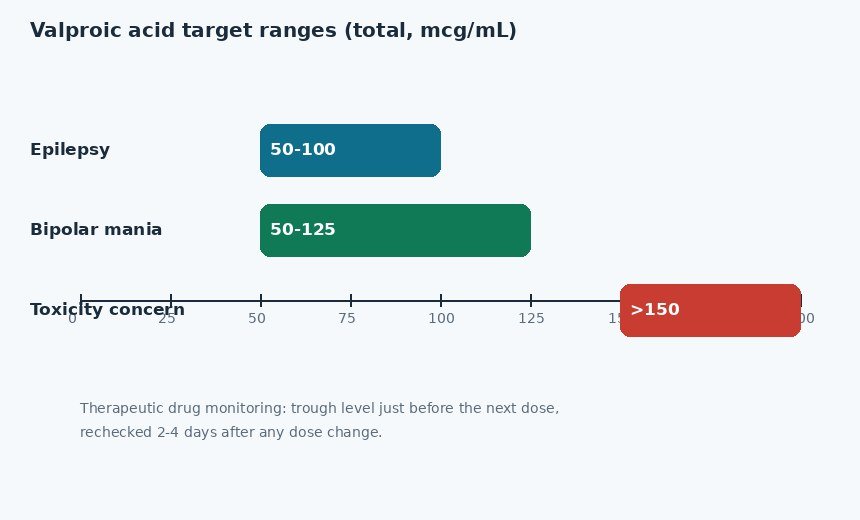
This valproic acid level calculator interprets a total VPA concentration against the right target range for the indication (50 to 100 mcg/mL for epilepsy, 50 to 125 mcg/mL for acute bipolar mania), computes the proportional dose correction to reach a chosen target, estimates the starting and loading doses from body weight, and warns when low albumin, old age or organ dysfunction makes the total level underestimate the active free drug.
What your result means
The result panel leads with the interpretation band for the measured level, then the proportional dose correction. For a 70 kg adult treated for epilepsy with a trough of 35 mcg/mL on 1,000 mg per day and a target of 75 mcg/mL, the calculator reports a subtherapeutic level and a corrected dose of about 2,150 mg per day (1,000 x 75/35), flagging that this is under the 60 mg/kg/day maximum of 4,200 mg. For the same patient with a level of 120 mcg/mL on 1,500 mg per day, it reports a supratherapeutic level and a corrected dose of about 938 mg per day. When no level is available, it gives the labeling starting range instead: 10 to 15 mg/kg/day, which is 700 to 1,050 mg per day for a 70 kg adult. If albumin is entered below 3.5 g/dL, or age 65+ or organ disease is selected, a free-fraction warning appears alongside every number, because the total level is then an underestimate of the active drug.
How the valproic acid calculator works
Interpretation is a band check: the measured total level is compared against the indication's range, and levels above 150 mcg/mL are flagged as a toxicity concern because adverse effects climb steeply there. The dose correction is one proportion: new daily dose = current daily dose x (target level / measured level). It assumes the level is a true steady-state trough and that protein binding has not changed; both assumptions are stated in the result because both are frequently wrong in real patients. The starting dose uses the labeling range of 10 to 15 mg/kg/day, and the loading dose uses 20 mg/kg intravenously for status epilepticus (hospital use only), the regimen shown to achieve about 80 mg/L rapidly.
Rounding is to the nearest 25 mg, roughly the size of a tablet split, and the corrected dose is capped with a warning at the labeling maximum of 60 mg/kg/day. A correction that lands above that maximum is reported with an explicit "exceeds maximum" flag rather than a silently trimmed number, because the right response is a clinical review, not a quieter number.
The two target ranges: epilepsy versus mania
The 50 to 100 mcg/mL range for epilepsy comes from the FDA labeling: most patients with epilepsy are controlled in this range, though some need lower or higher concentrations. For acute bipolar mania the evidence base is the Depakote trials, which titrated to trough concentrations of 50 to 125 mcg/mL with a starting dose of 750 mg per day in divided doses (or 25 mg/kg/day of the extended-release form), increasing as quickly as tolerated. The higher ceiling for mania reflects the trials, not a claim that higher is better: the lowest dose producing the desired effect remains the goal, and the calculator's default target of 75 sits in the middle of both ranges for that reason.
Migraine prophylaxis, the third labeled use, starts at 500 mg once daily of the extended-release form and may go to 1,000 mg per day; no plasma-level target is established for migraine, so this calculator's level interpretation applies to epilepsy and mania only.
Protein binding: why the total level can lie
Valproate is about 90 percent bound to albumin at therapeutic levels, and only the unbound 10 percent crosses into the brain. That binding is concentration-dependent: the free fraction rises from roughly 10 percent at 40 mcg/mL to 18.5 percent at 130 mcg/mL, so doubling the total level more than doubles the active drug. Anything that reduces binding, hypoalbuminemia, old age, liver or kidney disease, or displacement by other highly bound drugs, raises the free fraction further. A total level of 60 mcg/mL with albumin 2.2 g/dL can carry the free drug of a far higher total in a healthy patient; treating the number instead of the patient risks toxicity from a "therapeutic" level, or undertreatment from a "subtherapeutic" one.
Hermida and Tutor (2005) published a method for normalizing the total concentration in hypoalbuminemic patients, and the calculator's prose cites it, but the correction is not built into the tool: normalization is only valid for total levels below 75 mcg/mL and requires the laboratory's own binding data. When albumin is low, the calculator warns and the right move is a measured free valproate level, not a fancier equation.
Starting, loading, and maximum doses
For epilepsy, the labeling starts 10 to 15 mg/kg/day in 2 to 3 divided doses, increasing by 5 to 10 mg/kg/week until seizures are controlled or side effects appear, with 60 mg/kg/day as the ceiling (no safety data above it). For acute mania, 750 mg per day in divided doses (delayed-release) or 25 mg/kg once daily (extended-release) is the labeled start, pushed up as quickly as tolerated. An oral loading strategy of 20 mg/kg/day has been used to reach therapeutic levels by day 3 in acute mania, and 30 mg/kg/day for two days followed by 20 mg/kg/day reached target in most patients in one study, but loading is a hospital decision, not a home start.
For status epilepticus, intravenous valproate 20 to 25 mg/kg loads rapidly to therapeutic concentrations and is an accepted second-line option when benzodiazepines fail. The calculator reports the weight-based loading dose for reference and labels it hospital-only, because the infusion rate, monitoring and airway readiness around it are not calculator decisions.
| Situation | Dose | Notes |
|---|---|---|
| Epilepsy start | 10-15 mg/kg/day divided | Increase 5-10 mg/kg/week; max 60 mg/kg/day |
| Acute mania start | 750 mg/day divided (or 25 mg/kg/day ER) | Titrate rapidly to effect or target level; max 60 mg/kg/day |
| Oral loading (mania) | 20 mg/kg/day | Hospital decision; achieves ~80 mg/L quickly |
| IV loading (status epilepticus) | 20-25 mg/kg IV | Hospital only, with monitoring |
When to draw the level
Valproate's half-life is 9 to 16 hours in adults, so steady state arrives in about 2 to 3 days; the labeling-based practice is to check a trough level (just before the next dose) 2 to 4 days after starting or changing the dose. Recheck after adding or stopping interacting drugs: enzyme inducers such as carbamazepine, phenytoin and phenobarbital lower valproate levels, while inhibitors raise them, and valproate itself inhibits the metabolism of drugs like lamotrigine and phenobarbital. Also recheck in pregnancy (levels fall), in old age (free fraction rises while total looks unchanged), and whenever efficacy fades or toxicity is suspected.
Limitations of this calculator
- The proportional dose correction assumes linear pharmacokinetics, but valproate clearance rises as binding saturates; large corrections should be staged and rechecked.
- It interprets total levels only. In hypoalbuminemia, old age, pregnancy, or liver or kidney disease, the total level underestimates the free drug; measure free valproate when these apply.
- The albumin warning is qualitative. It does not apply the Hermida-Tutor normalization, which is only validated for total levels below 75 mcg/mL.
- It does not cover children (different mg/kg ranges and formulations), the elderly frail (lower starting doses are usual in practice), or drug interactions; valproate raises lamotrigine and phenobarbital levels and is lowered by carbapenem antibiotics among others.
- Target ranges are population guides. Some patients are controlled below 50 or need above 100 mcg/mL; clinical response and side effects decide the final target.
Frequently asked questions
What is the therapeutic range for valproic acid?
For epilepsy the commonly used range is 50 to 100 mcg/mL of total valproate; for acute bipolar mania, clinical studies targeted trough concentrations of 50 to 125 mcg/mL. Some patients are controlled below or above these ranges, so the level guides dosing but the clinical response decides.
How do you adjust a valproic acid dose from a measured level?
New daily dose = current daily dose x (target level / measured level). For example, a patient on 1,000 mg/day with a level of 35 mcg/mL and a target of 75 mcg/mL needs about 2,150 mg/day. The adjustment assumes steady state and unchanged protein binding; recheck the level 2 to 4 days after any change.
Why can a normal valproic acid level still mean toxicity?
Only the free (unbound) valproate works, and the free fraction is normally about 10 percent but rises in hypoalbuminemia, old age, liver or kidney disease, and at high total levels (up to 18.5 percent at 130 mcg/mL). A total level of 60 mcg/mL in a patient with albumin 2.2 g/dL can carry the same free drug as a much higher total level in a healthy patient, so free levels should be measured when albumin is low.
What is the starting dose of valproic acid?
For epilepsy, start 10 to 15 mg/kg/day in 2 to 3 divided doses, increasing by 5 to 10 mg/kg/week to clinical effect, up to a maximum of 60 mg/kg/day. For acute mania, the labeling starts 750 mg/day in divided doses (or 25 mg/kg/day of the extended-release form), titrating as quickly as tolerated toward the target level.
What is the valproic acid loading dose?
For status epilepticus, valproate is loaded intravenously at 20 to 25 mg/kg (hospital use, infused over the recommended time), which rapidly achieves therapeutic concentrations. A 20 mg/kg oral loading strategy has also been used for acute mania to reach about 80 mg/L quickly. Loading is not routine for starting maintenance therapy.
When should a valproic acid level be drawn?
Draw a trough level just before the next dose, 2 to 4 days after starting or changing the dose (about 4 to 5 half-lives; valproate half-life is 9 to 16 hours in adults). Also recheck after adding or stopping interacting drugs (enzyme inducers like carbamazepine and phenytoin lower it; inhibitors raise it), and whenever toxicity is suspected.
Sources
Target ranges and dosing: valproic acid FDA labeling via Drugs.com professional monograph (epilepsy 50-100 mcg/mL; free fraction 10% at 40 mcg/mL rising to 18.5% at 130 mcg/mL; start 10-15 mg/kg/day; max 60 mg/kg/day). Mania targets and starting doses: valproic acid monograph (trough 50-125 mcg/mL; 750 mg/day or 25 mg/kg/day ER). Albumin normalization method: Hermida J, Tutor JC. J Pharmacol Sci. 2005;97:489-493. doi:10.1254/jphs.fpe04007x.