Lithium Dosing Calculator
This lithium dosing calculator estimates the maintenance dose of lithium carbonate from kidney function. It derives fat-free mass with the Janmahasatian equation, estimates creatinine clearance with Cockcroft-Gault, converts that to lithium clearance with the Winter approximation, and computes the daily dose for your target level, split across your chosen interval and formulation. It also adjusts an existing regimen from a measured 12-hour trough level.
What your result means
The result panel starts with your target level and its interpretation band, then the three numbers the dose is built on: the Janmahasatian fat-free mass, the Cockcroft-Gault creatinine clearance, and the Winter lithium clearance. Below that comes the recommended daily dose in milligrams of lithium carbonate, the per-dose amount for your chosen interval, the estimated half-life, and the days to steady state. For a 45-year-old man weighing 70 kg, 175 cm tall, with a creatinine of 1.0 mg/dL targeting 0.8 mEq/L with immediate-release tablets twice daily, the calculator reports a fat-free mass of about 55.9 kg, a creatinine clearance of about 73.7 mL/min, a lithium clearance of about 1.11 L/hr, a daily dose of about 784 mg (about 392 mg every 12 hours), a half-life of about 24.5 hours, and steady state in about 5 days. For a 65-year-old woman weighing 60 kg, 160 cm tall, with a creatinine of 1.2 mg/dL targeting 0.6 mEq/L with extended-release once daily, the report is a fat-free mass of about 38.4 kg, a clearance of about 28.3 mL/min, a daily dose of about 251 mg, a half-life of about 43.8 hours, and steady state in about 9 days, which shows how age and renal function stretch the whole timeline. If you supplied a measured level and current dose, the panel derives the patient's own lithium clearance and gives an adjusted daily dose, which is the most trustworthy number on the page because it comes from the patient rather than a population model.
How the lithium dosing calculator works
Lithium is unusual among psychiatric drugs in that its dosing is pure pharmacokinetics: it is not metabolised, it is not protein-bound, and it is excreted unchanged by the kidneys. That means the dose that produces a given level is almost entirely a function of how fast the kidneys clear it, and the calculator builds its answer in four steps.
Step one is fat-free mass by the Janmahasatian equation: FFM = 9270 x weight / (6680 + 216 x BMI) for men and 9270 x weight / (8780 + 244 x BMI) for women, with BMI from weight and height. Lithium distributes in total body water, which tracks lean tissue rather than fat, so fat-free mass is a better size descriptor than total weight, especially in obesity. Using total body weight in an obese patient would overestimate clearance and suggest a dose that is too high.
Step two is creatinine clearance by Cockcroft-Gault, CrCl = (140 - age) x FFM / (72 x serum creatinine), multiplied by 0.85 for women. The fat-free mass goes into the equation, not total weight, for the same reason as above. A stable creatinine over the past few days matters: the estimate assumes steady-state renal function, and lithium is dangerous precisely when renal function is not stable.
Step three is lithium clearance by the Winter approximation: LiCl = 0.25 x CrCl, converted to litres per hour. Lithium is reabsorbed in the proximal tubule alongside sodium, and empirically its clearance runs at about a fifth to a third of creatinine clearance; 0.25 is the standard working value. The maintenance dose then follows from the definition of clearance at steady state: dose (mEq/day) = target (mEq/L) x LiCl (L/hr) x 24 / F, where F is 1.0 for immediate-release and 0.9 for extended-release. Because lithium carbonate is the salt actually prescribed, the calculator converts milliequivalents to milligrams with 1 mEq Li = 36.95 mg lithium carbonate, so the worked example above needs about 21.2 mEq/day, which is about 784 mg of lithium carbonate per day.
Step four splits the daily dose across the interval you chose. The daily total divided by 24/tau gives the per-dose amount: about 392 mg every 12 hours, about 261 mg every 8 hours, or the full daily amount once daily for the example patient. This per-dose split is new in this rewrite; the page it replaces computed an interval but echoed it without ever splitting the dose.
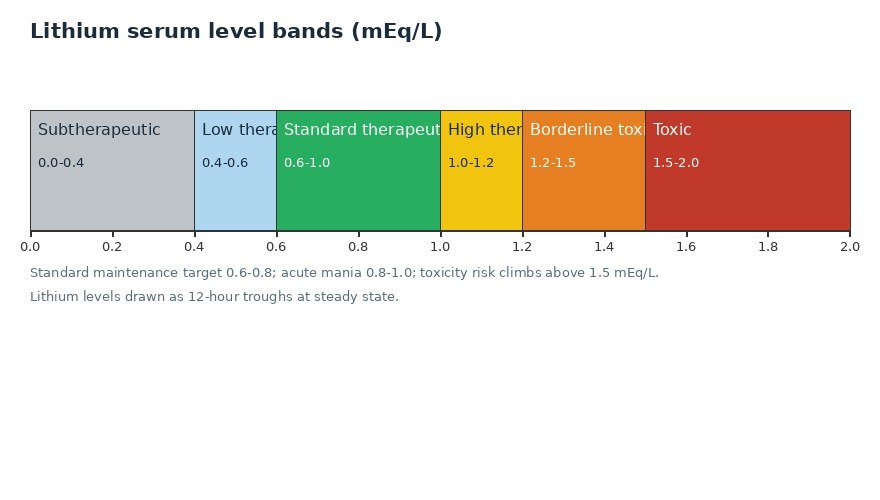
Target levels: maintenance versus acute mania
| Level (mEq/L) | Band | What it means |
|---|---|---|
| Below 0.4 | Subtherapeutic | Generally too low for prophylaxis; consider increase |
| 0.4-0.6 | Low therapeutic | May suit depression prophylaxis in sensitive patients |
| 0.6-1.0 | Standard therapeutic | Maintenance 0.6-0.8; acute mania up to 1.0 |
| 1.0-1.2 | High therapeutic | Acute mania range; monitor for toxicity |
| 1.2-1.5 | Borderline toxic | Reduce dose; check renal function and hydration |
| Above 1.5 | Toxic | Hold dose; urgent clinical assessment |
The target you choose should match the clinical job. Long-term prophylaxis of bipolar disorder typically aims at 0.6 to 0.8 mEq/L, which balances relapse prevention against the renal and thyroid burden of decades of therapy. Acute mania aims higher, 0.8 to 1.0, because the therapeutic effect needs to arrive quickly and the higher end of the band is tolerated short-term. Above 1.0 the benefit curve flattens while the toxicity curve steepens, which is why the calculator flags 1.0 to 1.2 as high therapeutic rather than routine, and treats anything above 1.2 as a warning.
Why lithium clearance follows the kidney so closely
Lithium is a small monovalent cation handled by the kidney much like sodium: freely filtered at the glomerulus and substantially reabsorbed in the proximal tubule. The net result is that lithium clearance is roughly a quarter of creatinine clearance in most patients. This is why lithium is the classic narrow-index drug of psychiatry: any fall in glomerular filtration raises the level, and the level rises before the creatinine does, because the same filtration change that moves creatinine by a little moves lithium by a lot relative to its narrow band.
The drugs and states that reduce lithium clearance are worth memorising because they ambush stable patients: thiazide and loop diuretics, NSAIDs, ACE inhibitors and angiotensin-receptor blockers, dehydration from any cause (gastroenteritis, heat, excessive sweating), and low-salt diets, which make the tubule reabsorb more lithium in place of sodium. Starting any of these in a patient on lithium calls for a level check within days, not weeks. Age matters twice over: the elderly clear lithium more slowly through age-related renal decline, and they have a smaller volume of distribution from loss of lean mass, both of which push levels up for the same dose. The second worked example above, a 65-year-old woman with a half-life near 44 hours, is the typical picture.
Immediate-release versus extended-release, and the interval
The formulation changes the shape of the level curve, not the total daily dose. Immediate-release lithium is usually given two or three times daily to avoid sharp peaks; extended-release is given once or twice daily because it releases the drug more slowly. The calculator applies a 0.9 factor for extended-release in its dose equation, reflecting the slightly lower effective exposure in the original modelling, and then splits the daily total across the interval selected: Q8H gives three doses, Q12H two, Q24H one. In practice the daily total is rounded to what the tablets allow, standard immediate-release tablets are 300 mg (8.12 mEq), so the worked example's 784 mg/day becomes a practical regimen like 300 mg in the morning and 450 to 600 mg at night only after clinician review and level confirmation. Never switch formulation or interval casually: the same milligrams behave differently when the release profile changes.
Adjusting the dose from a measured level
The most reliable number in lithium therapy is the patient's own clearance, derived from a steady-state level on a known dose. The standard draw is a 12-hour trough, 12 hours after the evening dose, taken at steady state after about 5 half-lives of unchanged dosing, which the calculator estimates for you. The derivation is simple: patient LiCl (L/hr) = (F x current daily dose in mEq / 24) / measured level, and the new daily dose is target x patient LiCl x 24 x 36.95 / F mg/day. For example, a patient on 900 mg/day of immediate-release lithium (24.4 mEq/day) with a 12-hour trough of 0.6 mEq/L has a personal clearance of about 1.69 L/hr; retargeting to 0.8 mEq/L gives about 32.5 mEq/day, or about 1,200 mg/day, a proportional increase because lithium kinetics are linear. The page this replaces had a unit error here: it treated the current daily dose as the per-interval dose, so its adjusted dose was wrong for every interval except Q24H. That is fixed in this rewrite.
Two cautions. First, a level drawn during a dose change, after missed doses, during dehydration or acute illness, or at the wrong time does not represent steady state, and adjusting from it will mislead. Second, proportionality has limits: at higher levels the kidney's handling changes and toxicity impairs renal function, so large upward adjustments from high measured levels need clinical supervision, not arithmetic.
Lithium toxicity: what to watch for
Toxicity tracks the level but is not defined by it alone: the elderly, the dehydrated, and patients with renal impairment can be toxic at levels that look acceptable. Early signs are polyuria and polydipsia, nausea, and a fine hand tremor. As levels climb into the 1.2 to 1.5 range, the tremor coarsens, confusion and slurred speech appear, and muscle weakness sets in. Above about 2.0 to 2.5 mEq/L, seizures, coma and acute kidney injury become the concern, and severe poisoning may need haemodialysis, which removes lithium effectively because the ion is small and unbound.
The practical defences are boring and they work: keep hydration steady, keep salt intake steady, check levels on schedule, recheck a few days after starting or stopping any interacting drug, and hold the dose and seek urgent review at the first signs of toxicity. Lithium is one of the few psychiatric drugs where the monitoring schedule is the treatment as much as the tablet is.
Monitoring beyond the level
Long-term lithium therapy needs more than drug levels. Renal function (creatinine and estimated GFR) is checked regularly because chronic lithium can cause nephrogenic diabetes insipidus and, over years, chronic kidney disease. Thyroid function is checked because lithium commonly causes hypothyroidism and can cause hyperthyroidism. Calcium is checked because lithium can raise parathyroid hormone. Weight is tracked because weight gain is common. None of these replace the 12-hour trough, but a normal level with a rising creatinine is a warning that the dose's days are numbered.
Limitations of this calculator
- Population estimates, not the patient: Janmahasatian fat-free mass, Cockcroft-Gault and the Winter clearance are population tools. Measured steady-state 12-hour troughs interpreted by a clinician remain the standard for dose adjustment.
- The 0.25 Winter fraction and the 0.9 extended-release factor are working approximations from standard clinical pharmacokinetics texts, not measurements of the individual patient; real lithium clearance varies with sodium balance, age and renal tubular function.
- Cockcroft-Gault assumes a stable creatinine and average muscle mass. In acute kidney injury, extremes of muscle mass, sarcopenic elderly patients, or rapidly changing renal function, a measured creatinine clearance is preferable.
- The calculator gives starting estimates and proportional adjustments. Initiation, titration and toxicity management need clinical supervision; loading doses are not part of lithium therapy and are not offered here.
- Drug interactions are described, not modelled: the calculator does not adjust for thiazides, NSAIDs, ACE inhibitors or other drugs that change lithium clearance.
- This calculator is for adults only and does not cover paediatric dosing, which follows different rules.
Frequently asked questions
What lithium level should I target?
Standard maintenance targets are 0.6 to 0.8 mEq/L, with up to 1.0 accepted in acute mania where a stronger effect is needed. Levels below 0.4 are generally subtherapeutic, 1.2 to 1.5 is borderline toxic, and above 1.5 is toxic. This calculator interprets your chosen target against these bands before computing the dose.
When should a lithium level be drawn?
The standard is a 12-hour trough: drawn 12 hours after the evening dose, at steady state (after about 5 half-lives of regular dosing, roughly 5 days with normal kidneys). Levels drawn earlier, during dose changes, or after missed doses do not represent steady state and cannot be used for dose adjustment.
Why does lithium dosing depend on kidney function?
Lithium is not metabolised; it is excreted unchanged by the kidneys at roughly a quarter of the creatinine clearance rate. Anything that lowers glomerular filtration, dehydration, thiazide diuretics, NSAIDs, ACE inhibitors, raises the lithium level for the same dose. This calculator derives lithium clearance directly from the Cockcroft-Gault creatinine clearance.
What are the early signs of lithium toxicity?
Early signs include increased thirst and urination, nausea, fine hand tremor, and drowsiness. Moderate toxicity brings coarse tremor, confusion, slurred speech and muscle weakness; severe toxicity (usually above 2.0 to 2.5 mEq/L) can cause seizures, coma and acute kidney injury. Any suspected toxicity is an emergency and the dose should be held.
Can I switch between immediate-release and extended-release lithium?
The total daily dose in milligrams is the same, but the interval differs: immediate-release lithium is usually given twice or three times daily, extended-release once or twice daily. This calculator applies a 0.9 factor for extended-release in its dose equation and splits the daily dose across your chosen interval. Never change formulation or interval without clinician review.
How long until lithium reaches a steady level?
Steady state takes about 5 half-lives. With the typical 20 to 24 hour half-life in a young adult with normal kidneys, that is roughly 5 days; in the elderly or in renal impairment the half-life lengthens to 36 hours or more, so steady state can take a week or longer. The calculator estimates the half-life from your inputs and reports the days to steady state.
Related adult dosing calculators
Sources: Janmahasatian S, Duffull SB, Ash S, Ward LC, Kirby BJ. Quantification of lean bodyweight. Clin Pharmacokinet. 2005;44(10):1051-1065. Lithium clearance as a fraction of creatinine clearance, the 12-hour trough standard, and therapeutic ranges follow the Winter clinical pharmacokinetics method and standard psychopharmacology references. Level bands: maintenance 0.6-0.8 mEq/L, acute mania 0.8-1.0, toxicity above 1.5 mEq/L.