Theophylline Dose Calculator
This theophylline dose calculator gives the loading dose, the continuous-infusion rate and the daily dose for a target serum theophylline level, adjusted for age and for the conditions that slow theophylline clearance. The infusion rates come straight from the FDA-approved labeling table (the rates that achieve about 10 mcg/mL, scaled to your target level), and the calculator warns when the computed daily dose exceeds the labeling maximum for the age or condition group.
What your result means
The result panel leads with the maintenance infusion rate in mg per hour and the total daily dose, because theophylline is usually run as a continuous infusion once a loading dose has been given. For a healthy 70 kg non-smoking adult aged 16 to 60 with a target of 10 mcg/mL, the calculator reports 28 mg per hour, which is 672 mg over 24 hours: the labeling rate of 0.4 mg/kg/hr times 70 kg. Raise the target to 15 mcg/mL and the rate scales proportionally to 42 mg per hour (1,008 mg per day), but that crosses the labeling maximum of 900 mg per day for this age group, so the calculator raises a warning rather than silently exceeding it. The loading dose for the same patient with no theophylline on board is 350 mg as theophylline (0.5 L/kg x 70 kg x 10 mcg/mL), or 437.5 mg expressed as aminophylline.
How the theophylline dose calculator works
Two separate pharmacokinetic ideas combine in the result. The loading dose fills the body up to the target level at once: loading dose = 0.5 L/kg x weight x (target - current level). The 0.5 L/kg is the average volume of distribution of theophylline, the fluid volume the drug appears to dissolve into. If a current level is already present, only the gap to the target is filled; if the current level already exceeds the target, no loading dose is needed and the calculator says so.
The maintenance rate replaces what the liver removes each hour: infusion rate = clearance x target level. The labeling expresses this as ready-made mg/kg/hr rates that produce about 10 mcg/mL, so the calculator looks up the rate for the age band or condition and multiplies by target/10 for any other target. A 70 kg adult at 0.4 mg/kg/hr gets 28 mg/hr for a target of 10, or 42 mg/hr for a target of 15. The rate is linear in the target because the labeling rates were built that way; at very high targets the calculator still warns, because linearity is an approximation and levels confirm the reality.
Clearance varies with age and disease: the rate table
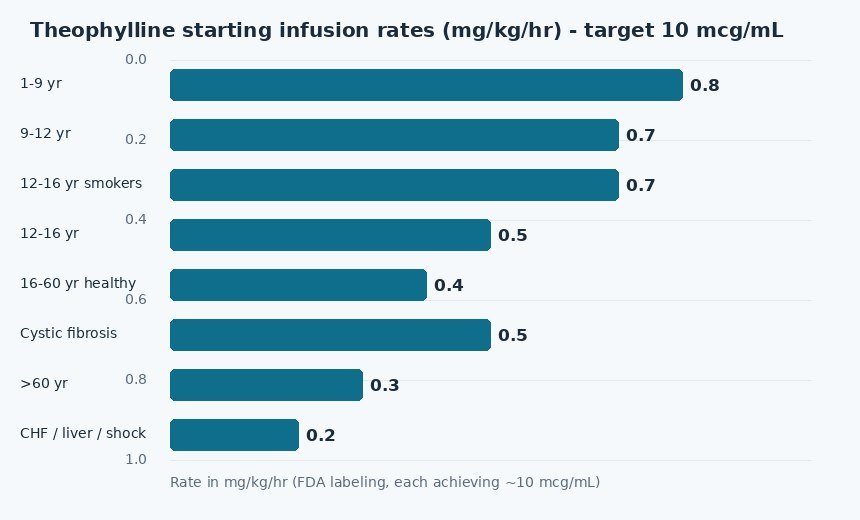
Theophylline clearance is highest in young children and falls with age and with any illness that reduces liver blood flow or enzyme activity. The labeling table (DailyMed) reports mean clearance of 1.7 mL/kg/min in children aged 1 to 4 (about 0.1 L/kg/hr), 0.65 mL/kg/min in healthy non-smoking adults aged 16 to 60 (about 0.04 L/kg/hr), 0.41 mL/kg/min over age 60, 0.31 in cirrhosis and 0.33 in acute pulmonary oedema. Those clearance values are exactly what the infusion-rate table converts into: 0.8 mg/kg/hr for ages 1 to 9, 0.7 for 9 to 12, 0.5 for non-smoking adolescents 12 to 16, 0.4 for healthy adults 16 to 60, 0.3 over 60, and 0.2 for cardiac decompensation, cor pulmonale, liver dysfunction, sepsis with multi-organ failure or shock.
Half-lives follow the same pattern. A healthy adult clears a dose with a half-life of about 8.7 hours, an elderly patient about 9.8 hours, but cirrhosis stretches it to about 32 hours and acute pulmonary oedema to about 19 hours. The long half-life in liver disease is why a level drawn too early misleads: steady state needs roughly five half-lives, which in cirrhosis means the better part of a week. The calculator reports the typical half-life for the selected group so the timing of the first level check makes sense.
| Group | Starting rate (mg/kg/hr)* | Max daily dose* | Typical half-life |
|---|---|---|---|
| Children 1 to 9 years | 0.8 | 600 mg | 3.4 h |
| Children 9 to 12 years | 0.7 | 600 mg | ~4 h |
| Adolescents 12 to 16, non-smokers | 0.5 | 900 mg | ~4 h |
| Adolescents 12 to 16, smokers | 0.7 | 900 mg | ~4 h |
| Adults 16 to 60, healthy non-smokers | 0.4 | 900 mg | 8.7 h |
| Adults over 60 | 0.3 | 400 mg | 9.8 h |
| CHF, cor pulmonale, liver dysfunction, sepsis/MOF, shock | 0.2 | 400 mg | 19 to 32 h |
| Cystic fibrosis | 0.5* | 900 mg | 6.0 h |
* To achieve a target of 10 mcg/mL; maximums apply unless serum levels indicate the need for a larger dose. Source: theophylline FDA labeling (DailyMed). The cystic fibrosis row uses the labeling clearance (1.25 mL/kg/min, roughly double the adult value) translated into an equivalent rate; a level must confirm it.
The therapeutic range and why levels are checked
The accepted therapeutic range for theophylline is 10 to 20 mcg/mL. Below 10, bronchodilation is usually inadequate; above 20, nausea, vomiting, tremor and tachycardia become common; above 30, seizures and life-threatening arrhythmias can occur without much warning, and seizures from theophylline can be refractory. Because clearance varies several-fold even among healthy people, the same mg/kg dose lands different patients at very different levels, so a level is drawn once steady state is reached and after every dose change or interacting-drug change.
The narrow range also explains the labeling maximums: 900 mg per day for healthy adolescents and adults, 400 mg per day for the elderly and for the impaired-clearance group, unless a measured level shows more is needed. These caps are not efficacy limits; they are guardrails against the accumulation that a slow clearer cannot handle. When the calculator's computed daily dose crosses a cap, the warning it shows is telling you to start lower and let the level, not the arithmetic, decide.
Drug interactions that change theophylline clearance
Theophylline is metabolised mainly by the liver enzyme CYP1A2, with contributions from CYP2E1 and CYP3A4, so inducers and inhibitors of these enzymes move levels substantially. Cimetidine, ciprofloxacin, erythromycin and clarithromycin, fluvoxamine, oral contraceptives and allopurinol slow clearance and can push a stable level into toxicity; the labeling specifically warns that lower initial doses may be needed with drugs like cimetidine. Going the other way, cigarette and marijuana smoking, phenytoin, carbamazepine, phenobarbital and rifampin speed clearance, so a smoker who quits, or a patient whose phenytoin is stopped, can see theophylline levels climb on an unchanged dose.
The practical rule is simple: recheck a level 2 to 3 days after starting or stopping any of these drugs, and after smoking cessation. The calculator cannot know the patient's drug list, so its result assumes no interacting drugs; the interaction section of the labeling is the reference to check against.
Limitations of this calculator
- The infusion rates are labeling starting rates for a 10 mcg/mL target scaled linearly; individual clearance varies widely, and measured levels override the calculation.
- It covers ages 1 year and up. Neonates and young infants use a different weight-and-age formula in the labeling (for example 1 mg/kg every 12 hours for postnatal age up to 24 days) and are not covered here.
- It assumes no interacting drugs and normal protein binding. Fever, acute viral illness and thyroid disease also alter clearance and half-life.
- The smoker adjustment (about 1.6-fold higher clearance) is an average estimate; the labeling table gives explicit smoker rates only for adolescents 12 to 16.
- Use ideal body weight for obese patients, as the labeling directs; dosing on total body weight overestimates the dose.
Frequently asked questions
What is the therapeutic range for theophylline?
The usual therapeutic range for theophylline is 10 to 20 mcg/mL. Levels above 20 mcg/mL increase the risk of nausea, tachycardia and tremor, and levels above 30 mcg/mL carry a risk of seizures and serious arrhythmias. Because the range between effective and toxic is narrow, serum levels are measured when starting, changing or interacting therapy.
How do you calculate a theophylline loading dose?
Loading dose (mg) = 0.5 L/kg x body weight (kg) x (target level - current level in mcg/mL). The 0.5 L/kg is the average volume of distribution of theophylline. For a 70 kg adult with no theophylline on board and a target of 10 mcg/mL, that is 350 mg. If the loading dose is given as aminophylline, divide by 0.8 (437.5 mg in this example) because aminophylline is 80 percent theophylline.
What infusion rate of theophylline should be used for a healthy adult?
The FDA labeling gives 0.4 mg/kg/hr for otherwise healthy non-smoking adults aged 16 to 60, which achieves a level of about 10 mcg/mL; the rate is scaled proportionally for a different target level. For a 70 kg adult targeting 10 mcg/mL that is 28 mg/hr, or about 672 mg per day.
Why is the theophylline dose lower in heart failure and liver disease?
Theophylline is cleared almost entirely by the liver, so any state that reduces hepatic blood flow or enzyme activity slows clearance and prolongs the half-life. In cardiac decompensation, cor pulmonale, liver dysfunction, sepsis with multi-organ failure or shock, the labeling drops the starting infusion rate to 0.2 mg/kg/hr with a 400 mg/day maximum until a level is checked, because standard rates would accumulate to toxic levels.
How do you convert between theophylline and aminophylline?
Aminophylline is the ethylenediamine salt of theophylline and contains about 80 percent theophylline by weight. To get the aminophylline dose, divide the theophylline dose by 0.8; to go the other way, multiply the aminophylline dose by 0.8. For example, 350 mg of theophylline equals about 438 mg of aminophylline.
Which drugs change theophylline levels?
Drugs that inhibit the liver enzymes clearing theophylline raise its level: ciprofloxacin, erythromycin and clarithromycin, cimetidine, fluvoxamine and oral contraceptives. Drugs that induce those enzymes lower it: cigarette smoking, phenytoin, carbamazepine, phenobarbital and rifampin. A level should be rechecked a few days after starting or stopping any of these.
Sources
Infusion-rate and clearance tables: theophylline FDA-approved labeling via DailyMed (Table I, mean clearance and half-life by age and altered physiological state; Table V/VI, infusion rates and final dosage adjustment). Therapeutic range 10-20 mcg/mL and the 0.5 L/kg volume of distribution are standard pharmacokinetic references used consistently across the labeling.