Digoxin Dosing Calculator
This digoxin dosing calculator plans loading and maintenance doses three ways: the Jelliffe total-body-stores method, the Jusko/Koup pharmacokinetic method, and Koda-Kimble clearance estimation. It corrects for the dosage form's bioavailability, interacting drugs and heart-failure severity, and can adjust an existing regimen from a measured level.
What your result means
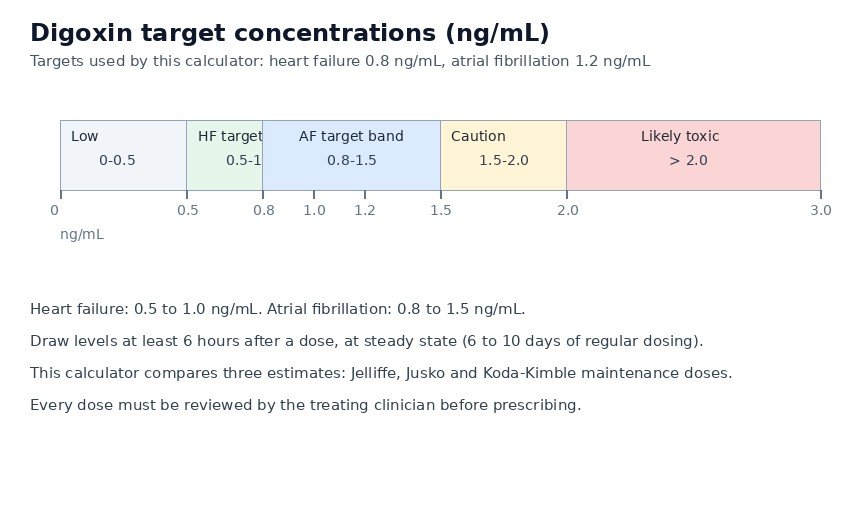
The result panel starts with the indication and its target: heart failure aims at 0.8 ng/mL (within the 0.5 to 1.0 band), atrial fibrillation at 1.2 ng/mL (within the 0.8 to 1.5 band). Below that, the three maintenance estimates are shown side by side. For a 70-year-old man weighing 70 kg with a creatinine of 1.2 mg/dL treated for heart failure with tablets, the calculator reports a Jelliffe maintenance dose of about 237 mcg/day, a Koda-Kimble estimate of about 149 mcg/day, and loading doses of 933 mcg (Jelliffe) and 482 mcg (Jusko). These are estimates, not prescriptions: the usual tablet strengths are 62.5, 125 and 250 mcg, so any estimate gets rounded to a practical regimen and confirmed with a level.
The panel also shows the intermediate pharmacokinetics the estimates are built on: the Cockcroft-Gault creatinine clearance, the estimated digoxin clearance in litres per day, the Jusko volume of distribution in litres, and the estimated half-life in hours. For the same 70-year-old, clearance is about 139.3 L/day, volume of distribution about 452 L, and half-life about 54 hours, which tells you steady state takes roughly 9 to 11 days. If you supplied a measured level and the current maintenance dose, the panel derives the patient's own clearance from those two numbers and gives an adjusted maintenance dose, which is the most trustworthy number on the page because it comes from the patient rather than a population model.
How the calculation works: three estimates
Every method starts from kidney function, because 50 to 70 percent of a digoxin dose is excreted unchanged in the urine and renal excretion is proportional to creatinine clearance. The calculator estimates creatinine clearance with Cockcroft-Gault, using ideal body weight when actual weight exceeds 120 percent of ideal, and the 0.85 factor for women. A stable creatinine over the past several days matters: the estimate assumes steady state, and a rising creatinine means the number is already out of date.
The Jelliffe method thinks in total body stores: the amount of digoxin in the body that produces the desired effect. The daily loss is 14 percent through nonrenal routes plus 0.20 percent per mL/min of creatinine clearance, so % lost per day = 14 + 0.20 x CrCl. Total body stores run 8 to 12 mcg/kg for the inotropic effect used in heart failure and 13 to 15 mcg/kg for the chronotropic effect used in atrial fibrillation, dropping to 6 to 10 mcg/kg when creatinine clearance is below 30 mL/min because renal disease shrinks the volume of distribution. The maintenance dose replaces exactly what is lost each day: D = TBS x (% lost per day) / (F x 100), and the loading dose is TBS / F, corrected for the dosage form's bioavailability.
The Jusko/Koup method builds a pharmacokinetic model instead. Volume of distribution comes from a creatinine-clearance-based equation scaled by body surface area: Vd = (226 + 298 x CrCl / (29.1 + CrCl)) x (BSA / 1.73), in litres. The loading dose then fills that volume to the target concentration: loading dose = Vd x target / F. The Koda-Kimble clearance estimates how fast the body removes the drug: Cl = (A x CrCl + B) in mL/min, converted to litres per day (x 1.44), with A = 1.0 and B = 40 normally, or A = 0.88 and B = 23 in moderate to severe heart failure where nonrenal clearance falls, multiplied by an interaction factor for quinidine, verapamil, spironolactone or amiodarone. The maintenance dose is then Cl x target / F per 24 hours. (An earlier version of this page multiplied the mL/min clearance by 24 instead of converting units, displaying roughly a 17-fold overdose; that error is fixed here.)
Half-life ties the two together: t1/2 = 0.693 x Vd / (Cl per hour). With normal kidneys it runs 1.5 to 2 days; in anuric patients it stretches to 3.5 to 5 days, which is why dose and interval both change in renal failure. Digoxin is not effectively removed by dialysis, so there is no dialyzing your way out of accumulation.
Why the three maintenance estimates differ
Disagreement between the methods is information, not a malfunction. Jelliffe keys off total body stores with fixed per-kilo targets, so it is most sensitive to the weight used and the indication band. Jusko keys off a modelled volume of distribution, so it moves with body surface area and creatinine clearance. Koda-Kimble keys off estimated clearance with the heart-failure and interaction corrections, so it shifts most when those factors are present. In the worked example above, Jelliffe says 237 mcg/day while Koda-Kimble says 149 mcg/day for the same patient, and the honest response is not to average them blindly but to pick a conservative starting regimen, usually 125 to 250 mcg daily in such a patient, and let a steady-state level arbitrate.
That is also why the calculator offers dose adjustment from a measured level. The patient's own clearance, derived as (current dose x F / measured level) / 24 litres per hour, replaces all three population estimates at once. Measured-level adjustment is the core of therapeutic drug monitoring: models get you started safely, levels get you to the right dose.
Targets: heart failure versus atrial fibrillation
The target you aim at depends on what you want the drug to do. In heart failure the goal is a modest inotropic effect, and the DIG trial era taught that lower is better: the 0.5 to 1.0 ng/mL band is associated with benefit without the excess mortality seen at higher levels, and this calculator targets 0.8 ng/mL within it. In atrial fibrillation the goal is rate control, a chronotropic effect that needs more drug in the body, hence the 0.8 to 1.5 ng/mL band and the 1.2 ng/mL target. These are starting targets, not promises: an elderly patient with borderline potassium may be toxic at 1.2, while a young patient with atrial fibrillation may need the top of the band for rate control.
Bioavailability and why the dosage form matters
The same milligram is not the same dose in every formulation. Digoxin tablets are about 75 percent bioavailable, capsules about 95 percent, the elixir about 80 percent, and intravenous digoxin is 100 percent by definition. The calculator divides every dose by F, the bioavailability factor, so switching a patient from 250 mcg of tablets to capsules without adjusting the dose would raise the effective exposure by more than a quarter. This is one of the commonest preventable causes of digoxin toxicity in practice: the formulation changes, the milligram dose stays the same, and the level climbs.
Interactions and patient factors that change the numbers
Four interacting drugs are built into the calculator because they are the ones most likely to ambush a stable patient: amiodarone (clearance factor 0.5), quinidine (0.65), verapamil (0.7) and spironolactone (0.75). Starting any of them typically calls for cutting the digoxin dose and rechecking the level, and stopping them calls for the reverse. Beyond the list, anything that lowers potassium or magnesium, loop and thiazide diuretics chief among them, makes a given digoxin level more toxic without changing the number, because hypokalaemia sensitizes the myocardium to digoxin. Hypothyroidism slows clearance; hyperthyroidism may blunt the effect.
Age changes the pharmacokinetics twice over. The elderly eliminate digoxin more slowly because of age-related renal decline, and they also have a smaller volume of distribution from loss of lean muscle mass, per the FDA label. Both changes push levels up for the same dose, which is why the label advises careful dose selection and monitoring in elderly patients. Women clear digoxin about 12 percent more slowly than men in studies, a difference the label notes is unlikely to be clinically important but is still worth knowing.
When to draw the level
Timing rules are strict because the pharmacokinetics are slow. Wait 6 to 10 days of regular daily dosing before the first level, which is 4 to 5 half-lives at the normal 1.5 to 2 day half-life, and longer in renal impairment. Draw no sooner than 6 hours after the most recent dose: before that, the drug is still distributing from blood into heart, skeletal muscle, liver and kidney, and the level reflects distribution rather than the steady-state concentration. A level drawn at 2 hours that looks high may be perfectly fine at 8 hours. Record the exact draw time relative to the dose on every requisition; a mistimed level is worse than no level.
Toxicity: what to watch for
Digoxin toxicity is common, under-recognized and potentially fatal, which is the entire reason therapeutic drug monitoring exists for this drug. Early signs are gastrointestinal and vague: nausea, loss of appetite, sometimes diarrhoea. The classic visual changes, yellow-green halos around lights, blurred or double vision, are more specific. Neurologic signs include confusion and weakness, and the cardiac signs are the dangerous ones: virtually any arrhythmia, from bradycardia and heart block to ventricular tachycardia. Toxicity becomes likely above about 2 ng/mL, but the number is not a shield: with low potassium, low magnesium or advanced age, patients can be toxic inside the therapeutic band. Severe poisoning is treated with digoxin-specific antibody fragments, and suspected toxicity is an emergency.
Limitations of this calculator
- Population models, not the patient: Jelliffe, Jusko and Koda-Kimble estimate from averages. Measured steady-state levels interpreted by a clinician remain the standard for dose adjustment.
- Cockcroft-Gault assumes a stable creatinine and average muscle mass. In acute kidney injury, extremes of muscle mass, or rapidly changing renal function, a measured clearance is preferable.
- Only four interacting drugs carry explicit factors. Many other drugs and conditions alter digoxin handling or toxicity risk; the calculator does not model hypokalaemia, hypomagnesaemia or thyroid disease.
- Target bands are starting points. Individual patients, particularly the elderly and those with electrolyte disturbances, may need lower targets.
- Loading doses are rarely given as a single bolus in modern practice; they are usually divided over 24 hours with clinical monitoring between aliquots.
- This calculator is for adults only and does not cover paediatric dosing, which follows different rules.
Frequently asked questions
What is the target digoxin level for heart failure versus atrial fibrillation?
This calculator targets 0.8 ng/mL for heart failure (within the 0.5 to 1.0 ng/mL band supported by the DIG trial) and 1.2 ng/mL for atrial fibrillation (within the 0.8 to 1.5 ng/mL band). Rate control in atrial fibrillation generally needs more drug in the body than the inotropic effect used in heart failure, hence the higher target.
Why does this calculator give three different maintenance dose estimates?
Jelliffe, Jusko and Koda-Kimble are three published approaches to the same question, and they model the patient differently: Jelliffe works from total body stores and the daily percentage lost, Jusko from a creatinine-clearance-based volume of distribution, and Koda-Kimble from an estimated clearance. Seeing all three side by side shows how sensitive the answer is to the model; when they agree, confidence is higher, and when they diverge, measured levels should decide.
When should digoxin levels be drawn?
Draw the level at steady state, after 6 to 10 days of regular daily dosing (the half-life is 1.5 to 2 days with normal kidneys, so 4 to 5 half-lives pass in about a week), and no sooner than 6 hours after the most recent dose. Earlier samples fall in the distribution phase, when drug is still moving from blood into tissue, and are uninterpretable.
How do amiodarone and verapamil affect digoxin dosing?
Amiodarone, verapamil, quinidine and spironolactone reduce digoxin clearance or volume of distribution, so digoxin levels rise when they are started. This calculator applies clearance factors of 0.5 for amiodarone, 0.7 for verapamil, 0.65 for quinidine and 0.75 for spironolactone. Starting any of these in a patient on digoxin calls for a lower digoxin dose and a rechecked level.
Why is ideal body weight used for digoxin dosing?
Digoxin distributes into lean tissue, not fat, so its distribution space tracks lean (ideal) body weight. The FDA label states that serum concentrations are not significantly altered by large changes in fat tissue weight. Dosing an obese patient on total body weight would overestimate the distribution space and suggest a toxic loading dose; this calculator uses ideal body weight when actual weight exceeds 120% of ideal.
What digoxin level is toxic?
Toxicity becomes likely above about 2 ng/mL, but it can occur at lower levels, especially with low potassium, low magnesium, or in elderly patients. Warning signs include nausea, loss of appetite, visual changes (notably yellow-green halos), confusion, and cardiac arrhythmias. Suspected toxicity is an emergency; digoxin-specific antibody fragments are the treatment for severe poisoning.
Related adult dosing calculators
Sources: Digoxin tablets, FDA-approved product label (DailyMed): distribution into lean body weight, 50-70% excreted unchanged in urine, half-life 1.5-2 days (3.5-5 days anuric), not removed by dialysis, elderly dosing cautions. The Digitalis Investigation Group. The effect of digoxin on mortality and morbidity in patients with heart failure. N Engl J Med. 1997;336:525-33. Method equations follow the Jelliffe total-body-stores method and the Jusko/Koup and Koda-Kimble clearance approaches as presented in Bauer LA, Applied Clinical Pharmacokinetics (McGraw-Hill).