BMI Calculator
This BMI calculator computes your body mass index from height and weight in metric or imperial units, then places the result in the World Health Organization weight categories. Enter your numbers below for an instant result with a plain-language interpretation.
What your BMI result means
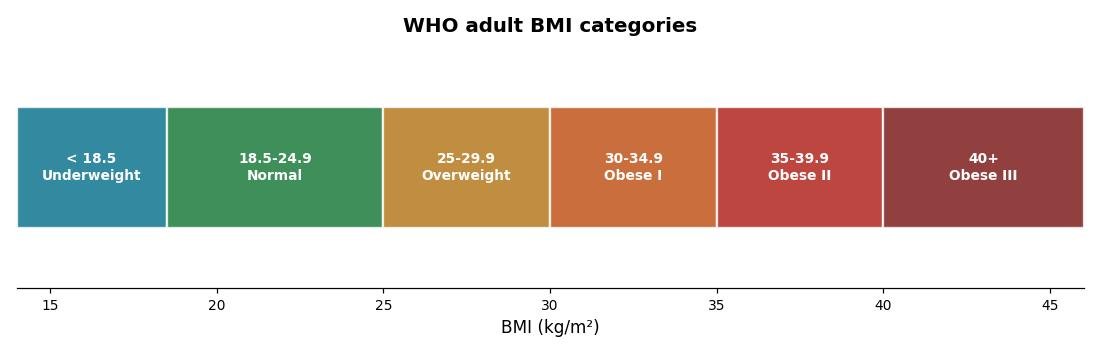
The calculator divides your weight by the square of your height and reports the result in kilograms per square metre. The World Health Organization groups adult results into the categories below, which were chosen because disease risk rises measurably across them at population level.
| BMI (kg/m²) | WHO category | What it usually means |
|---|---|---|
| Below 18.5 | Underweight | Possible undernutrition; screening for causes is sensible. |
| 18.5 to 24.9 | Normal weight | The range linked with the lowest overall health risk. |
| 25.0 to 29.9 | Overweight | Risk begins to rise; lifestyle review is worthwhile. |
| 30.0 to 34.9 | Obesity class I | Clearly raised risk; structured weight management helps. |
| 35.0 to 39.9 | Obesity class II | High risk; medical weight management worth discussing. |
| 40.0 or above | Obesity class III | Very high risk; specialist assessment is recommended. |
How the BMI calculation works
The formula is disarmingly simple. In metric units, body mass index equals weight in kilograms divided by height in metres squared. A person who weighs 70 kg at 1.75 m has a BMI of 70 divided by 3.0625, which is 22.9. In imperial units the same relationship is expressed as 703 times weight in pounds divided by height in inches squared; the 703 is just the conversion factor that keeps the two systems consistent. This calculator applies the right version automatically based on the unit toggle.
The index is old. The Belgian polymath Adolphe Quetelet described the weight-over-height-squared relationship in 1832 while studying the "average man", and for more than a century it was known as the Quetelet index. It became the body mass index in 1972, when the physiologist Ancel Keys and colleagues showed it tracked body fatness better than competing height-weight ratios and gave it the name we use today. Its staying power comes from needing only a scale and a tape measure, which is why it remains the standard first screen for weight-related risk in clinics, insurance assessments and population surveys worldwide.
You may also meet BMI prime, which is simply your BMI divided by 25, the upper limit of normal. A BMI prime of 1.0 sits exactly on the boundary between normal and overweight, values below 1.0 are within the healthy range, and values above it are not. It is a neat way of expressing how far someone is from the threshold, though it adds no new information beyond the BMI itself.
What BMI actually measures, and what it misses
BMI measures weight relative to height. It does not measure fat. That distinction explains nearly every criticism of the index: two people with the same BMI can carry very different amounts of body fat, and fat distribution matters as much as fat quantity for health. Fat stored around the abdomen drives metabolic risk far more than fat on the hips and thighs, which is why clinicians pair BMI with a waist measurement rather than trusting either alone.
The groups for whom BMI misleads most are well known. Athletes and manual workers with heavy muscle mass can land in the overweight or obese bands while being lean, because muscle is denser than fat. Older adults can have a reassuring BMI while carrying excess fat, because muscle is gradually replaced by fat with ageing even as weight stays steady. Pregnancy obviously invalidates the standard cutoffs. And at a given BMI, body composition differs between populations: the WHO has noted that metabolic risk in Asian populations rises at lower BMIs than in European populations, so lower action thresholds may be appropriate there. None of this makes BMI useless; it makes it a screening tool, a way of deciding who needs a closer look rather than a diagnosis in itself.
For children the adult cutoffs do not apply at all. Healthy BMI changes continuously through growth, so children are assessed with BMI-for-age percentiles against a growth reference, exactly the approach used by paediatric growth charts. If you are checking a child, use a proper growth reference rather than this calculator.
Why clinicians still ask for it
Despite its crudeness, BMI earns its place because it is cheap, instant and standardised. A clinic can record it at every visit with no equipment beyond scales and a stadiometer, and because the whole world uses the same cutoffs, a BMI of 32 means the same thing in Karachi, Copenhagen and Nairobi. At population level it tracks closely with the outcomes that matter: type 2 diabetes, hypertension, coronary disease, sleep apnoea and several cancers all rise with BMI across large cohorts, which is why guidelines use it as the entry gate for weight-management pathways.
In practice it is rarely used alone. A sensible assessment adds waist circumference, blood pressure, fasting glucose or HbA1c, and a lipid panel, plus history: family patterns, medications that affect weight, sleep, and previous weight trajectories. BMI opens the conversation; the rest of the assessment decides what, if anything, needs doing. Our companion body surface area calculator covers the related but distinct measurement used for drug dosing, and the BMI and BSA hub explains when each one is the right tool.
Limitations of this calculator
- Uses the adult WHO cutoffs only. It is not valid for children, teenagers or pregnancy.
- Cannot distinguish fat from muscle; muscular individuals may be misclassified upward and older adults downward.
- Does not account for fat distribution. Abdominal fat carries more metabolic risk than the index alone suggests.
- Population cutoffs are a starting point. Ethnicity, age and medical history can shift what a given number means for you.
- A screening result, not a diagnosis. Decisions about weight management belong in a conversation with a clinician.
Frequently asked questions
How is BMI calculated?
BMI is your weight in kilograms divided by the square of your height in metres. With imperial units the formula is 703 times weight in pounds divided by height in inches squared. This calculator handles both unit systems automatically.
What is a healthy BMI for adults?
The World Health Organization defines a healthy adult BMI as 18.5 to 24.9 kg per square metre. Below 18.5 is underweight, 25 to 29.9 is overweight, and 30 or above is obesity, split into class I (30 to 34.9), class II (35 to 39.9) and class III (40 or above).
Is BMI accurate for muscular people?
Not always. BMI cannot tell muscle from fat, so athletes and very muscular people can score as overweight or obese while carrying little body fat. In those cases waist circumference, waist-to-height ratio or a body composition assessment give a truer picture.
Can I use this BMI calculator for children?
No. Children and teenagers are assessed with BMI-for-age percentiles, not the adult cutoffs, because healthy BMI changes as children grow. Use a paediatric growth reference instead.
Does BMI differ by ethnicity?
Body composition at a given BMI varies between populations. The WHO has noted that lower BMI action thresholds may be appropriate for Asian populations, where metabolic risk rises at lower BMIs than in European populations. Discuss the right target with your clinician.
What should I do if my BMI is high?
Treat the number as a prompt, not a verdict. A high BMI is worth discussing with a clinician, who will look at blood pressure, blood sugar, cholesterol, waist circumference and family history before recommending anything. Sustainable weight change comes from lasting changes to eating, activity and sleep, not crash diets.
Related cardiology calculators
Sources: World Health Organization. Obesity and overweight fact sheet. Quetelet A. Recherches sur le poids de l'homme aux differens ages. 1832. Keys A, Fidanza F, Karvonen MJ, Kimura N, Taylor HL. Indices of relative weight and obesity. J Chronic Dis. 1972;25(6-7):329-343.