BSA Calculator
This body surface area calculator estimates BSA from height and weight using five standard formulas: DuBois, Mosteller, Haycock, Gehan and George, and Boyd. Pick a formula or compare them all, with an instant result in square metres.
What your BSA result means
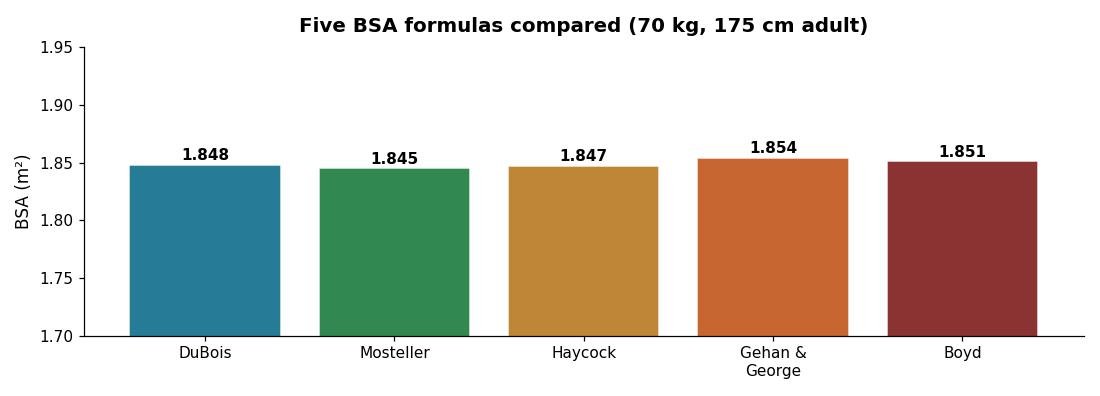
Body surface area is reported in square metres. Most adults fall between roughly 1.5 and 2.0 m²: a 70 kg adult who is 175 cm tall measures about 1.85 m² on every standard formula. Unlike BMI there are no healthy or unhealthy cutoffs. BSA is a sizing measurement, used to scale doses and physiological values to the patient in front of you, so the number is only meaningful in context: the chemotherapy dose it implies, the cardiac index it produces, or the kidney function it normalises.
The comparison table under the calculator shows all five formulas for your inputs. In average-sized adults they agree within a few percent, which is why the choice of formula rarely changes a clinical decision. The spread widens at extremes of height and weight, where picking the formula your local protocol specifies matters more.
The five BSA formulas
Every BSA formula is an empirical fit: researchers measured real body surfaces, then found the height-weight combination that predicted them best. The oldest is also the most cited. In 1916, Delafield DuBois and Eugene DuBois at Cornell published BSA = 0.007184 x W^0.425 x H^0.725, with weight in kilograms and height in centimetres, derived from direct measurements of nine individuals. A formula built on nine people sounds fragile, yet it has survived a century of validation and remains the reference against which the others are judged.
The alternatives each solved a practical problem. Boyd's 1935 formula came from growth studies and handles the very young. Gehan and George (1970) fitted their exponents to a larger dataset specifically to improve chemotherapy dosing. Haycock (1978) derived his formula from measurements of infants, children and adults, making it popular in paediatrics. Mosteller's 1987 contribution was radical simplification: BSA = sqrt(H x W / 3600), computable on any pocket calculator with no fractional exponents, and validation showed it matched DuBois closely enough for clinical work. That simplicity is why Mosteller dominates bedside practice today.
| Formula | Year | Equation (W in kg, H in cm) |
|---|---|---|
| DuBois and DuBois | 1916 | 0.007184 x W^0.425 x H^0.725 |
| Boyd | 1935 | 0.0003207 x H^0.3 x Wg^(0.7285 - 0.0188 log Wg)* |
| Gehan and George | 1970 | 0.0235 x W^0.51456 x H^0.42246 |
| Haycock | 1978 | 0.024265 x W^0.5378 x H^0.3964 |
| Mosteller | 1987 | sqrt(H x W / 3600) |
* Boyd uses weight in grams (Wg). This calculator converts automatically.
What body surface area is actually used for
BSA survives in medicine because several physiological processes scale with surface area better than with weight. The most consequential is chemotherapy dosing. Cytotoxic drugs have narrow margins between effective and toxic, and protocols specify doses in milligrams per square metre of BSA, so a patient's BSA directly sets the milligrams drawn up. A dosing error here is a toxicity event or an undertreated cancer, which is why oncology double-checks BSA on every cycle.
Cardiology uses BSA to index cardiac output. Dividing cardiac output by BSA gives the cardiac index in litres per minute per square metre, letting a clinician judge whether a small patient's heart is performing as well as a large patient's. Nephrology reports estimated GFR normalised to a standard BSA of 1.73 m², the origin of the familiar mL/min/1.73 m² unit; for drug dosing at body-size extremes, some clinicians convert back using the patient's actual BSA. Burn surgeons estimate burn extent as a percentage of BSA, and paediatric prescribing frequently scales adult doses by the child's fraction of adult BSA. Our companion BMI calculator covers the related weight-for-height index, and the BMI and BSA hub explains when each measurement is the right one.
Which formula should you use
For routine adult work, use whichever formula your protocol names; if none is specified, Mosteller is the pragmatic default because it can be checked mentally and matches the reference closely. In paediatrics, Haycock is the common choice given its derivation across ages. At extremes of body size, be aware the formulas diverge: comparisons have shown the gap between DuBois and Mosteller widening in very small and very large patients, so consistency within a patient matters more than the theoretical best formula. Whatever you choose, record the formula alongside the result so the next clinician can reproduce it.
Limitations of this calculator
- All formulas are estimates fitted to limited measurement datasets, not direct measurements of your surface area.
- Accuracy falls at extremes of height and weight, where formulas can disagree by clinically relevant amounts.
- BSA-based chemotherapy dosing still requires clinical judgement: organ function, performance status and protocol rules modify the calculated dose.
- This calculator is for estimation and education. Treatment doses must be verified against the applicable protocol by a qualified clinician or pharmacist.
Frequently asked questions
How is body surface area calculated?
BSA is estimated from height and weight with a published formula. The DuBois formula (0.007184 times weight to the 0.425 power times height to the 0.725 power) is the classic reference; the Mosteller formula (the square root of height times weight divided by 3600) is the simpler bedside alternative. This calculator computes five standard formulas side by side.
What is a normal body surface area?
Most adults fall between about 1.5 and 2.0 square metres. A 70 kg adult who is 175 cm tall has a BSA of roughly 1.85 square metres by any of the standard formulas. There is no healthy versus unhealthy cutoff: BSA is a sizing measurement, not a risk category.
Why do doctors use BSA instead of weight for drug doses?
Many physiological processes, including metabolism and kidney filtration, scale more closely with surface area than with weight. Dosing chemotherapy per square metre of BSA gives more consistent drug exposure across small and large patients than weight-based dosing alone, which is why oncology protocols are written in mg per square metre.
Which BSA formula is the most accurate?
In average-sized adults the established formulas agree within a few percent, so the choice rarely changes clinical decisions. The DuBois formula remains the historical reference, while Mosteller is favoured at the bedside for its simplicity. Differences grow at extremes of height and weight, where formula choice deserves more thought.
What is cardiac index and how does BSA relate to it?
Cardiac index is cardiac output divided by body surface area, expressed in litres per minute per square metre. Indexing to BSA lets clinicians compare heart performance between patients of different sizes: a normal cardiac index is roughly 2.5 to 4.0 L/min/m2.
Is BSA used in kidney function estimates?
Yes. Estimated GFR is conventionally reported normalised to a standard BSA of 1.73 square metres, which is why eGFR results carry the unit mL/min/1.73 m2. For drug dosing in very small or very large patients, some clinicians convert back to a non-normalised value using the patient's actual BSA.
Related cardiology calculators
Sources: Body Surface Area. StatPearls. NIH/NCBI Bookshelf. Redlarski G, et al. Comparison of two different formulas for body surface area in adults at extremes of height and weight. J Oncol Pharm Pract. 2016. DuBois D, DuBois EF. A formula to estimate the approximate surface area if height and weight be known. Arch Intern Med. 1916;17:863-871. Mosteller RD. Simplified calculation of body-surface area. N Engl J Med. 1987;317:1098.