Heparin and LMWH Dosing Calculator
This heparin dosing calculator computes weight-based unfractionated heparin (UFH) bolus and infusion doses using the Raschke nomogram, aPTT-based infusion adjustments, and enoxaparin and dalteparin therapeutic and prophylactic doses with renal adjustment. Select the agent and indication, enter the weight, and add creatinine clearance or a current aPTT when available.
What your result means
The calculator reports absolute doses, not just per-kilogram regimens, because the syringe or the infusion pump needs a concrete number. For unfractionated heparin it gives the IV bolus in units and the starting infusion rate in units per hour, each computed from the entered weight with the standard caps applied. For enoxaparin it gives the dose in milligrams per injection, rounded to the nearest 10 mg to match available prefilled syringes (40, 60, 80, 100, 120, and 150 mg). For dalteparin it gives the dose in international units, rounded to the nearest 500 IU. When a current aPTT is entered for a patient on UFH, the calculator adds the Raschke titration step: a rebolus if needed and the new infusion rate in units per hour.
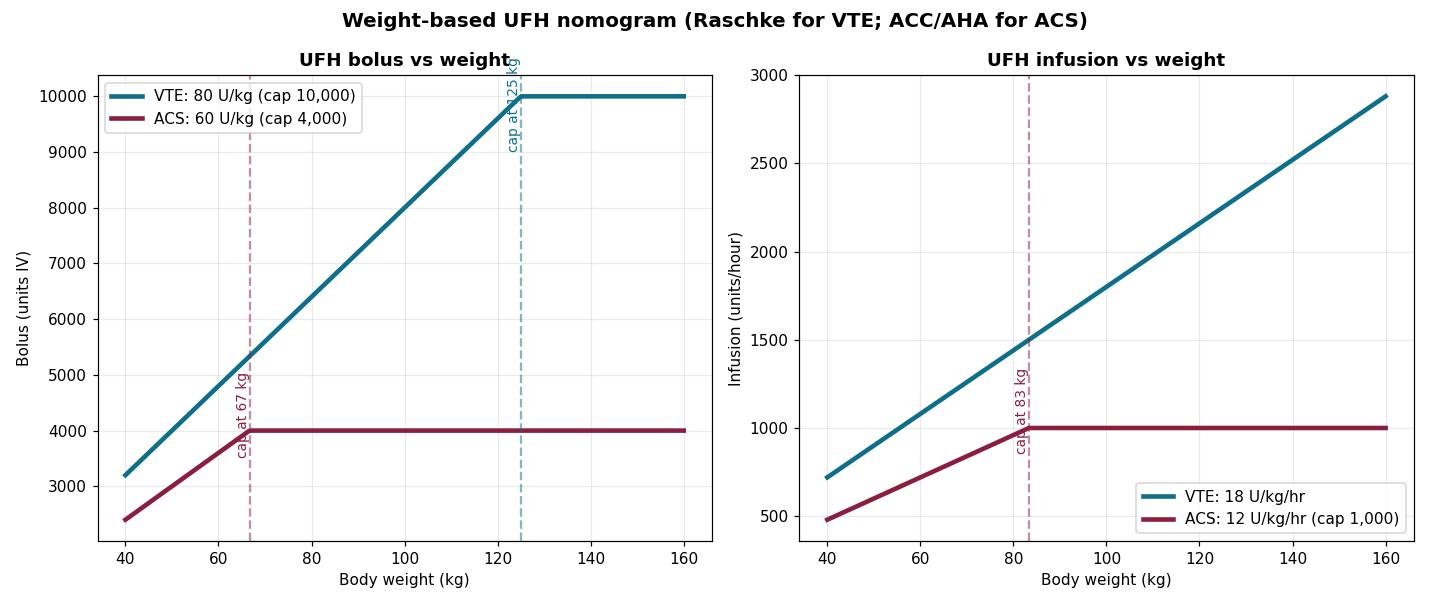
The reference chart below shows how the UFH bolus and infusion scale with weight for the two therapeutic regimens, so you can see where the caps cut in:
Unfractionated heparin: the weight-based nomogram
Before weight-based dosing, heparin was given in fixed doses that left small patients over-anticoagulated and large patients under-anticoagulated. The Raschke nomogram, published in 1993 from a randomised comparison against standard care, fixed this: an 80 units/kg IV bolus (capped at 10,000 units) followed by an 18 units/kg/hour infusion reached the therapeutic aPTT range faster and kept patients in range longer than the old 5,000-unit bolus plus 1,000 units/hour approach. That 80/18 regimen, with aPTT-based titration, became the default therapeutic UFH protocol for venous thromboembolism in most hospitals.
Acute coronary syndrome uses a gentler regimen. ACC/AHA guidance for NSTE-ACS recommends a 60 units/kg bolus (maximum 4,000 units) and a 12 units/kg/hour infusion (maximum 1,000 units/hour), reflecting the balance between preventing recurrent ischaemia and avoiding bleeding in patients who will also receive antiplatelet therapy and often an early invasive procedure. For prophylaxis, weight-based dosing gives way to fixed doses: 5,000 units subcutaneously every 8 to 12 hours, which this calculator reports directly.
aPTT monitoring and infusion adjustment
UFH has unpredictable pharmacokinetics: it binds plasma proteins, endothelial cells, and macrophages, so the same infusion rate produces different anticoagulation in different patients and in the same patient over time. The aPTT is therefore checked 6 hours after starting the infusion and after every dose change, and the infusion is titrated with the Raschke adjustment table:
| aPTT (seconds) | Rebolus | Infusion change |
|---|---|---|
| Below 35 | 80 units/kg IV | Increase by 4 units/kg/hour |
| 35 to 45 | 40 units/kg IV | Increase by 2 units/kg/hour |
| 46 to 70 | None | No change (therapeutic) |
| 71 to 90 | None | Decrease by 2 units/kg/hour |
| Above 90 | None | Hold 1 hour, then decrease by 3 units/kg/hour |
One caveat the table cannot show: the "therapeutic" aPTT range of 46 to 70 seconds is the range from the original Raschke study, but aPTT reagents differ between laboratories. Each laboratory should calibrate its therapeutic aPTT range to an anti-Xa level of 0.3 to 0.7 units/mL; where the local range differs, the local range governs and this calculator's adjustment bands should be mapped onto it. Anti-Xa monitoring is preferred outright in patients whose baseline aPTT is abnormal, such as lupus anticoagulant or factor XII deficiency.
Enoxaparin: treatment and prophylaxis
Enoxaparin's predictable pharmacokinetics are the reason it largely replaced UFH for VTE treatment outside the hospital: no routine monitoring, fixed weight-based dosing, subcutaneous administration. The standard treatment dose is 1 mg/kg every 12 hours; the once-daily 1.5 mg/kg regimen is an alternative for selected outpatients without obesity or active cancer, trading a higher peak for convenience. In acute coronary syndrome, enoxaparin 1 mg/kg every 12 hours is the standard, with two age and renal caveats from the product labelling: patients 75 and older receive 0.75 mg/kg every 12 hours with no IV bolus, and severe renal impairment calls for 1 mg/kg once daily.
Prophylaxis is simpler: 40 mg subcutaneously once daily for most medical and surgical patients, reduced to 30 mg daily when creatinine clearance falls below 30 mL/min. The calculator applies the renal reduction automatically when a creatinine clearance is entered, because enoxaparin accumulates in renal failure and the bleeding risk rises steeply.
Dalteparin: treatment and prophylaxis
Dalteparin follows the same logic with its own numbers. For VTE treatment, 200 IU/kg subcutaneously once daily (maximum 18,000 IU), which may be divided into 100 IU/kg twice daily for patients at higher bleeding risk. For unstable angina and NSTEMI, 120 IU/kg every 12 hours (maximum 10,000 IU per dose) with concurrent aspirin. For prophylaxis, 5,000 IU once daily covers high-risk surgical patients, while 2,500 IU once daily is used for moderate-risk medical patients. Unlike enoxaparin, dalteparin's labelling does not mandate a fixed renal dose reduction, but anti-Xa monitoring is still advised in severe renal impairment.
Renal impairment and the two heparins
The kidney handles the two heparins very differently, and this is the main reason both appear in one calculator. UFH is cleared by the reticuloendothelial system and endothelium, not the kidney, so renal failure does not require a dose reduction; UFH is the anticoagulant of choice when creatinine clearance is below 30 mL/min or the patient is unstable enough that rapid reversibility with protamine matters. LMWHs are renally cleared and accumulate as glomerular filtration falls, so enoxaparin needs the dose reductions built into this calculator and anti-Xa monitoring in severe renal impairment. When in doubt in a renally impaired or critically ill patient, UFH is the safer default.
Limitations of this heparin dosing calculator
This calculator implements standard published nomograms; it does not implement any specific hospital's protocol, and where the two differ, the hospital protocol governs. It does not adjust for obesity beyond the standard caps: patients above 150 kg were under-represented in the nomogram studies, and anti-Xa-guided dosing is often used instead. It does not cover heparin bridging for warfarin interruption, dosing in pregnancy, or paediatric dosing, all of which follow separate guidance. The aPTT bands assume the Raschke therapeutic range; laboratories with a locally calibrated range must translate the bands. Finally, dosing is only half of heparin safety: platelet counts must be monitored for heparin-induced thrombocytopenia, and any platelet fall of 50% or more, or a thrombotic event on heparin, should prompt immediate HIT evaluation and a switch to a non-heparin anticoagulant.
Frequently asked questions
What is the standard weight-based heparin bolus and infusion?
The widely used Raschke weight-based nomogram gives an 80 units/kg IV bolus (maximum 10,000 units) followed by an 18 units/kg/hour infusion for venous thromboembolism, titrated to the aPTT. For acute coronary syndrome, ACC/AHA guidance uses 60 units/kg (maximum 4,000 units) bolus and 12 units/kg/hour (maximum 1,000 units/hour) infusion.
How do you adjust a heparin infusion based on aPTT?
Using the Raschke nomogram: aPTT below 35 seconds gets an 80 units/kg rebolus and the infusion increased by 4 units/kg/hour; 35 to 45 gets a 40 units/kg rebolus and plus 2 units/kg/hour; 46 to 70 is therapeutic with no change; 71 to 90 decreases the infusion by 2 units/kg/hour; above 90 holds the infusion for one hour then decreases by 3 units/kg/hour. The aPTT range should be calibrated to anti-Xa 0.3 to 0.7 units/mL at each laboratory.
What is the enoxaparin dose for DVT or PE treatment?
Enoxaparin 1 mg/kg subcutaneously every 12 hours is the standard inpatient treatment dose for DVT and PE, or 1.5 mg/kg once daily for suitable outpatients. In severe renal impairment (creatinine clearance below 30 mL/min), the dose is 1 mg/kg once daily. Doses are rounded to available syringe sizes.
Does enoxaparin need dose adjustment in kidney disease?
Yes. When creatinine clearance is below 30 mL/min, enoxaparin treatment dosing drops from 1 mg/kg twice daily to 1 mg/kg once daily, and prophylactic dosing drops from 40 mg daily to 30 mg daily, because the drug accumulates. Anti-Xa monitoring is recommended in severe renal impairment.
What is the dalteparin dose for VTE treatment?
Dalteparin 200 IU/kg subcutaneously once daily (maximum 18,000 IU) treats venous thromboembolism, and it may be split as 100 IU/kg twice daily. For unstable angina or NSTEMI, the dose is 120 IU/kg every 12 hours (maximum 10,000 IU per dose).
When should heparin be avoided or used with caution?
Heparin is contraindicated with active bleeding, heparin-induced thrombocytopenia (HIT), or known hypersensitivity. Use caution with severe thrombocytopenia, recent surgery or trauma, and severe uncontrolled hypertension. Platelet counts should be monitored during heparin therapy to detect HIT, and protamine is the reversal agent for unfractionated heparin.
Related cardiology calculators
Sources: Raschke RA et al. The weight-based heparin dosing nomogram compared with a "standard care" nomogram. Ann Intern Med. 1993;118(6):461-467 (80 units/kg bolus, 18 units/kg/hour infusion, aPTT titration bands). Enoxaparin sodium (Lovenox) FDA prescribing information: treatment 1 mg/kg q12h or 1.5 mg/kg q24h, CrCl below 30 mL/min 1 mg/kg q24h; ACS 1 mg/kg q12h (age 75 and above 0.75 mg/kg q12h, no IV bolus); prophylaxis 40 mg daily (CrCl below 30: 30 mg daily). Dalteparin sodium (Fragmin) FDA prescribing information: VTE treatment 200 IU/kg daily (max 18,000 IU); unstable angina/NSTEMI 120 IU/kg q12h (max 10,000 IU/dose). UFH ACS dosing per ACC/AHA NSTE-ACS guidance: 60 units/kg bolus (max 4,000 units), 12 units/kg/hour infusion (max 1,000 units/hour).