TIMI Risk Score Calculator
This TIMI risk score calculator covers both of the validated TIMI scores for acute coronary syndrome. Select the clinical situation, tick the variables that apply, and the calculator adds the points and maps the total to the published event rate. For unstable angina and NSTEMI it uses the Antman 7 one-point variables (total 0 to 7, 14-day composite event rate); for STEMI it uses the Morrow weighted admission variables (total 0 to 14, 30-day mortality).
How to use this TIMI risk score calculator
Start by choosing the clinical situation at the top of the calculator. The two TIMI scores are completely separate tools that share a name, so the first decision is which one your patient needs. For unstable angina or NSTEMI, tick the seven one-point boxes that apply and press Calculate; every box is optional and the calculator simply counts the ticks, so there is no way to leave a required field blank. For STEMI, select the age band (this one is required) and tick the admission variables that apply.
The result panel shows the total score, the published event rate for that exact score, the risk band, and a component breakdown listing each variable with the points it contributed. It also shows a management paragraph tied to the risk band. Use the Reset button to clear everything before scoring the next patient. The breakdown list doubles as a documentation aid: it records exactly which variables were positive, which is what the next clinician needs to see in the notes.
What the TIMI risk score is and why it exists
Acute coronary syndrome is a spectrum, from unstable angina through NSTEMI to STEMI, and patients across that spectrum face very different short-term risks. Two patients can both carry a diagnosis of NSTEMI yet have wildly different chances of dying or having another event in the next two weeks. Clinicians needed a way to quantify that difference at the bedside, using information already available on admission, so that aggressive treatment could be directed at the patients most likely to benefit and spared where the risk was low. That is the job the TIMI risk scores were built to do.
The name comes from the Thrombolysis In Myocardial Infarction trial group, whose studies supplied the patient data. Antman and colleagues developed the UA/NSTEMI score in 2000, published in JAMA (volume 284, pages 835 to 842), by pooling the unstable angina and NSTEMI patients from two large trials. Morrow and colleagues developed the STEMI score the same year, published in Circulation (volume 102, pages 2031 to 2037). The two scores answer different questions in different populations: the Antman score predicts a 14-day composite of death, MI, or severe recurrent ischaemia needing urgent revascularization in UA/NSTEMI, while the Morrow score predicts 30-day all-cause mortality in STEMI. Because the populations, variables, and outcomes all differ, the two must never be mixed.
The TIMI score for UA and NSTEMI: the 7 one-point variables
The Antman score deliberately keeps every variable worth exactly one point. That simplicity is the point: a clinician can count the ticks on one hand without a calculator, and the equal weighting reflects the finding that each variable carried roughly similar prognostic weight in the derivation data. The seven variables are:
1. Age 65 years or older. Age is the most consistent predictor of bad outcomes across all of cardiology, and in ACS the risk rises steeply from the mid-sixties. Older patients have less physiological reserve, more diffuse coronary disease, and a higher chance of complications from both the disease and its treatment.
2. Three or more CAD risk factors. The score counts family history of coronary artery disease, hypertension, hypercholesterolaemia, diabetes, and current smoking, and awards the point only when three or more are present. This is a single yes-or-no variable, not one point per factor. The logic is that risk-factor clustering drives atherosclerotic burden more than any single factor in isolation.
3. Known coronary artery disease. A prior angiogram showing a coronary stenosis of 50% or more means the patient has established, anatomically proven disease rather than a first presentation. These patients re-present with more extensive disease and have less room for a benign course.
4. Aspirin use in the past 7 days. This variable looks paradoxical until you think it through: aspirin does not cause the event. Rather, a patient having an ACS despite being on aspirin is having a breakthrough event on therapy, which signals a more aggressive or treatment-resistant process than an event in an untreated patient.
5. Severe angina: 2 or more episodes in the past 24 hours. Recurrent rest or minimal-exertion episodes in the day before presentation mark an unstable, active plaque. A single settled episode is less concerning than a pattern that keeps recurring despite rest and initial treatment.
6. ST-segment deviation of 0.5 mm or more. On the presenting ECG, either ST depression or transient ST elevation of at least half a millimetre counts. The ECG is the most immediate window into ongoing ischaemia, and measurable ST deviation at presentation strongly predicts downstream events.
7. Elevated cardiac markers. A troponin or CK-MB above the normal limit indicates myocardial necrosis has already occurred, which is what separates NSTEMI from unstable angina. Note that this is only one of seven variables: a patient with a normal troponin can still reach a score of 6, so normal markers never mean zero risk.
What the 14-day event rate means in practice
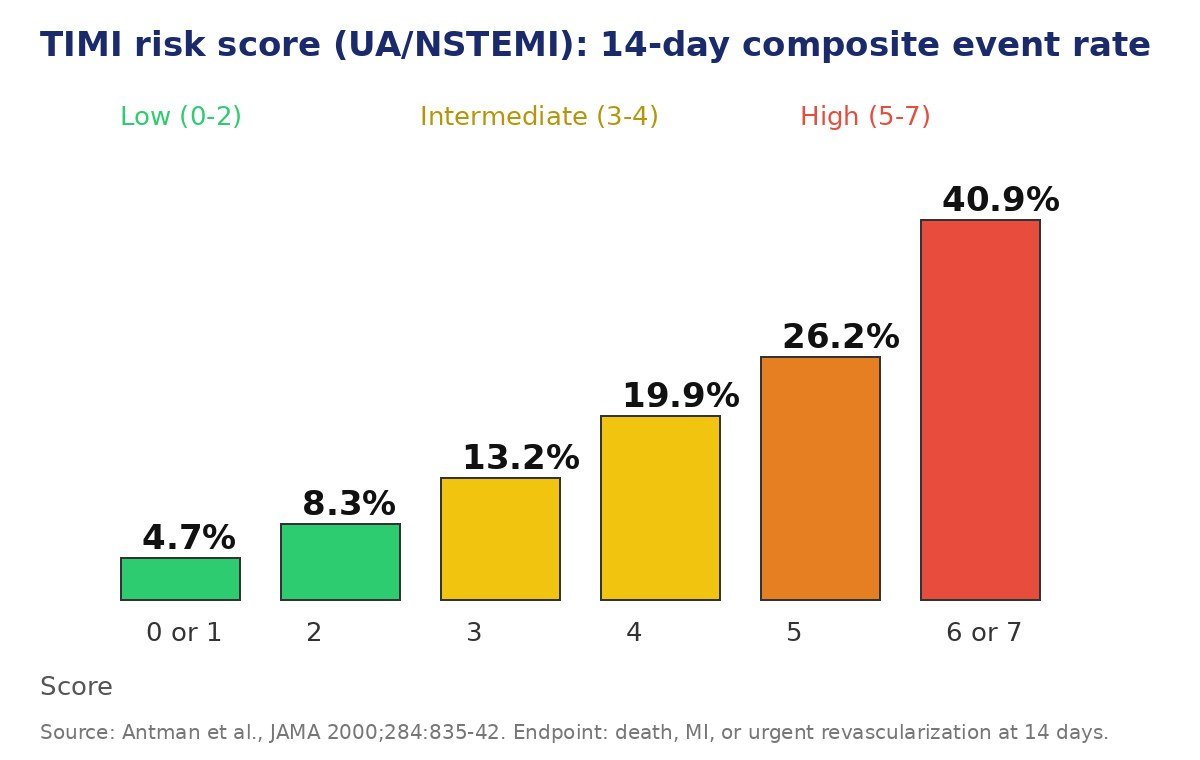
The percentage attached to each UA/NSTEMI score is the observed 14-day composite event rate in the derivation and validation cohorts. The composite endpoint combines three outcomes: all-cause mortality, new or recurrent myocardial infarction, and severe recurrent ischaemia requiring urgent revascularization. Because the composite includes urgent revascularization, the rates are higher than a pure death-or-MI endpoint would give; that is deliberate, since the score was designed to identify patients who need an invasive strategy, and needing urgent revascularization is exactly the signal that matters for that decision.
| TIMI score | Risk band | 14-day composite event rate | Management |
|---|---|---|---|
| 0 to 1 | Low | 4.7% | Conservative strategy; early stress testing or coronary imaging within 72 hours |
| 2 | Low | 8.3% | Conservative strategy; early stress testing or coronary imaging within 72 hours |
| 3 | Intermediate | 13.2% | Consider early invasive strategy (angiography within 24 to 72 hours) with intensified antiplatelet/anticoagulant therapy |
| 4 | Intermediate | 19.9% | Consider early invasive strategy (angiography within 24 to 72 hours) with intensified antiplatelet/anticoagulant therapy |
| 5 | High | 26.2% | Early invasive strategy within 2 to 24 hours; intensive dual antiplatelet therapy; close monitoring |
| 6 to 7 | High | 40.9% | Early invasive strategy within 2 to 24 hours; intensive dual antiplatelet therapy; close monitoring |
The gradient is steep and roughly doubles with each additional point through the middle of the scale: 4.7% at 0 to 1, 8.3% at 2, 13.2% at 3, 19.9% at 4, 26.2% at 5, and 40.9% at 6 to 7. The three risk bands turn that gradient into decisions. Low risk (0 to 2) supports a conservative strategy with early stress testing or coronary imaging within 72 hours, because the short-term event rate is modest. Intermediate risk (3 to 4) is where the score earns its keep: these patients should be considered for an early invasive strategy, with angiography within 24 to 72 hours and intensified antiplatelet and anticoagulant therapy, because roughly one in six will have an event. High risk (5 to 7) means an early invasive strategy within 2 to 24 hours, intensive dual antiplatelet therapy, and close monitoring, because more than one in four, and up to two in five, will have an event within two weeks.
Read the percentage for what it is: the observed event rate in a group of trial patients with that score, not a prediction about the individual in front of you. A single-point estimate is not a guarantee in either direction. A patient with a score of 2 still has an 8.3% group event rate, and a patient with a score of 6 may do perfectly well. The number structures the decision; it does not make it.
The TIMI score for STEMI: weighted admission variables
The Morrow STEMI score works differently from its UA/NSTEMI sibling: the variables are weighted, because in STEMI the admission findings carry very unequal prognostic weight. Age dominates the score, contributing up to 3 points, and haemodynamic instability contributes heavily too. The total runs from 0 to 14 and predicts 30-day all-cause mortality, a harder and simpler endpoint than the UA/NSTEMI composite. The variables, all available at or shortly after presentation, are:
Age: under 65 years scores 0, 65 to 74 scores 2, and 75 or older scores 3. Age is the single strongest predictor of death after STEMI, which is why it carries the heaviest weight in the score.
Systolic blood pressure below 100 mmHg (3 points). Hypotension on arrival signals a failing pump or a large infarct, and it is the heaviest-weighted bedside finding after age.
Heart rate above 100 beats per minute (2 points). Tachycardia reflects sympathetic drive compensating for reduced stroke volume, and it raises myocardial oxygen demand exactly when supply is cut off.
Killip class II to IV (2 points). Any sign of heart failure or shock on examination counts: rales or an S3 (class II), pulmonary oedema (class III), or cardiogenic shock with hypotension and hypoperfusion (class IV).
Body weight below 67 kg (1 point). Low body weight was associated with higher mortality in the derivation data, partly reflecting frailty and partly reflecting relatively higher drug exposure with weight-based dosing.
Diabetes, hypertension, or prior angina (1 point). Any one of these three history items scores the point; it marks a patient with established vascular disease burden.
Anterior ST elevation or left bundle branch block (1 point). An anterior infarct threatens a larger territory of myocardium (the left anterior descending artery), and a new left bundle branch block in this context is treated as an equivalent.
More than 4 hours from symptom onset to treatment (1 point). Time is muscle: longer ischaemic time before reperfusion means more completed infarction and worse outcomes.
| TIMI score | 30-day mortality |
|---|---|
| 0 | 0.8% |
| 1 | 1.6% |
| 2 | 2.2% |
| 3 | 4.4% |
| 4 | 7.3% |
| 5 | 12.4% |
| 6 | 16.1% |
| 7 | 23.4% |
| 8 | 26.8% |
| 9 or more | 35.9% (pooled) |
The mortality climbs from under 1% at a score of 0 to over one in three at 9 or above, with the pooled 35.9% rate covering scores 9 through 14 because individual scores at the top were too sparse to report separately. From that published mortality curve, three interpretive zones can be described for bedside use. Scores of 0 to 2 carry under 3% mortality and fit standard reperfusion care. Scores of 3 to 5 carry about 4 to 12% mortality and call for close monitoring with senior review. Scores of 6 or more carry above 16% mortality, rising steeply, and should prompt consideration of escalation: ICU-level care and an early discussion about tertiary transfer. These zones are interpretive readings of the published mortality curve, not formal categories from the original paper, and they should be used as a communication aid rather than a protocol.
How clinicians use the score at the bedside
In UA/NSTEMI, the score's main job is timing. A high score moves angiography from "within a few days" to "within 2 to 24 hours" and justifies intensive dual antiplatelet therapy and close monitoring, while a low score supports a conservative path with stress testing or coronary imaging within 72 hours. The intermediate band is where the score changes minds most often: a patient who looks comfortable but scores 4 has a one-in-five 14-day event rate, and that number is what gets the case discussed urgently rather than routinely. The score also standardizes handover: "TIMI 5" conveys the whole risk picture in two syllables.
In STEMI, where reperfusion is already the plan for everyone, the score's job is triage and expectation-setting. A score of 8 or more flags a patient with roughly one-in-four 30-day mortality who needs ICU-level care, senior involvement from the start, and an honest conversation with the family about the gravity of the situation. A score of 1 or 2 identifies a low-risk patient who can follow the standard pathway without escalation. In both modes, documenting the individual positive variables matters as much as the total, because it shows the reasoning and lets the next clinician re-score independently.
None of this replaces the examination, the ECG, the troponin trend, or the patient's own trajectory. The score is a validated summary of population risk, applied to an individual who may not behave like the population. A falling blood pressure or new arrhythmia changes management immediately, whatever the number says. The score supports but never replaces clinical judgment.
TIMI, GRACE, and HEART: which score for which patient
The three major ACS-era risk scores were built for different patients, and matching the score to the patient is more important than any difference between the scores themselves. TIMI and GRACE were both derived in confirmed acute coronary syndrome populations: their job starts once the diagnosis of ACS is established. HEART was derived in undifferentiated emergency department chest pain, including patients who turn out not to have ACS at all: its job is to sort the whole crowd and, uniquely, to identify patients safe for discharge.
Between TIMI and GRACE, the difference is mainly in the outcome and the time horizon. The TIMI UA/NSTEMI score predicts a broad 14-day composite that includes severe recurrent ischaemia requiring urgent revascularization, which makes it sensitive to the need for an invasive strategy. GRACE predicts death and MI out to 6 months and is the score guidelines lean on for setting the timing of angiography in NSTEMI. Many clinicians compute both: TIMI for its simplicity at the bedside and GRACE for its longer-horizon mortality prediction. This site's GRACE score calculator and HEART score calculator cover the other two sides of the triangle.
The practical rule is simple. Undifferentiated chest pain in the emergency department, where ACS is possible but not confirmed: use HEART. Confirmed unstable angina or NSTEMI, deciding how urgently to go invasive: use the TIMI UA/NSTEMI score, with or without GRACE. Confirmed STEMI at admission, gauging short-term mortality risk and intensity of care: use the TIMI STEMI score. Using HEART on a confirmed STEMI, or TIMI on undifferentiated chest pain, applies a tool outside the population it was built for, and the numbers lose their meaning.
Limitations of the TIMI score
Both scores were derived in clinical trial populations enrolled around the year 2000, and trial populations are never quite the same as everyday practice: they tend to be younger, less comorbid, and more adherent than unselected patients. The STEMI score in particular belongs to the fibrinolytic era of reperfusion, before primary PCI became the dominant strategy, so its absolute mortality percentages should be read as era-specific estimates. The relative ordering of risk remains useful, but the exact numbers belong to the era that produced them.
The UA/NSTEMI composite endpoint includes urgent revascularization, which is partly a clinical decision rather than a pure biological event: thresholds for taking a patient to the catheter laboratory vary by centre and era, so that component of the rate is the softest. The score is also a single snapshot at presentation. It does not update as troponins rise, as the ECG evolves, or as the patient deteriorates or stabilizes, so re-scoring after a change in condition is good practice.
Finally, the score predicts ischaemic events and death, not bleeding, and a normal troponin is only one negative out of seven variables. Most importantly, the score is a decision aid, not a decision maker. A single-point estimate is not a guarantee, the percentages describe groups rather than individuals, and no score overrules the clinician at the bedside. When the number and the patient disagree, believe the patient.
Frequently asked questions
What does TIMI stand for?
TIMI stands for Thrombolysis In Myocardial Infarction, the name of the clinical trial group whose studies produced the data behind both scores. The UA/NSTEMI score was developed by Antman and colleagues (JAMA 2000), and the STEMI score by Morrow and colleagues (Circulation 2000).
Can the TIMI score be used with a normal troponin?
Yes. Elevated cardiac markers are only one of the seven one-point variables in the UA/NSTEMI score, so a patient with a normal troponin can still score up to 6. A normal troponin lowers the score but does not make risk zero.
What TIMI score needs an early invasive strategy?
In the UA/NSTEMI score, a total of 5 to 7 (high risk, 26.2 to 40.9% 14-day event rate) calls for an early invasive strategy within 2 to 24 hours. Scores of 3 to 4 (intermediate) merit considering an early invasive strategy with angiography within 24 to 72 hours, while scores of 0 to 2 (low) can be managed conservatively with early stress testing or coronary imaging within 72 hours.
Does the TIMI score predict bleeding?
No. The UA/NSTEMI score predicts a composite of death, MI, or severe recurrent ischaemia requiring urgent revascularization at 14 days, and the STEMI score predicts 30-day all-cause mortality. Neither predicts bleeding risk. Bleeding on anticoagulation is assessed with dedicated scores such as HAS-BLED, which has its own calculator on this site.
Is the TIMI score valid in the primary PCI era?
Both scores were derived in trial populations enrolled around the year 2000, and the STEMI score belongs to the fibrinolytic era of reperfusion. The relative ranking of risk holds up, but the absolute percentage rates should be read as era-specific estimates rather than exact modern predictions, and the score supports but never replaces clinical judgment.
Which TIMI score do I use for unstable angina versus STEMI?
Use the Antman 7-variable score (0 to 7, 14-day composite event rate) for unstable angina and NSTEMI. Use the Morrow weighted score (0 to 14, 30-day mortality) for STEMI. The two scores use different variables and predict different outcomes, so picking the wrong one gives a meaningless number.
Related cardiology calculators
Browse all cardiology calculators
Sources: Antman EM et al. The TIMI risk score for unstable angina/non-ST elevation MI: a method for prognostication and therapeutic decision making. JAMA. 2000;284(7):835-842 (7 one-point variables; 14-day event rates 4.7% at 0-1 to 40.9% at 6-7). Morrow DA et al. TIMI risk score for ST-elevation myocardial infarction: a convenient, bedside, clinical score for risk assessment at presentation. Circulation. 2000;102(17):2031-2037 (weighted 0-14 score; 30-day mortality 0.8% at 0 to 35.9% pooled at 9 or more).