HEART Score Calculator
This HEART score calculator estimates the 6-week risk of a major adverse cardiac event (MACE) in adults presenting to the emergency department with chest pain. It scores the five HEART components (History, ECG, Age, Risk factors, Troponin) from 0 to 2 each, for a total of 0 to 10, then maps the total to MACE risk and disposition guidance from the prospective validation study. Select all five components below.
What your HEART score calculator result means
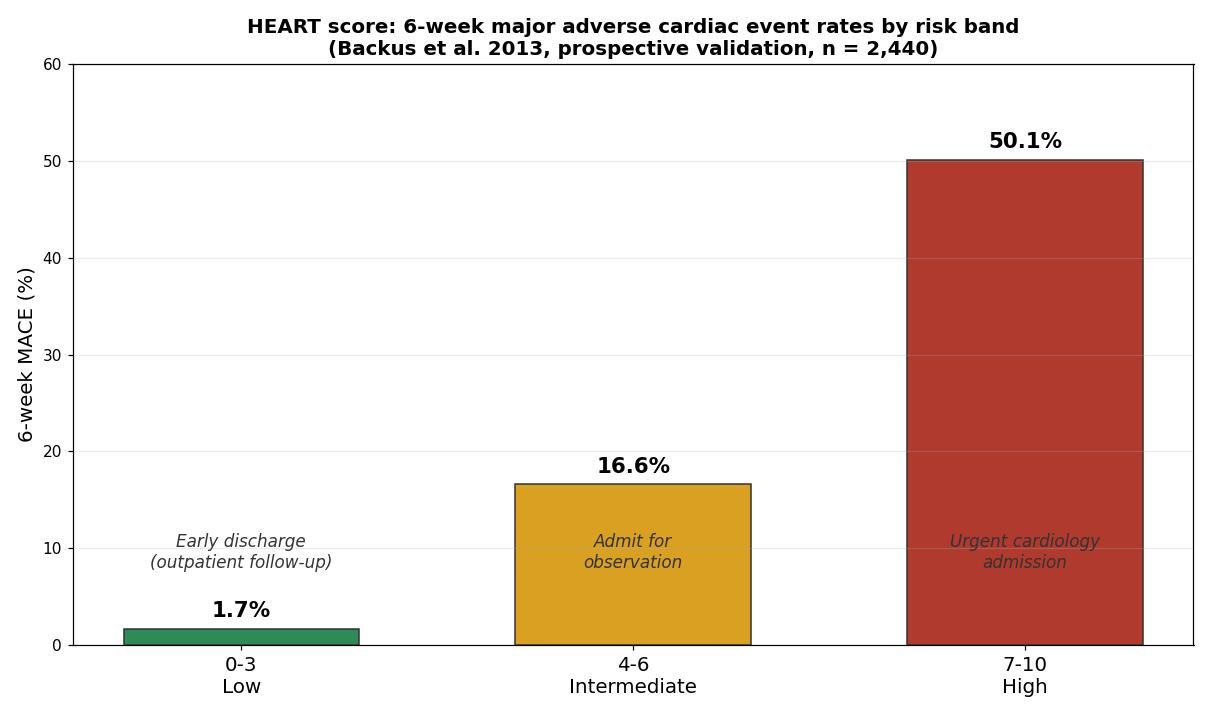
The calculator adds the five component scores to a total between 0 and 10 and assigns one of three risk bands. These bands, and the MACE rates attached to them, come from the prospective validation study by Backus and colleagues, which followed 2,440 unselected emergency department chest pain patients for 6 weeks:
| HEART score | Risk band | 6-week MACE | Recommended disposition |
|---|---|---|---|
| 0 to 3 | Low | About 1.7% | Early discharge with outpatient follow-up |
| 4 to 6 | Intermediate | About 16.6% | Admit for clinical observation and further testing |
| 7 to 10 | High | About 50.1% | Urgent cardiology admission, early invasive strategy |
MACE means a major adverse cardiac event: acute myocardial infarction, percutaneous coronary intervention or bypass surgery, or death within 6 weeks of the index visit. The bands are not arbitrary cutoffs on a smooth curve; they reflect where the validation data actually changed behaviour. Below 4, the miss rate is small enough that discharging is defensible. Above 6, one patient in two has a major event, so aggressive management is clearly justified. The middle band is the zone of genuine uncertainty, where admission buys the time needed for serial troponins and observation.
How the HEART score is calculated
Each of the five components is scored 0, 1, or 2, and the total is the HEART score. History is the clinician's judgement of how suspicious the story is for ACS: slightly suspicious scores 0, moderately suspicious 1, highly suspicious 2. A highly suspicious history is typically retrosternal pressure with exertional onset, radiation to the arm or jaw, and associated sweating or nausea; a slightly suspicious history is sharp, positional, or clearly reproducible chest wall pain. ECG scores 0 when normal, 1 for non-specific repolarisation disturbance, and 2 for significant ST depression. Note that ST elevation is excluded from this scheme entirely: a STEMI needs immediate reperfusion, not a risk score.
Age scores 0 under 45, 1 from 45 to 64, and 2 at 65 and above. Risk factors counts six items: hypertension, hypercholesterolaemia, diabetes mellitus, current smoking, family history of coronary artery disease, and obesity. None scores 0, one or two scores 1, and three or more scores 2; a history of atherosclerotic disease (prior myocardial infarction, PCI, bypass surgery, stroke, or peripheral artery disease) automatically scores 2 regardless of the count. Troponin scores 0 at or below the normal limit, 1 at one to three times the normal limit, and 2 above three times the normal limit. The tick-box design above computes the risk-factor component for you from the individual factors.
What the score changes in practice
The HEART score is unusual among cardiac risk scores because it explicitly guides disposition, including the decision to send a patient home. In the HEART Pathway, developed by Mahler and colleagues, a HEART score of 0 to 3 combined with serial troponins at 0 and 3 hours identifies patients safe for early discharge; the trial found no 30-day MACE in patients discharged this way, while cutting length of stay by about 12 hours and early discharges rose by 21%. That pathway matters because most emergency department chest pain is not ACS, and admitting every patient is neither affordable nor harmless.
For intermediate scores of 4 to 6, the score argues for admission to a clinical observation unit: serial troponins, a repeat ECG, and often a stress test or coronary CT, depending on local pathways. For scores of 7 to 10, the score argues for cardiology admission and an early invasive strategy, because half of these patients will have a major event within 6 weeks. In each case the score structures a decision the clinician was going to make anyway, but it does so transparently, with a number that the next clinician can reproduce.
HEART versus TIMI and GRACE
Chest pain risk scores are not interchangeable, because they were built for different patients. The HEART score was derived in undifferentiated emergency department chest pain, including patients who turn out not to have ACS; its job is to sort the whole crowd, and uniquely among the major scores it can recommend discharge. The TIMI risk score was derived in confirmed unstable angina and NSTEMI trial populations; its job is to predict 30-day death, MI, or urgent revascularisation in patients already known to have ACS. The GRACE score was derived in a multinational ACS registry; its job is to predict in-hospital and 6-month mortality and to set the timing of angiography.
In the head-to-head comparison inside the 2013 validation study, the HEART score discriminated 6-week MACE better than TIMI and GRACE in the emergency department chest pain population (c-statistic 0.83 versus 0.75 and 0.70). That is expected, not surprising: each score wins on its home ground. The practical rule is to match the score to the patient in front of you. Undifferentiated chest pain in the emergency department calls for HEART; confirmed NSTEMI or unstable angina calls for TIMI or GRACE. This site's GRACE score calculator and TIMI risk score cover the confirmed-ACS side.
Limitations of this HEART score calculator
The HEART score applies to adults presenting to the emergency department with chest pain in whom ACS is being considered. It was not derived or validated in patients with STEMI, in clearly non-cardiac chest pain, in children, or in patients already diagnosed with ACS, and the MACE rates should not be quoted for those groups. The history component is the most subjective part of the score; two clinicians can reasonably score the same story differently, and the validation studies reflect that real-world variability rather than eliminating it.
The score uses the troponin available at assessment, so a very early troponin can under-score a patient whose markers have not yet risen; this is why the HEART Pathway pairs the score with serial troponins rather than a single draw. High-sensitivity troponin assays, which postdate the original validation, shift the meaning of "normal limit" and are handled by local protocols, not by this calculator. Finally, the score predicts events; it does not dictate care. A low score in a patient with a concerning story, unstable vitals, or an alternative dangerous diagnosis (aortic dissection, pulmonary embolism, tension pneumothorax) must never override the clinician's judgement.
Frequently asked questions
What does the HEART score measure?
The HEART score estimates the risk of a major adverse cardiac event (MACE: acute myocardial infarction, PCI or CABG, or death) within 6 weeks in patients presenting to the emergency department with chest pain. It scores five components: History, ECG, Age, Risk factors, and Troponin, each 0 to 2 points, for a total of 0 to 10.
What HEART score is safe for discharge?
A HEART score of 0 to 3 is low risk, with about 1.7% 6-week MACE in the prospective validation study. Guidelines and the HEART Pathway support early discharge with outpatient follow-up for these patients, provided serial troponins and the clinical picture agree.
What does a HEART score of 7 or more mean?
A HEART score of 7 to 10 is high risk, with about 50% 6-week MACE in the validation study. These patients should be admitted with urgent cardiology involvement and an early invasive strategy, because half will experience a major adverse cardiac event.
How are risk factors counted in the HEART score?
Count hypertension, hypercholesterolaemia, diabetes mellitus, smoking, family history of coronary artery disease, and obesity. No risk factors scores 0, one or two scores 1, and three or more, or any history of atherosclerotic disease (prior MI, PCI, CABG, stroke, or peripheral artery disease), scores 2.
Can the HEART score rule out ACS with a single troponin?
The HEART score was validated using the troponin available at assessment, and the HEART Pathway combines a low HEART score (0-3) with serial 0- and 3-hour troponins to identify patients safe for early discharge. A single troponin alone does not rule out ACS; follow local serial-troponin protocols.
How does the HEART score differ from TIMI and GRACE?
HEART is designed for undifferentiated emergency department chest pain and predicts 6-week MACE, including the option of safe discharge. TIMI and GRACE were derived in confirmed acute coronary syndrome populations and predict death or ischaemic events to guide the timing of invasive treatment. In head-to-head validation, HEART discriminated MACE better than TIMI and GRACE in the ED chest pain population.
Related cardiology calculators
Sources: Backus BE et al. A prospective validation of the HEART score for chest pain patients at the emergency department. Int J Cardiol. 2013;168(3):2153-2158 (MACE 1.7% / 16.6% / 50.1% for scores 0-3 / 4-6 / 7-10; c-statistic 0.83). Six AJ, Backus BE, Kelder JC. Chest pain in the emergency room: value of the HEART score. Neth Heart J. 2008;16(6):191-196 (original score derivation). Mahler SA et al. The HEART Pathway randomized trial. Circulation. 2015;131(16):1330-1339 (HEART Pathway with 0- and 3-hour troponins).