Bone Age Calculator
This bone age calculator compares a child's bone age with their chronological age and predicts adult height using the published Bayley-Pinneau tables. Enter the bone age from your clinician's X-ray reading, the child's current age and height, and the calculator reports how far ahead or behind the bone age is, the percentage of adult height already attained, and the predicted adult height. It does not read radiographs and it does not replace your paediatrician's assessment.
What your bone age calculator result means
The calculator gives you three things. First, the difference between bone age and chronological age, which is the core of any bone age assessment. A bone age within about one year of the chronological age is considered normal variation: children do not mature on identical schedules, and the reference atlases themselves were built from children whose skeletal maturity spread around the average. The table below shows how paediatricians usually describe the size of the gap.
| Bone age minus chronological age | Interpretation | What it suggests |
|---|---|---|
| More than 2 years ahead (above +2.0) | Significantly advanced | Skeletal maturation well ahead of age; discuss promptly with your clinician |
| 1 to 2 years ahead (+1.0 to +2.0) | Advanced | Faster maturation than average; worth discussing at the next visit |
| Within 1 year (-1.0 to +1.0) | Average | Expected range; bone age matches chronological age |
| 1 to 2 years behind (-1.0 to -2.0) | Delayed | Slower maturation than average; worth discussing at the next visit |
| More than 2 years behind (below -2.0) | Significantly delayed | Skeletal maturation well behind age; discuss promptly with your clinician |
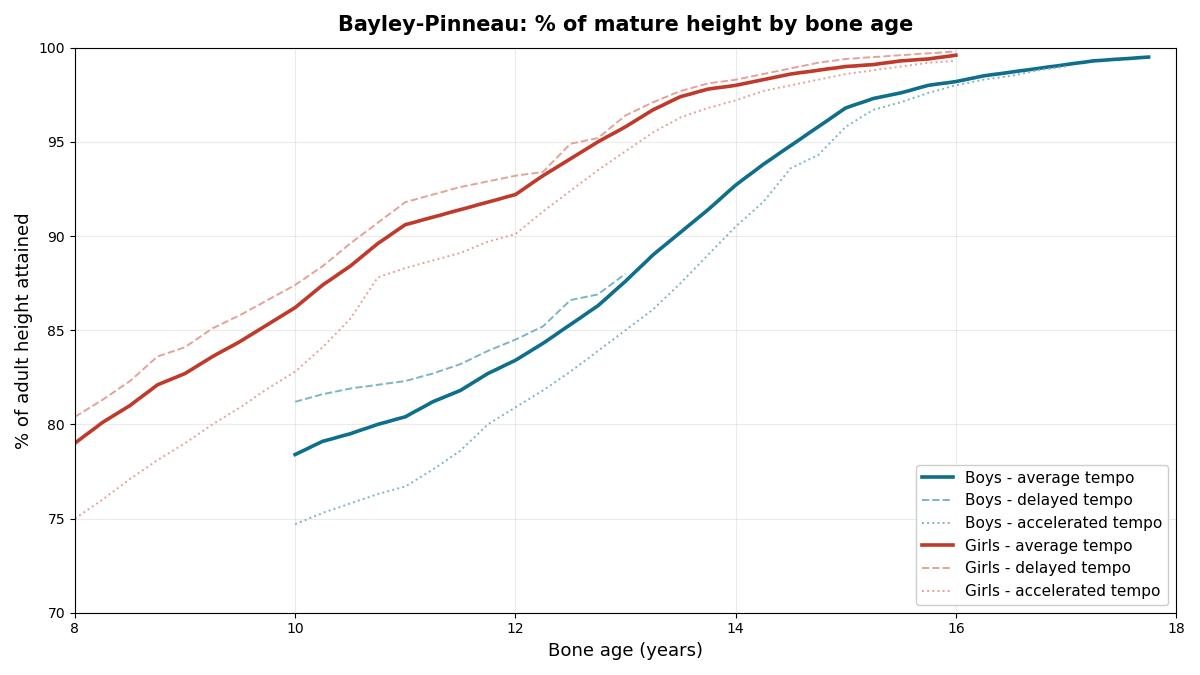
Second, the calculator reports the percentage of adult height already attained. This comes straight from the Bayley-Pinneau reference tables: at each bone age, the tables state what fraction of final height the average child with that skeletal maturity has already reached. A boy whose bone age is 10 years with average maturation has attained 78.40 percent of his adult height, so about one fifth of his growth is still to come. A girl whose bone age is 10 years with average maturation has attained 86.20 percent, reflecting the fact that girls mature earlier and are closer to their final height at the same bone age.
Third, the calculator divides the current height by that percentage to give the predicted adult height, plus the remaining growth in centimetres. This is the Bayley-Pinneau prediction. It is the secondary output: the bone age assessment itself is the primary clinical tool, and the height prediction is an estimate built on it. Both numbers assume the child keeps growing on the same trajectory, which is why the result should be read as a guide for discussion with your clinician rather than a fixed forecast.
How bone age is measured: Greulich-Pyle and Tanner-Whitehouse
Bone age is read from a radiograph of the left hand and wrist. The hand is used because it contains many small bones that ossify in a predictable sequence through childhood, giving the reader plenty of detail to judge. The two established methods are the Greulich-Pyle atlas and the Tanner-Whitehouse scoring system.
The Greulich-Pyle method, published in 1959 from the earlier work of Greulich and Pyle, is an atlas: a book of reference X-ray images, one standard image for each age and sex. The clinician holds the child's radiograph against the standards and picks the closest match, sometimes interpolating between two adjacent standards. It is fast and widely used, which is why most bone age readings parents receive are Greulich-Pyle bone ages. Its weakness is subjectivity: two readers can differ by six months to a year on the same film, and the 1950s American reference children may not match every population today.
The Tanner-Whitehouse method (TW2, revised as TW3) is a scoring system rather than an atlas. The reader grades the maturity of about 20 individual bones in the hand and wrist, assigns each a stage, converts the stages to scores, and sums them to a skeletal maturity score that maps to a bone age. It takes longer but is more reproducible between readers. In practice, most clinics use Greulich-Pyle for speed and reserve detailed scoring for research or difficult cases.
Whichever method is used, the reading belongs in a clinical context. A single bone age number means little on its own: the paediatrician combines it with the child's measured height, weight, growth velocity over time, stage of puberty, and sometimes hormone blood tests before deciding whether the growth pattern needs investigation or treatment.
How the Bayley-Pinneau adult height prediction works
In 1952, Nancy Bayley and Sarah Pinneau published tables for predicting adult height from skeletal age, revised for use with the Greulich-Pyle hand standards. Their insight was that how much of your final height you have reached depends on your skeletal maturity, not your birthday. A tall 9-year-old with a bone age of 11 has less growing left than a short 11-year-old with a bone age of 9, even though the second child is older.
The tables give, for each bone age and each sex, the percentage of mature height already attained. They also split children by maturation tempo: delayed (bone age at least one year behind chronological age), average (within one year), or accelerated (at least one year ahead). This matters because at the same bone age, a slow maturer has attained more of their final height than a fast maturer. In the tables, the delayed column always shows the highest percentage and the accelerated column the lowest: for example, at bone age 10 years a boy shows 81.20 percent (delayed), 78.40 percent (average), or 74.70 percent (accelerated).
The prediction itself is simple arithmetic: predicted adult height equals current height divided by the percentage expressed as a decimal. A boy of 137 cm with bone age 10.0 years and average tempo gives 137 divided by 0.7840, about 174.7 cm. A girl of 135 cm with bone age 10.0 years whose maturation is accelerated (bone age two years ahead of her chronological age of 8) uses the accelerated column, 82.80 percent, giving 135 divided by 0.8280, about 163.0 cm. Between the monthly table rows the calculator interpolates linearly, which is the standard way of handling values that fall between printed table entries.
The percentage tables embedded in this calculator are the published values tabulated by Paley and colleagues (Bone and Joint Open, 2023, supplementary Table i, "Adjusted multiplier table according to Bayley and Pinneau"), which reproduce the Bayley-Pinneau percentages at monthly resolution: bone ages 10 years to 17 years 9 months for boys and 8 years to 16 years for girls. One gap in that published tabulation is worth stating plainly: the delayed-tempo column for boys ends at bone age 13 years, and the accelerated-tempo column for boys ends at 17 years, because those cells were left blank in the source. Where a boy's result needs one of those missing cells, the calculator uses the average-tempo percentage and labels the prediction as approximate, since the true delayed or accelerated percentage is not in the published table.
Why a child's bone age can be advanced or delayed
An advanced bone age means the skeleton is maturing faster than the calendar suggests. The most common reason is simply early puberty: sex hormones accelerate bone maturation, so a child entering puberty early will usually have a bone age ahead of their chronological age. Less common causes include excess androgen exposure and certain genetic conditions. An advanced bone age matters because early maturation usually means early fusion of the growth plates, which can reduce the final adult height even though the child looks tall for their age right now.
A delayed bone age means the skeleton is maturing more slowly than expected. Constitutional delay of growth and puberty, the common "late bloomer" pattern, is the frequent benign explanation, especially in boys with a family history of late puberty. But persistent delay can also signal growth hormone deficiency, hypothyroidism, chronic illness such as coeliac disease or kidney disease, malnutrition, or excessive athletic training combined with low energy intake. This is why a delayed reading should not simply be reassuring on its own: the pattern over time and the accompanying clinical picture decide whether it is a normal variant or something to investigate.
In both directions, a single reading is less informative than the trend. Paediatricians watch whether the gap between bone age and chronological age is stable, narrowing, or widening across serial X-rays taken a year or more apart, alongside the child's growth velocity measured on accurate clinic stadiometers.
Limitations of this bone age calculator
First and most important: this tool does not measure bone age. It calculates from a number a clinician has already read from an X-ray. Entering a guessed bone age produces a meaningless result, and no online tool can substitute for the radiograph.
Second, the height prediction is an estimate with real uncertainty. The Bayley-Pinneau tables were built from mid-20th-century American children, and while they remain the standard reference, any prediction assumes the child continues on the same growth and puberty trajectory. Illness, treatment such as growth hormone or puberty blockers, and a puberty tempo that changes after the measurement all move the final height away from the prediction. Accuracy is generally best around puberty and weakest in young children, whose growth has the longest left to run.
Third, the tables have finite coverage. This calculator accepts bone ages from 10 to 17.75 years for boys and 8 to 16 years for girls, matching the published tabulation. Readings outside those ranges, which do occur in clinical practice, cannot be processed here. The male delayed-tempo and accelerated-tempo columns are also incomplete at the upper end of the range in the published source, as explained above, and the calculator flags those predictions as approximate.
Fourth, the tempo classification uses a one-year cutoff between bone age and chronological age, following the Bayley-Pinneau grouping. Children near the cutoff can flip between tempo columns with small changes in either age, which shifts the prediction by a few centimetres. Do not over-interpret small differences.
When to talk to your child's doctor
Use this calculator's output as a starting point for a conversation, not a conclusion. Contact your paediatrician if the bone age is more than two years ahead of or behind the chronological age, if the predicted adult height is much shorter or taller than the family's expectation based on parental heights, if your child's growth has slowed or stopped on their growth chart, or if puberty seems to be starting very early (breast development before 8 in girls, testicular enlargement before 9 in boys) or has not started by 13 in girls or 14 in boys. Bring the actual X-ray report and the growth measurements to the appointment: the numbers this calculator produces are only useful alongside the clinical record.
If your child is already under a paediatric endocrinologist's care, follow their plan rather than this tool. Decisions about investigating growth or puberty, and especially about any treatment, rest on the full clinical assessment, including blood tests and often more than one bone age reading over time.
Frequently asked questions
What is bone age?
Bone age is a measure of skeletal maturity, read from an X-ray of the child's hand and wrist (usually the left hand). A clinician compares the size, shape, and degree of mineralisation of the bones with reference images for each age, most often the Greulich-Pyle atlas. If the bones look like the reference for a 10-year-old, the bone age is 10 years, regardless of the child's actual (chronological) age.
Can this bone age calculator read my child's X-ray?
No. This calculator cannot read radiographs. Bone age must be measured by a clinician, usually a paediatrician or radiologist, from a hand and wrist X-ray. You enter the bone age they report, and the calculator compares it with the child's chronological age and estimates adult height with the Bayley-Pinneau tables. Never guess the bone age.
What does it mean if bone age is ahead of or behind chronological age?
A bone age within about 1 year of the chronological age is considered normal variation. A bone age more than 1 to 2 years ahead (advanced) can occur with early puberty, and a bone age more than 1 to 2 years behind (delayed) can occur with late puberty, chronic illness, or hormone deficiencies. Either pattern deserves discussion with the child's doctor, who interprets it alongside growth measurements, puberty staging, and sometimes blood tests.
How does the Bayley-Pinneau method predict adult height?
Bayley and Pinneau (1952) published tables giving the percentage of final adult height already attained at each bone age, separately for boys and girls and for children whose maturation is delayed, average, or accelerated relative to their chronological age. Predicted adult height equals current height divided by that percentage. For example, a boy of bone age 10 years with average maturation has attained 78.40 percent of his adult height, so a height of 137 cm predicts about 174.7 cm.
How accurate is a Bayley-Pinneau height prediction?
It is an estimate, not a guarantee. In the original studies the prediction was typically within a few centimetres of the final adult height, but accuracy is best near puberty and poorer in very young children. The prediction assumes the child continues on the same growth pattern and does not account for illness, treatment, or unusually early or late puberty after the measurement. Treat the result as a guide for discussion with your clinician, not as a fixed outcome.
At what age should bone age be measured?
Bone age X-rays are ordered when a clinician has a reason to assess growth or puberty, such as short stature, tall stature, early or late puberty, or monitoring of growth hormone treatment. There is no routine screening age. The reference tables used in this calculator cover bone ages from 10 to about 17.7 years in boys and 8 to 16 years in girls, which spans the ages where bone age assessment is most commonly requested.
Related child development calculators
Sources: Bayley N, Pinneau SR. Tables for predicting adult height from skeletal age: revised for use with the Greulich-Pyle hand standards. J Pediatr. 1952;40(4):423-441 (original percentage tables). Paley D et al. Bone Joint Open. 2023;4(10) supplementary Table i: "Adjusted multiplier table according to Bayley and Pinneau" (monthly tabulation of the percentages embedded in this calculator: boys 10y-17y9m, girls 8y-16y). Greulich WW, Pyle SI. Radiographic Atlas of Skeletal Development of the Hand and Wrist. 2nd ed. Stanford University Press; 1959 (bone age method).