How the predicted adult height calculator works
This predicted adult height calculator applies the Bayley-Pinneau method, first published by Nancy Bayley and Samuel R. Pinneau in the Journal of Pediatrics in 1952. The idea behind it is simple: children do not all grow on the same timetable, but the skeleton keeps a reliable record of how far along that timetable a child has travelled. A hand and wrist X-ray, read against the Greulich-Pyle atlas, gives a bone age: the age whose reference plate the child's skeleton most closely matches. Bayley and Pinneau measured what percentage of final adult height children had already reached at each bone age, and published those percentages as tables. The prediction is then one division: predicted adult height equals current height divided by the fraction of mature height already attained.
Take a concrete example. A boy whose clinician reports a bone age of 10.0 years has, on the average-tempo table, attained 78.4 percent of his mature height. If he stands 137 cm tall today, the prediction is 137 divided by 0.784, which is about 174.7 cm. A girl with a bone age of 10.0 years has attained 82.8 percent on average, so a current height of 135 cm predicts about 163.0 cm. Notice that the two sexes use different tables at every bone age, because girls mature earlier and their growth curves have a different shape.
This tool implements the average-tempo tables at their original half-year steps. When a bone age falls between two published points, for example 12.25 years, the calculator uses straight-line interpolation between the neighbouring points and labels the result as approximate. Interpolation between two measured points is standard practice and is disclosed every time it happens. What this tool never does is extrapolate beyond the tables or invent percentages where the source has gaps.
What you need before you start: a clinician's bone age reading
The single most important input is the bone age, and it must come from a clinician who has read a real X-ray. Usually this is a left hand and wrist radiograph compared against the Greulich-Pyle atlas by a radiologist or paediatrician, and increasingly it is produced by validated automated software such as BoneXpert. This page does not read radiographs, does not estimate bone age from a photograph or a description, and cannot substitute chronological age for bone age.
That honesty matters because the whole method collapses without a true bone age. Chronological age tells you how long a child has been alive; bone age tells you how far the skeleton has matured, and in growing children those two numbers routinely differ by a year or more in either direction. A tall ten-year-old with a bone age of twelve is much closer to finished growing than a tall ten-year-old with a bone age of nine, and no calculator can tell those two children apart without the X-ray reading. If you do not have a bone age from a clinician, the correct next step is to ask the child's doctor, not to guess a number.
You will also need an accurate current standing height in centimetres, measured without shoes, heels together, back straight, with a stadiometer if one is available. Small measurement errors matter: a 1 cm error in current height translates almost directly into a 1 cm error in the prediction, because the calculation is a simple scaling.
The Bayley-Pinneau percentage table this tool uses
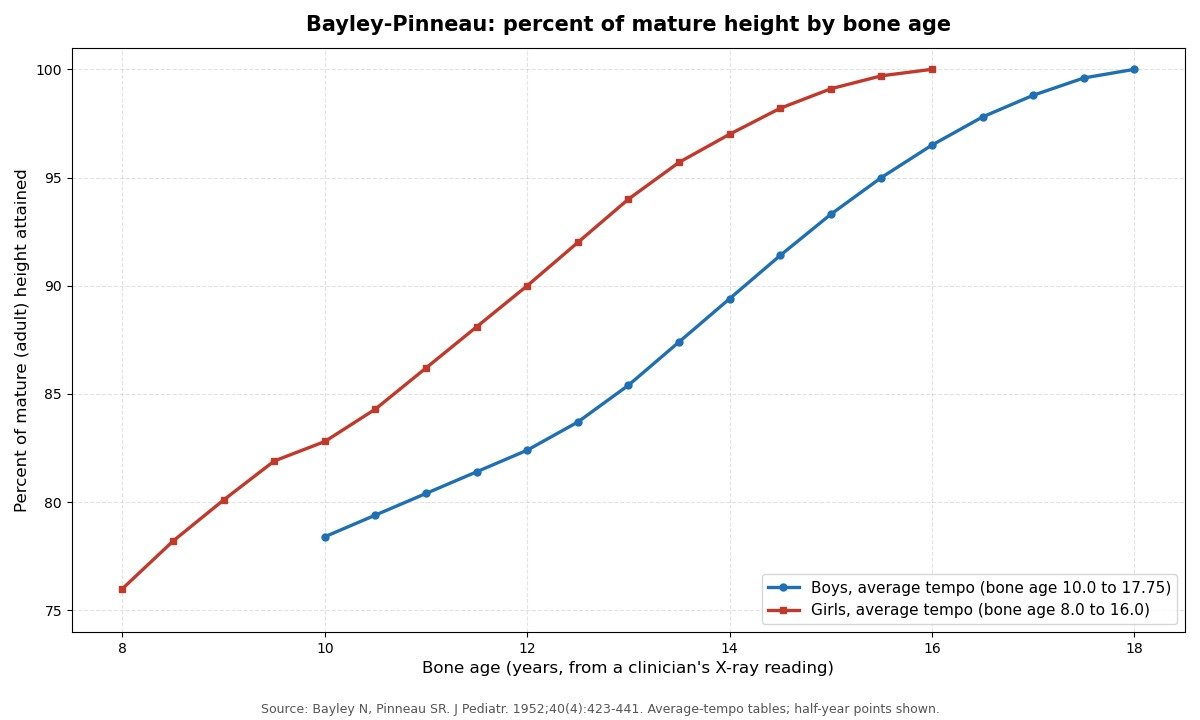
The tables below are the average-tempo percentage-of-mature-height values from Bayley and Pinneau 1952, reproduced at their original half-year granularity. They are the data this calculator actually uses, and the chart above plots exactly these points.
For boys, the validated coverage runs from bone age 10.0 to 17.75 years:
10.0: 78.4, 10.5: 79.4, 11.0: 80.4, 11.5: 81.4, 12.0: 82.4, 12.5: 83.7, 13.0: 85.4, 13.5: 87.4, 14.0: 89.4, 14.5: 91.4, 15.0: 93.3, 15.5: 95.0, 16.0: 96.5, 16.5: 97.8, 17.0: 98.8, 17.5: 99.6, 18.0: 100.0.
For girls, the validated coverage runs from bone age 8.0 to 16.0 years:
8.0: 76.0, 8.5: 78.2, 9.0: 80.1, 9.5: 81.9, 10.0: 82.8, 10.5: 84.3, 11.0: 86.2, 11.5: 88.1, 12.0: 90.0, 12.5: 92.0, 13.0: 94.0, 13.5: 95.7, 14.0: 97.0, 14.5: 98.2, 15.0: 99.1, 15.5: 99.7, 16.0: 100.0.
A few features of these tables deserve attention. First, girls reach any given percentage roughly two years earlier than boys, which mirrors the earlier timing of female puberty. Second, the curve is steepest in mid-puberty, around bone age 12.5 to 14.5 in boys and 10.5 to 12.5 in girls, which is when the largest share of remaining growth is being used up. Third, the final percentages approach 100 asymptotically: a boy at bone age 17.0 has only about 1.2 percent of growth left, which is why predictions become very stable near the end of growth and very uncertain at the start.
The calculator validates every bone age against the real coverage above. A bone age below 10.0 or above 17.75 for a boy, or below 8.0 or above 16.0 for a girl, is rejected with a named error rather than guessed at, because the source tables simply do not extend there.
Reading your result
The headline number is the predicted adult height in centimetres, shown to one decimal place. Beneath it you will see the percentage of mature height the tables say has already been attained, and the implied remaining growth, which is just the prediction minus today's height. If parental heights were entered, you will also see the mid-parental target height for comparison.
Two labels can appear alongside the number. "Approximate prediction" means the bone age fell between two published table points and the percentage was interpolated; the number is still computed honestly, but it carries one extra layer of estimation. If the bone age landed exactly on a published point, no interpolation was needed and the label does not appear. Either way, the prediction should be read as the centre of a wide range, not as a promise. The next section explains how wide that range really is.
It is also worth checking whether the result passes a basic plausibility test. A prediction far outside the family's height range, or one that implies a child has already stopped growing years early, deserves a second look at the inputs first and a clinician's opinion second. Data entry mistakes, especially a bone age typed as chronological age, are the most common cause of startling results.
How accurate is Bayley-Pinneau height prediction?
This is the section most height calculators skip, and it is the most important one. The Bayley-Pinneau method is the oldest and most widely used height prediction method in paediatric practice, but "most used" does not mean "very accurate". Bayley and Pinneau themselves reported a standard error of about plus or minus 5 cm, meaning a typical prediction misses the true final height by several centimetres in either direction.
Independent validation studies report wider scatter in real clinic populations. A Korean study of 44 children followed to near-final height found that 95 percent of Bayley-Pinneau predictions fell between plus 8.0 cm and minus 7.1 cm of the measured height in girls, a span of about 15 cm. The Berkeley Growth Study, the same population the tables were built from, showed that the standard deviation of the percentage of mature height attained could reach nearly 4 percentage points at some bone ages, which translates into several centimetres of prediction error on its own.
Accuracy also depends on who is being predicted. The method works best for healthy children whose bone age is close to their chronological age, that is, average-tempo children, because those are the children the tables describe. It systematically overestimates final height when bone age is advanced, as in precocious puberty, and underestimates it when bone age is delayed, as in constitutional delay of growth, a pattern documented across multiple studies including work in girls with idiopathic precocious puberty. Predictions made at young bone ages are less reliable than predictions made near the end of growth, which is simply because more growing remains to be done and more can still go differently.
The honest way to use this tool is therefore as a rough guide and a conversation starter with a clinician, never as a verdict. A prediction of 174.7 cm is better read as "most likely somewhere in the high 160s to low 180s". Any decision about treatment, such as growth hormone or puberty-delaying therapy, needs a paediatric endocrinologist, serial measurements, and usually more than one prediction method.
Early, average and late maturers: why this tool uses one table
Bayley and Pinneau knew that tempo matters, so they actually published three sets of tables for each sex: one for children whose bone age is more than a year ahead of chronological age (early maturers), one for children within a year either way (average maturers), and one for children more than a year behind (late maturers). An early maturer grows with what they called exceptional vigour but for a shorter time; a late maturer grows more slowly but for longer.
This calculator deliberately uses only the average-tempo tables. The reason is transparency: choosing the right tempo table requires a reliable comparison of bone age against chronological age plus clinical judgement about pubertal stage, and getting that choice wrong shifts the prediction by several centimetres. Rather than asking users to self-classify tempo, which most cannot do reliably, the tool applies the average table to everyone and states the limitation openly. If a clinician has determined that a child is clearly early or late maturing, the clinician's own prediction using the tempo-specific tables takes precedence over this tool's number.
This choice also explains part of the error pattern described above. When an early maturer's bone age is run through the average table, the prediction tends to come out too high; for a late maturer, too low. If your result looks surprisingly tall or short for the family, tempo mismatch is the first suspect, and the second is an input error.
Comparing with mid-parental target height
The optional parental heights unlock a useful second perspective. The mid-parental target height estimates genetic potential from the parents: add the father's and mother's heights, then add 13 cm for a boy or subtract 13 cm for a girl, and divide by two. Most children end up within about 8 to 10 cm of this target, which gives a rough expected range.
The two numbers answer different questions, so disagreement between them is informative rather than alarming. The Bayley-Pinneau prediction reflects where the child's skeleton is right now: current tempo, current health, current nutrition. The mid-parental target reflects where the genes point in the long run. A late-maturing boy can easily have a Bayley-Pinneau prediction above his family target, because his skeleton is young for his age and has more growing time left than the average table assumes; an early-maturing girl can have one below it for the mirror-image reason.
When the two methods agree, confidence in the general neighbourhood of the answer goes up a little. When they disagree by more than about 8 to 10 cm, that is worth mentioning to the child's doctor, because it can flag a tempo issue, a measurement problem, or occasionally a genuine growth concern. For a dedicated tool that explores the family-height side in depth, see our mid-parental height predictor.
When a growth concern needs a clinician
A calculator cannot diagnose anything, but it can help you decide whether a conversation with a doctor is warranted. Seek a clinician's assessment, ideally a paediatrician or paediatric endocrinologist, if any of the following apply: the child's growth has slowed markedly or stopped well before the expected end of puberty; the child's height has fallen across centile lines on the growth chart; predicted adult height is far below the mid-parental target range without an obvious tempo explanation; puberty started very early (before 8 in girls or 9 in boys) or has not started by 13 in girls or 14 in boys; or there are symptoms suggesting illness, such as unexplained weight loss, chronic disease, or poor nutrition.
Bring this tool's result to the appointment if you like, but bring the raw inputs too: the bone age report, the measured heights with dates, and the parents' heights. A clinician will want serial measurements plotted on a proper growth chart, such as our height-for-age centile tool and height velocity calculator, because a single prediction is always weaker evidence than a growth trend. If you have not yet had a bone age read at all, our bone age calculator explains what the reading involves and what the numbers mean.
Frequently asked questions
What is the Bayley-Pinneau method of predicting adult height?
It is a method published by Nancy Bayley and Samuel Pinneau in the Journal of Pediatrics in 1952. It predicts final adult height from the child's current height and bone age, using tables of the percentage of mature height attained at each bone age. Predicted adult height equals current height divided by that percentage expressed as a fraction. It remains the most widely used height prediction method in paediatric practice, even though newer methods exist.
Do I need an X-ray to use this predicted adult height calculator?
You need the bone age number from a clinician's reading of a hand and wrist X-ray, usually against the Greulich-Pyle atlas. This tool does not read radiographs and cannot estimate bone age from a photo, a description, or chronological age. Guessing the bone age produces a meaningless result, so get the real reading from the child's doctor or radiologist first.
How is predicted adult height calculated from bone age?
In three steps. First, the bone age is matched to the Bayley-Pinneau percentage table for the child's sex to find the fraction of adult height already achieved. Second, the current height in centimetres is divided by that fraction. Third, the answer is shown with its context: the percentage attained, the implied remaining growth, and an approximate label whenever the bone age fell between published table points and needed interpolation.
How accurate is the Bayley-Pinneau height prediction?
Moderately at best. Bayley and Pinneau reported a standard error around plus or minus 5 cm, and independent studies find 95 percent of predictions landing within roughly plus or minus 7 to 8 cm of the true final height. Predictions are most reliable for healthy, average-tempo children measured near the end of growth, and least reliable for young children or those whose bone age is far ahead of or behind their chronological age.
What bone age range does this calculator cover?
Boys from 10.0 to 17.75 years of bone age, and girls from 8.0 to 16.0 years, which is the validated coverage of the average-tempo tables. Bone ages outside those ranges are rejected with a named error. Values between the half-year table points are linearly interpolated and flagged as approximate rather than silently treated as exact.
Why does this prediction differ from the mid-parental target height?
Because they measure different things. Bayley-Pinneau reflects the skeleton's current maturity and tempo; the mid-parental target reflects genetic potential from the parents' heights. Early maturers often get Bayley-Pinneau predictions below their family target and late maturers above it. Agreement between the two is reassuring; a large disagreement is worth discussing with the child's doctor.
Sources: Bayley N, Pinneau SR. Tables for predicting adult height from skeletal age: revised for use with the Greulich-Pyle hand standards. J Pediatr. 1952;40(4):423-441 (tables reproduced in the 1959 Greulich-Pyle atlas appendix). Thodberg HH et al. Handbook of Growth: Adult Height Prediction Models. Springer; 2009 (background on the Bayley-Pinneau method and its Berkeley Growth Study population). Jeong SW et al. Near final height in Korean children referred for evaluation of short stature. Ann Pediatr Endocrinol Metab. 2018;23:28-32 (independent validation, limits of agreement). Tarim O. Accuracy of height prediction by Bayley-Pinneau method. J Pediatr Endocrinol. 2016;1(1):1002 (error discussion, Berkeley Growth Study variability). Page medically reviewed by Dr. Taimoor Asghar, Physician and Community Medicine Researcher.