Head Circumference Percentile Calculator
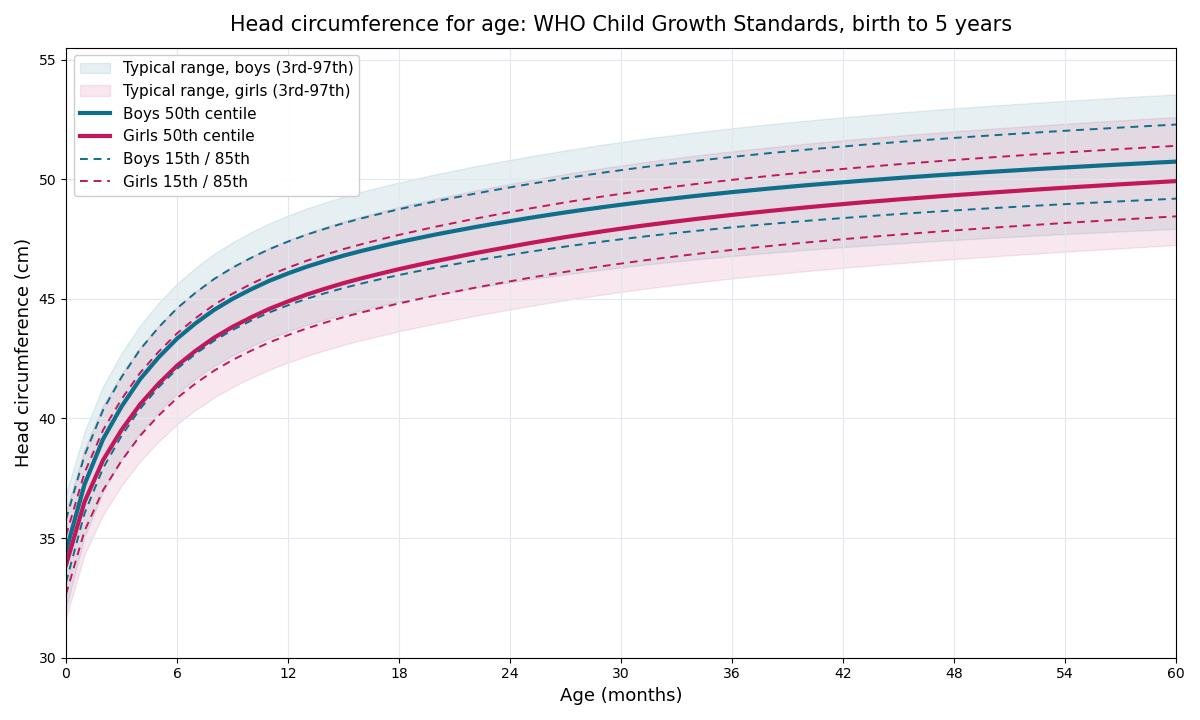
This head circumference percentile calculator places your child on the WHO Child Growth Standards for ages 0 to 5 years. Enter sex, age, and the measured head circumference in centimetres for an instant centile, z-score, and plain-language interpretation.
What your head circumference percentile calculator result means
A centile compares your child with 100 healthy children of the same age and sex from the WHO reference population. A child on the 40th centile has a larger head circumference than 40 of those 100 children and a smaller one than 60. The middle of the scale, around the 50th centile, is simply the average; anywhere between the 3rd and 97th centiles sits within the typical range for that age and sex.
| Centile (z-score) | Interpretation | What to do |
|---|---|---|
| 3rd to 97th (z -2 to +2) | Typical range | Normal growth pattern. Keep measuring at routine checks. |
| Below 3rd (z below -2) | Microcephaly range | Warrants clinical evaluation. A single reading does not diagnose a condition. |
| Above 97th (z above +2) | Macrocephaly range | Warrants clinical evaluation. A single reading does not diagnose a condition. |
The trend over time matters more than any single reading. A child steadily following one centile line is growing normally even far from the 50th, while a child crossing two centile bands in either direction deserves a review even while the readings sit inside the typical range. A one-off unusual number should always be confirmed with a careful remeasurement before anyone draws conclusions from it.
How the head circumference percentile calculator works
The WHO Child Growth Standards come from the Multicentre Growth Reference Study (1997-2003), which followed about 8,440 healthy, breastfed children in Brazil, Ghana, India, Norway, Oman, and the United States. Because these children were raised in conditions that support full growth, the standards describe how children should grow, not just how they do grow, and they apply to children everywhere regardless of ethnicity.
This calculator uses the official WHO LMS parameters for head circumference-for-age, birth to 5 years, taken from the WHO expanded tables for constructing growth charts. For each age the WHO publishes an M (the median) and an S (the spread of values around the median). For head circumference the L parameter, which adjusts for skew, equals 1 at every age, so the z-score is simply (measurement / M - 1) / S. The centile is the matching point on the standard normal distribution: a z-score of 0 sits exactly on the 50th centile, -2 on about the 2.3rd centile, and +2 on about the 97.7th centile. Your child's age is matched to the nearest completed month of the WHO tables.
Why head circumference is measured in early childhood
Of all the measurements taken at a well-baby visit, head circumference is the one most directly tied to what is happening inside the skull. The brain grows faster in the first two years of life than at any other time, roughly doubling in volume in the first year, and the skull expands to accommodate it. A tape measure around the head is therefore the simplest available window into brain growth, which is why paediatricians record it at every routine visit alongside weight and length, and plot each reading on a growth chart rather than judging any single number on its own.
Most of the time the reading simply confirms that growth is on track, and parents never hear another word about it. The value of routine measurement lies in the exceptions: a head that stops growing, grows unusually fast, or sits far from the expected range can be the earliest clue to a condition affecting the brain or the skull bones. Caught early through growth monitoring, many of these conditions are far more treatable than when they are discovered late, which is the whole reason the measurement is repeated so faithfully in the first years.
How to measure head circumference accurately
- Use a flexible, non-stretchable measuring tape. Paper tapes from clinic visits are fine; a tailor's tape also works.
- Wrap the tape around the widest part of the head: just above the eyebrows and the ears, and around the most prominent part of the back of the head (the occiput).
- Keep the tape snug against the scalp but not tight enough to indent the skin. Hair bulk can add a few millimetres, so press the tape through the hair.
- Take three readings and keep the largest. Measure to the nearest 0.1 cm and note the date and the child's exact age.
- A crying or wriggling baby gives unreliable numbers. Measure when the baby is calm, and have a second person help if needed.
- Always remeasure before acting on an unexpected result. Most surprises are measurement slips, not growth problems.
A low reading: understanding the microcephaly range
When a confirmed head circumference sits below the 3rd centile, meaning a z-score below -2, clinicians use the term microcephaly: literally, a small head for age and sex. The word describes a measurement, not a cause, and reaching for a diagnosis from a single calculator result would be a mistake. Many low readings resolve on remeasurement, and a meaningful share reflect a constitutionally small head that simply runs in the family. Premature babies also need their age corrected for how early they were born, usually until at least 2 years of age, before their centile means anything at all.
When a low reading persists across careful repeat measurements, the paediatrician looks at the whole child rather than the number alone: developmental milestones, the neurological examination, how weight and length are growing, the head sizes of both parents, and the pregnancy and birth history. Conditions they consider include genetic syndromes, infections during pregnancy, and severe early undernutrition, but the evaluation always begins with confirming the measurement and taking a careful history. The appropriate response to a low reading is a timely clinical review, not alarm, because context determines what the number means.
A high reading: understanding the macrocephaly range
A confirmed head circumference above the 97th centile, a z-score above +2, falls in the range clinicians call macrocephaly. In practice the commonest explanation is also the most reassuring: large heads run in families, and a baby with two large-headed parents who is developing normally and has always tracked along a high centile line is usually following the family pattern. Benign familial macrocephaly is common enough that paediatricians routinely ask about parental head size before doing anything else.
What changes the picture is the pattern of growth rather than the size itself. A head circumference that climbs rapidly across centile lines, especially in the first year, prompts the clinician to check for excess fluid around the brain, such as hydrocephalus, and to feel the fontanelle (the soft spot) and assess development. A stable high line with normal development is reassuring; a fast-rising line is not, and it deserves prompt assessment. Either way, a single high reading is a reason to track carefully and mention it at the next routine check, not a reason to panic.
Centiles versus z-scores
This calculator shows both a centile and a z-score, and they describe the same position in two different ways. The z-score counts standard deviations from the WHO median: a z-score of 0 is exactly average, -1 is one standard deviation below the median, and +1 is one above. The centile translates that position into "out of 100 children": a z-score of -2 sits at about the 2.3rd centile, and +2 at about the 97.7th.
Clinicians often prefer z-scores for tracking because centiles compress at the extremes. A child moving from a z-score of -2.5 to -3.5 has changed substantially, but on the centile scale that looks like a tiny shift from roughly the 0.6th to the 0.02nd centile, which is easy to misread as no change. For day-to-day understanding, centiles are more intuitive; for following a child over months and years, the z-score tells the truer story.
Limitations
- These standards cover birth to 5 years. For ages 5 to 19 the WHO publishes a separate 2007 growth reference; ask your paediatrician for those charts.
- Premature babies need their age corrected for prematurity until at least 2 years; use the corrected age in this calculator.
- A centile describes one moment. The growth pattern across several visits is more informative than any single reading.
- Head shape affects the tape measurement. Positional flattening of the back of the head, for example, can slightly alter the reading; a clinician interprets the number alongside an examination of head shape.
- This tool does not diagnose microcephaly, macrocephaly, or any other condition, and it does not replace professional assessment.
Frequently asked questions
What is a head circumference centile?
A head circumference centile compares your child's head size with the WHO reference population of healthy children of the same age and sex. A baby on the 40th centile has a larger head circumference than 40 out of 100 same-age children and a smaller one than 60. It describes where the child sits in the population, not a grade or a pass mark.
Why do doctors measure head circumference?
Head circumference is the simplest window into brain and skull growth. The brain grows fastest in the first two years of life, so paediatricians measure head circumference at every routine well-baby visit alongside weight and length, and plot each reading to check that the child keeps following their own growth curve.
Which ages does this head circumference percentile calculator cover?
This calculator covers birth to 5 years (0 to 60 months), using the WHO Child Growth Standards. For children aged 5 to 19, the WHO publishes a separate 2007 growth reference, so ask your paediatrician for those charts.
How do I measure head circumference correctly?
Use a flexible, non-stretchable tape. Wrap it around the widest part of the head: just above the eyebrows and ears, and around the most prominent part of the back of the head. Keep the tape snug but not tight, take the largest of three readings, and record to the nearest 0.1 cm.
My baby is below the 3rd centile. Does that mean microcephaly?
Not from one reading. Below the 3rd centile is the range where clinicians start calling it microcephaly when the finding is confirmed, but many single low readings turn out to be measurement slips, a constitutionally small head that runs in the family, or an age that was not corrected for prematurity. The correct next step is a careful remeasurement and a paediatric review, not a diagnosis from a calculator.
My baby is above the 97th centile. Should I worry?
A single high reading is most often familial: large heads run in families and are usually completely benign when development is normal. What prompts closer attention is rapid upward crossing of centile lines over time, or a large head alongside developmental concerns. Mention any high reading at the next routine check so it can be tracked.
Why did the centile change between visits?
Small shifts are normal: tape position, a crying baby, or a slightly different measurer can move a reading by a centimetre, which shifts the centile noticeably in a small infant. Real growth change shows as a consistent drift across several visits in the same direction. That is why clinicians trust the trend line over any single point.
Related child development calculators
Source: WHO Child Growth Standards: Head circumference-for-age. WHO Multicentre Growth Reference Study Group. Geneva: World Health Organization; 2006. LMS parameters from the official WHO expanded tables for head circumference-for-age, birth to 5 years.