Developmental Milestones Checklist
This developmental milestones checklist helps you track what your child can do at each stage from 2 months to 5 years. It is built directly from the Centers for Disease Control and Prevention (CDC) "Learn the Signs. Act Early." milestone lists, updated in 2022. Enter your child's age in months, tick the milestones you have seen your child reach, and the tool shows how many have been achieved and flags any missed milestones with clear act-early guidance.
What developmental milestones are
Developmental milestones are skills that children typically gain as they grow: a first smile, a first word, a first step. They cover how a child plays, learns, speaks, acts, and moves. Paediatricians use milestones as clues about how development is progressing, and they are one of the simplest tools a parent has for watching a child grow. The lists on this page come from the CDC "Learn the Signs. Act Early." programme, which revised its milestone checklists in 2022 after a major evidence review. The revision kept only milestones that at least 75 percent of children can do by each age, so a missed milestone is worth noticing rather than something most children fail.
Every child develops at their own pace, and there is a wide range of normal. Milestones are best seen as guideposts, not deadlines. A child who walks at 13 months instead of 12 is usually developing perfectly well. The value of a milestone checklist is the pattern it reveals: one late milestone is rarely meaningful, but several missed milestones in one domain, or a skill a child had and then lost, are patterns a doctor should hear about. That is why the CDC asks families to take a completed checklist to every well-child visit and to talk about the milestones reached and what to expect next.
The four developmental domains
The CDC organises milestones into four domains, and this checklist follows the same grouping. Watching all four gives a fuller picture than watching any single skill, because development is connected: a child who cannot hear well may be slow to talk, and a child who cannot sit steadily may be slow to play with toys.
Social and emotional
This domain covers how a child bonds with people and handles feelings. Early social milestones include calming when picked up, looking at faces, and smiling back. Later ones include playing games like peek-a-boo, showing affection, noticing when others are upset, and eventually playing cooperatively and following rules with other children. Social and emotional development is the foundation of relationships, and it is also the domain where early signs of autism most often appear, which is one reason doctors screen for autism specifically at 18 and 24 months.
Language and communication
This domain covers both understanding and expression, from reacting to loud sounds at 2 months to telling a story with several events at 5 years. It includes gestures as well as words: waving bye-bye, pointing to ask for help, and nodding yes all count as communication. Because language milestones are easy for parents to observe in daily life, they are often the first place a concern shows up. If a child is not using words or gestures as expected, a hearing check is usually one of the first steps a doctor takes.
Cognitive
The cognitive domain covers learning, thinking, and problem-solving: exploring objects with the mouth and hands, looking for a hidden toy, stacking blocks, following instructions, counting, and recognising letters. Cognitive milestones show how a child takes in information and works things out. Many of them look like play, and that is no accident: play is how young children learn. Offering simple, open-ended play, like blocks, books, and pretend games, gives a child the practice these skills need.
Movement and physical development
This domain covers gross motor skills (holding the head up, sitting, standing, walking, running, jumping, hopping) and fine motor skills (grasping, picking up small bits of food, scribbling, drawing, buttoning). Motor milestones follow a predictable head-to-toe sequence, and they unlock the other domains: a baby who can sit can see and reach more, and a toddler who can walk can explore. The CDC also publishes a free Milestone Tracker app that lets families record these skills with photos and videos between doctor visits.
How this developmental milestones checklist works
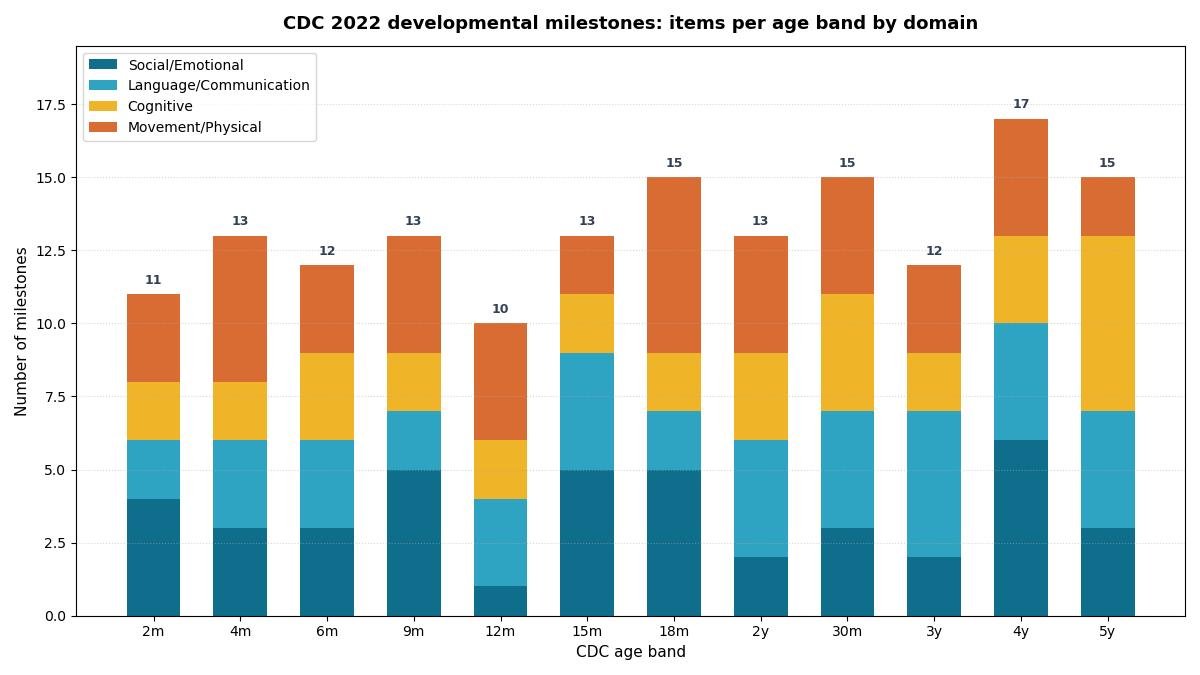
Enter your child's age in months and the tool shows the CDC milestone set for the nearest age band at or below that age. The bands are 2, 4, 6, 9, 12, 15, and 18 months, then 2 years, 30 months, 3, 4, and 5 years. If your child is 7 months old, for example, you will see the 6-month list, because a 7-month-old is expected to have reached the 6-month milestones and is still working toward the 9-month ones. If your child is under 2 months, the tool shows the 2-month set, which is the youngest CDC list.
Tick each milestone your child has clearly reached. Be honest rather than generous: a skill counts when your child does it consistently, not once by accident. When you submit, the tool reports how many milestones were achieved out of the total for that band, with a percentage. Most importantly, any milestone left unticked is listed by name under an "Act early" flag, with the CDC's guidance to discuss it with your child's doctor. You can print the result or copy it to take to an appointment.
What "act early" means
"Act early" is the second half of the CDC programme's name, and it carries a specific message: do not adopt a wait-and-see approach to developmental concerns. Research on early intervention consistently shows that services help most when they start early, while the brain is at its most adaptable. Waiting to see if a child "grows out of it" can cost months of support during exactly the period when support works best. The CDC's own wording is direct: you know your child best, and if your child is not meeting one or more milestones, has lost skills they once had, or you have other concerns, talk with your child's doctor, share your concerns, and ask about developmental screening.
Acting early does not mean panicking, and it does not mean a diagnosis. It means a conversation and, where the doctor agrees, a formal screening with a validated tool. In many countries, including through early intervention programmes in the United States, families can also contact their local early intervention service directly for an evaluation. Bringing a completed checklist to that conversation, with specific milestones named, makes it far more productive than saying "I am a bit worried." This tool's act-early list is designed for exactly that purpose: a clear, named list to hand to the doctor.
Developmental screening is not a diagnosis
It helps to keep three levels separate. Surveillance is what this checklist does: watching and recording, raising or lowering concern. Screening is the next step: the doctor uses a standardized, validated instrument, such as a parent questionnaire scored against norms, to decide whether a full evaluation is warranted. Diagnosis comes only after a detailed evaluation by specialists, and it is what unlocks targeted therapies and support services.
A missed milestone on this checklist therefore means "ask about screening", not "my child has a developmental disorder". Most children who miss one milestone turn out to be developing typically once the full picture is seen. At the same time, the checklist's thresholds are deliberately set where 75 percent or more of children succeed, so repeated misses are a genuine signal. The American Academy of Pediatrics recommends formal developmental screening at 9, 18, and 30 months, and autism-specific screening at 18 and 24 months, or sooner whenever a parent or provider has a concern. A checklist used between those visits keeps the family's observations in the record.
One pattern deserves special mention: losing a skill a child once had. Developmental regression is uncommon, but when it happens it should always be discussed with a doctor promptly, whatever the checklist score. The CDC checklists include this as one of the questions families should raise at every visit.
When to seek an evaluation
Beyond the milestone lists, seek advice promptly if any of the following apply: your child has lost a skill they once had; your child does not respond to their name or to loud sounds; your child avoids eye contact or does not seek comfort from familiar people; your child shows no back-and-forth play or communication by the end of the first year; or your own concern persists even when a checklist looks reassuring. Parental concern is itself a valid reason for screening, and doctors are used to hearing it.
For babies born prematurely, use the adjusted age (actual age minus the number of weeks early) until about two years of age, which is what the age field on this tool expects. Twins and multiples develop on the same milestone schedule as singletons, judged individually. If your child was recently ill, is going through a major change, or is being assessed in a second language, mention the context to the doctor: milestones describe typical development, and a good evaluation always interprets them alongside the child's circumstances. What matters most is a pattern over time, recorded honestly, and a conversation started early.
Frequently asked questions
What is a developmental milestones checklist?
A developmental milestones checklist lists the skills that most children (75 percent or more) can do by a given age, grouped into the social/emotional, language/communication, cognitive, and movement/physical domains. Parents tick the milestones they see in their child. It is a surveillance aid that helps families notice concerns early and bring them to the child's doctor; it is not a diagnostic test.
What are the four developmental domains in the CDC lists?
The CDC 2022 lists use four domains: social/emotional (bonding and interaction, such as smiling or playing with others), language/communication (sounds, gestures, words, and understanding), cognitive (learning, thinking, and problem-solving, such as stacking blocks or following instructions), and movement/physical development (gross and fine motor skills, from holding the head up to hopping on one foot).
What should I do if my child has not reached one or more milestones?
Talk with your child's doctor, share your concerns, and ask about developmental screening. You know your child best, and you do not need to wait for the next scheduled checkup. Early intervention services make the greatest difference in the early years, so the CDC's guidance is to act early rather than wait and see.
What is the difference between developmental screening and diagnosis?
Surveillance (this checklist) raises or lowers concern. Screening uses standardized, validated tools to decide whether a full evaluation is needed. Diagnosis follows a detailed evaluation by specialists. A missed milestone on a checklist means "ask the doctor about screening", not "my child has a developmental disorder".
How often should my child's development be screened?
The American Academy of Pediatrics recommends screening for general development with standardized, validated tools at 9, 18, and 30 months of age, and screening for autism at 18 and 24 months, or whenever a parent or provider has a concern. Milestone checklists complement that schedule by helping families watch between visits.
Should I use my premature baby's actual age or adjusted age?
For babies born prematurely, doctors usually use adjusted (corrected) age, which subtracts the number of weeks the baby was early, until about two years of age. Using adjusted age gives a fairer comparison with the milestone lists. If you are unsure, enter the adjusted age and mention both ages to your child's doctor.
Related child development calculators
Sources: milestone lists adapted from CDC "Learn the Signs. Act Early." developmental milestone checklists, updated February 2022 (CDC milestones page). Evidence review: Zubler JM et al. Evidence-informed milestones for developmental surveillance tools. Pediatrics. 2022;149(3):e2021052138. Screening schedule: American Academy of Pediatrics recommendations as summarised by CDC (general development screening at 9, 18, and 30 months; autism screening at 18 and 24 months).