Tanner Stage Calculator
This Tanner stage calculator is a guided self-assessment that estimates the likely stage of puberty from plain, clinical questions. It cannot replace a clinician's examination, and every result is labelled as likely, not definitive.
How this Tanner stage calculator works
This Tanner stage calculator asks plain, clinical questions about observable changes: breast development and pubic hair for girls, genital development and pubic hair for boys, plus questions on the growth spurt, voice and body changes, and the timing of periods. Each answer maps to a stage from 1 (prepubertal) to 5 (adult). The tool combines the two main tracks, breast or genital development and pubic hair, into a single likely stage, and shows the two tracks separately because they often differ by a stage.
Three design choices keep the tool honest. First, the result is always worded as likely, never definite, because self-assessment regularly differs from a clinician's examination by one stage. Second, pubic hair is scored on its own track, since it is driven by adrenal hormones (adrenarche) rather than the reproductive hormone axis (gonadarche), and the two can progress at different speeds. Third, if you enter the child's age, the tool flags possible early or late timing against standard cutoffs, so you know when a paediatrician's review is the sensible next step.
What the Tanner stages are
The Tanner stages, sometimes called Sexual Maturity Ratings, are a five-stage scale published by the paediatricians William Marshall and James Tanner in 1969 and 1970. They describe the sequence of physical changes in puberty. The stages are defined by development, not by age, which is why two healthy children of the same age can be at different stages.
The five stages in girls
In girls, staging is based on breast development, with pubic hair scored on a parallel scale:
- Stage 1 (prepubertal): no breast tissue; only the nipple is raised. Only fine, light vellus hair is present.
- Stage 2: breast bud stage. A small, firm mound raises the breast and nipple, and the areola widens. A few sparse, slightly darker hairs appear along the labia.
- Stage 3: the breast and areola enlarge further as a single contour, with no separation between them. Pubic hair becomes darker, coarser and curlier, spreading over the pubic area.
- Stage 4: the areola and nipple form a secondary mound above the level of the breast. Pubic hair is now adult in type but covers a smaller area, without spread to the inner thighs.
- Stage 5: mature stage. The areola recedes into the general breast contour and only the nipple projects. Pubic hair is adult in type and quantity.
The first sign of puberty in girls is usually breast budding (thelarche), which is why the absence of any breast development by age 13 is the standard marker used when checking for delayed puberty.
The five stages in boys
In boys, staging is based on genital development, again with pubic hair on a parallel scale:
- Stage 1 (prepubertal): testes, scrotum and penis are the same size and shape as in early childhood.
- Stage 2: the scrotum and testes enlarge; the scrotal skin reddens and changes in texture. There is little or no enlargement of the penis at this point.
- Stage 3: the penis enlarges, lengthening first, and the testes grow further. Pubic hair becomes darker, coarser and curlier.
- Stage 4: the penis grows in breadth and the glans develops; the testes and scrotum are larger and the scrotal skin darkens. Pubic hair is adult in type over a smaller area.
- Stage 5: adult genitalia in size and shape, with adult pubic hair distribution.
The first sign of puberty in boys is enlargement of the testes (a volume of about 4 ml or more), which is why the absence of testicular enlargement by age 14 is the standard marker used when checking for delayed puberty.
Typical ages for each Tanner stage
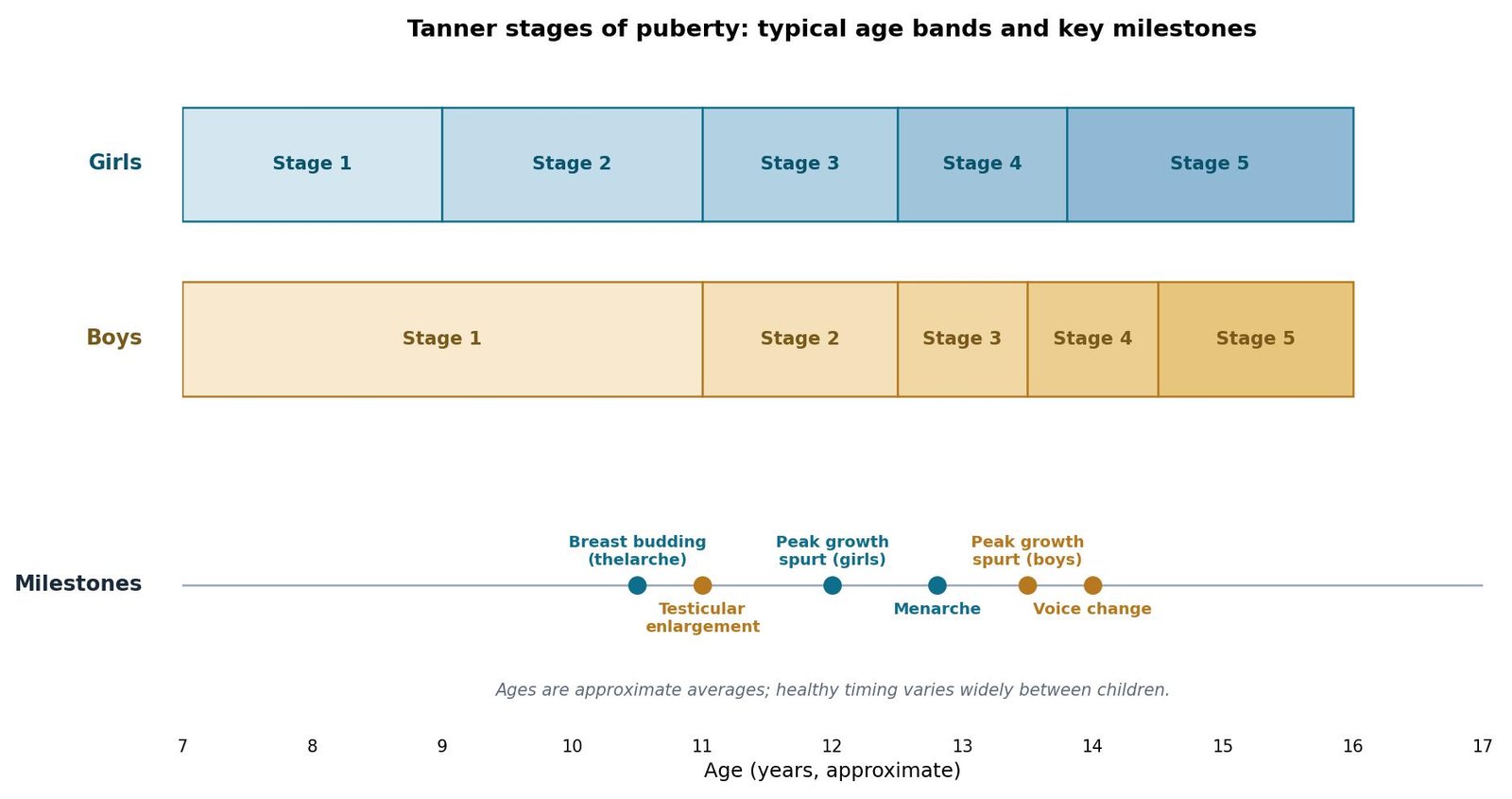
Stages are defined by development, so age ranges are approximate averages, and healthy children vary widely. The average age of pubertal onset is about 10.5 years in girls (usual range 8 to 13) and about 11 years in boys (usual range 9 to 14). The table below shows roughly when each stage begins in an average child. A child who is a stage ahead of or behind these ages is often still entirely normal, especially if the family pattern is similar.
| Stage | Girls: begins around | Boys: begins around |
|---|---|---|
| Stage 1 | After the 8th birthday | After the 9th or 10th birthday |
| Stage 2 | Around age 9 to 11 | Around age 11 |
| Stage 3 | After age 12 | Around age 13 |
| Stage 4 | Around age 13 | Around age 14 |
| Stage 5 | Around age 15 | Around age 15 |
Notice that the growth spurt does not happen at the same point in both sexes. In girls, peak height velocity usually arrives early, around stages 2 to 3, and menarche (the first period) follows about two to two and a half years after puberty begins, at an average age of around 12 to 12.5 years. In boys, the growth spurt comes later, around stages 3 to 4, roughly two years after onset, which is why boys are often still growing when girls their age have nearly finished.
Why puberty timing varies so much
Puberty timing is one of the most variable parts of child development, and most of that variation is normal. Genetics is the strongest influence: children tend to follow the timing of their parents, and identical twins often begin puberty at nearly the same age. General health and nutrition matter too; chronic illness, very low body weight, or intense athletic training can delay puberty, while higher body fat is associated with earlier onset in girls.
There is also a long-term trend toward earlier puberty in the general population, reported first in girls in the 1990s and later, to a lesser extent, in boys. Because of this, specialists continue to debate whether the traditional cutoffs should be adjusted, but the standard definitions below remain generally accepted in clinical guidance.
One more source of confusion is worth knowing. Pubic hair, underarm hair, body odour and mild acne are driven by adrenal hormones (adrenarche) and can appear a few years before true central puberty begins. A child can therefore have pubic hair while still being at breast or genital stage 1. The questionnaire scores pubic hair separately for exactly this reason.
Precocious puberty: when puberty starts too early
Puberty is considered precocious when the first signs appear before age 8 in girls or before age 9 in boys. This definition is used in the Endocrine Society's clinical practice guidance and in American Academy of Pediatrics guidance, and it remains the standard despite ongoing debate about secular trends toward earlier development.
Early puberty is much more common in girls than in boys, roughly ten times more common, and in girls most cases of central precocious puberty have no identifiable underlying cause. In boys, early puberty is more likely to have an underlying medical cause, so it is treated as needing prompt specialist evaluation. Possible consequences of genuinely precocious puberty include a reduced final adult height, because the growth plates fuse earlier, and psychosocial strain from developing visibly earlier than peers.
Not every early sign is precocious puberty. Isolated breast development (premature thelarche) or isolated early pubic hair (premature adrenarche), with a normal growth rate and no other pubertal changes, are usually benign variants rather than true early puberty. A paediatrician distinguishes these with growth records, and sometimes hormone tests, which is another reason an online estimate can never substitute for clinical assessment.
Delayed puberty: when puberty starts late
Puberty is considered delayed when there is no breast development by age 13 in girls, no testicular enlargement by age 14 in boys, or no menarche by age 15. These cutoffs mark the point at which about 95 percent of children of that sex have started puberty, so falling outside them deserves a clinical look even though the cause is usually benign.
The most common explanation is constitutional delay of growth and puberty, often called being a late bloomer. It runs strongly in families: if a parent started late, the child often does too, and puberty then proceeds normally once it begins. Chronic illness, thyroid problems, and significant undernutrition can also delay puberty, and rarely there is a hormonal or genetic cause. Karyotype testing is advised for girls with delayed puberty and short stature, and bone age measurement helps clinicians interpret hormone results.
A delayed result from this calculator is a prompt to book a paediatrician visit, not a diagnosis. The clinician will plot growth, examine development, ask about family timing, and decide whether watchful waiting or investigation is appropriate.
When to see a doctor
Use this Tanner stage calculator as a conversation starter, and seek medical advice if any of the following apply:
- Any sign of puberty before age 8 in a girl or before age 9 in a boy.
- No breast development by age 13 in a girl, or no testicular enlargement by age 14 in a boy.
- No periods by age 15, or periods that started but then stopped for an unusual length of time.
- Puberty seems to have started and then stalled for a long time, or stages appear in a clearly unusual order.
- Very rapid progression through stages, or puberty accompanied by headaches, vision changes, or other worrying symptoms.
- The child is distressed about the timing of their development, whether early or late.
A paediatrician can confirm the stage with a brief examination, review the growth chart, and arrange an endocrine referral only if it is genuinely needed. Most timing concerns turn out to be normal variation.
Frequently asked questions
Can a questionnaire really tell me my Tanner stage?
No, not definitively. Tanner stages are assigned by a clinician who examines physical development directly. A questionnaire can only estimate the likely stage from the changes you report, and self-assessment is often off by a stage. Treat any online result as a rough guide and confirm it with your paediatrician if the stage matters for a medical decision.
Why are breast or genital development and pubic hair staged separately?
Because they are driven by different hormone systems. Breast development in girls and genital development in boys reflect activation of the hypothalamic-pituitary-gonadal axis (gonadarche), while pubic and underarm hair reflect adrenal androgens (adrenarche). The two tracks often differ by a stage, which is normal and expected.
At what age should puberty normally start?
The typical age of onset is about 10.5 years in girls (range 8 to 13) and about 11 years in boys (range 9 to 14). A child who starts at the early or late end of these ranges is usually still within normal variation, especially if the family pattern is similar.
What counts as precocious (early) puberty?
Puberty is considered precocious when the first signs appear before age 8 in girls or before age 9 in boys. These cutoffs are still generally accepted by specialists, including in the Endocrine Society and American Academy of Pediatrics guidance. A child who meets them should be evaluated by a paediatrician.
What counts as delayed puberty?
Puberty is considered delayed when there is no breast development by age 13 in girls, no testicular enlargement by age 14 in boys, or no menarche by age 15. The most common cause is constitutional delay of growth and puberty, often running in families, but a clinician should still assess the child to rule out other causes.
My child's stages seem out of order. Is that a problem?
Puberty usually follows an orderly sequence, but the tracks can progress at different speeds, and one track can be a stage ahead of the other without any problem. If the sequence looks clearly unusual, for example periods starting before any breast development, or if you are worried for any reason, discuss it with a paediatrician rather than trying to interpret it alone.
Related calculators
- Child Development calculators hub
- Developmental Milestones Checklist
- Height Velocity Calculator
- Mid-Parental Height Predictor
- Bone Age Calculator
References
- Marshall WA, Tanner JM. Variations in pattern of pubertal changes in girls. Archives of Disease in Childhood. 1969;44(235):291-303. https://doi.org/10.1136/adc.44.235.291
- Marshall WA, Tanner JM. Variations in the pattern of pubertal changes in boys. Archives of Disease in Childhood. 1970;45(239):13-23.
- Endocrine Society clinical practice guideline on central precocious puberty (presented at ENDO 2026): precocious puberty defined as secondary sexual characteristics before age 8 in girls and before age 9 in boys. Endocrinology Advisor summary
- American Academy of Pediatrics guidance on evaluating early puberty: the standard cutoff of before age 8 in girls and age 9 in boys is still generally accepted. Contemporary Pediatrics summary
- Brix N et al. Trends in the incidence of central precocious puberty and normal variant puberty among children in Denmark, 1998 to 2017. J Clin Endocrinol Metab. 2020. PMC7550972
- Delayed puberty: diagnosed in the absence of thelarche by 13 years or menarche by 15 years in girls, and absence of testicular enlargement by 14 years in boys. SpringerMedizin review
- Normal pubertal development: average age at onset 10.5 years (range 8-13) in girls and 11 years (range 9-14) in boys; menarche on average 2 to 2.5 years after onset. PedsCases teaching note
- Stages of puberty: approximate ages at which each Tanner stage begins in girls and boys. Healthline