NAC Dosing Calculator
This NAC dosing calculator plans intravenous N-acetylcysteine treatment for paracetamol overdose. Enter the patient's weight and choose either the traditional three-bag protocol (150 mg/kg over 1 hour, then 50 mg/kg over 4 hours, then 100 mg/kg over 16 hours) or the modified two-bag protocol (200 mg/kg over 4 hours, then 100 mg/kg over 16 hours). Both deliver 300 mg/kg in total. The calculator reports every bag's dose, diluent volume, infusion rate and duration, plus the protocol total.
What your result means
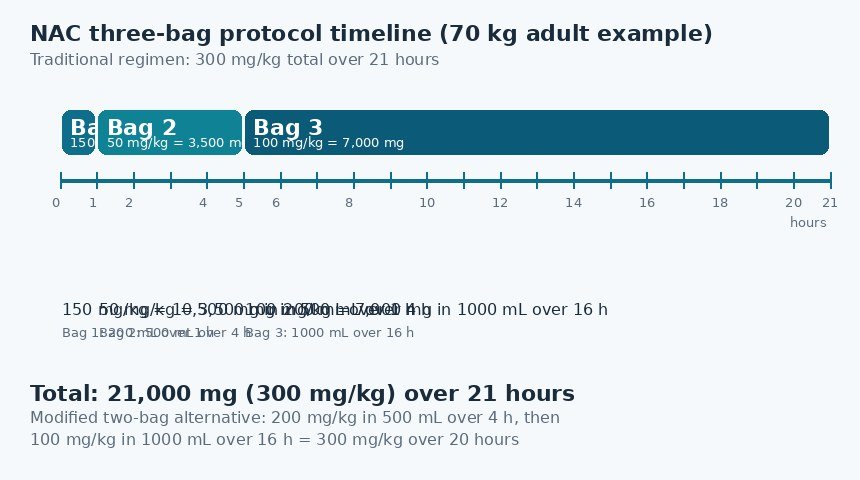
The result panel lists every bag of the chosen protocol with four numbers each: the N-acetylcysteine dose in milligrams, the 5% dextrose diluent volume in millilitres, the infusion rate, and the duration. For a 70 kg adult on the traditional three-bag protocol, the calculator reports bag 1 as 10,500 mg (150 mg/kg) in 200 mL over 1 hour, an infusion rate of 10,500 mg/h or 200 mL/h; bag 2 as 3,500 mg (50 mg/kg) in 500 mL over 4 hours, a rate of 875 mg/h or 125 mL/h; and bag 3 as 7,000 mg (100 mg/kg) in 1,000 mL over 16 hours, a rate of 437.5 mg/h or 62.5 mL/h. The protocol total is 21,000 mg, which is 300 mg/kg, delivered over 21 hours. For the same patient on the modified two-bag protocol, bag 1 is 14,000 mg (200 mg/kg) in 500 mL over 4 hours at 3,500 mg/h, bag 2 is 7,000 mg (100 mg/kg) in 1,000 mL over 16 hours at 437.5 mg/h, and the total is again 21,000 mg (300 mg/kg), this time over 20 hours.
How the NAC dosing calculator works
The calculator multiplies the entered weight by the published per-kilo dose for each bag and pairs it with the standard adult diluent volume for that bag. All NAC infusions in these protocols are mixed in 5% dextrose; the standard adult volumes are fixed per protocol rather than per kilo, because they were validated at those volumes for patients of 40 kg and above. For a patient under 40 kg, the calculator still computes the correct weight-based doses in milligrams, but it does not display volumes: paediatric diluent volumes follow the local paediatric toxicology protocol and should not be improvised from adult numbers.
The rate shown for each bag is the dose divided by the bag duration and the volume divided by the duration, so the bedside nurse can set the infusion pump in either mg/h or mL/h. Rates matter more than most people expect with NAC: the anaphylactoid reactions are rate-related, and an accidentally fast first bag is the most common preventable problem in NAC therapy. Checking the pump rate against the calculator's mg/h figure before pressing start is a small habit that prevents a large error.
The three-bag protocol: the traditional standard
The three-bag regimen is the protocol under which NAC's efficacy against paracetamol liver injury was originally established: 150 mg/kg over the first hour, 50 mg/kg over the next 4 hours, and 100 mg/kg over the following 16 hours. Its logic was pharmacologic caution layered over urgency: get a large dose on board quickly, then settle into a sustained lower-rate infusion while the paracetamol is cleared. The first hour is deliberately intense, and it is also the period when hypersensitivity-type reactions cluster, which is why the infusion rate for bag 1 deserves explicit verification.
The three-bag protocol remains the default in many centres and is the regimen most clinicians were trained on. Its main drawback is not efficacy but tolerability of the front-loaded first hour, which prompted the modified protocol below. Where local guidance still specifies the three-bag form, this calculator gives the exact adult numbers: 150/50/100 mg/kg in 200/500/1,000 mL over 1/4/16 hours.
The two-bag modified protocol: same total, gentler start
The modified protocol tested by Bateman and colleagues in 2014 delivers the same 300 mg/kg but restructures the timing: 200 mg/kg over 4 hours, then 100 mg/kg over 16 hours, for a 20-hour total. Spreading the loading infusion over 4 hours instead of 1 hour roughly halved the anaphylactoid reactions in the trial, without any loss of the antidote effect. Many toxicology units have since adopted it as their standard because the safety gain comes at no pharmacologic cost: the total dose and the slow third-phase infusion, which is where most of the liver protection happens, are unchanged.
Practically, the two-bag form is also simpler: two infusion bags instead of three, with the first bag run at 125 mL/h for a 70 kg adult rather than the 200 mL/h sprint of the traditional first bag. The calculator presents both protocols side by side so a team can check the numbers for whichever form their local guideline specifies, without doing the arithmetic at the bedside.
When NAC is indicated: the decision this calculator assumes
This calculator computes doses; it does not decide whether NAC is needed. The standard indication after a single acute paracetamol ingestion is a plasma paracetamol concentration at 4 hours or later that plots on or above the treatment line of the Rumack-Matthew nomogram, conventionally the 150 line, or the 100 line for high-risk patients such as those with chronic alcohol use, malnutrition, or enzyme-inducing drugs. NAC is most protective when started within 8 hours, but benefit continues well beyond that, and late presentation is never a reason to withhold it.
Several situations bypass the nomogram entirely. A staggered ingestion over more than an hour, repeated supratherapeutic ingestion, unknown timing, an ingestion too large to quantify reliably, or a patient who already has a rising transaminase or a detectable paracetamol level with any clinical concern: all of these warrant immediate NAC. And if the history is convincing but the level is not yet available, start the infusion and adjust when the result arrives, because the first hours are when NAC does its most important work.
Anaphylactoid reactions: what they are and what to do
Up to one in five patients develops some reaction to intravenous NAC, most often flushing, itching or rash, sometimes nausea, and occasionally bronchospasm or hypotension. These are anaphylactoid reactions driven by the infusion rate and by NAC's direct histamine-releasing properties, not by true IgE-mediated allergy, which is why the same patient can usually be rechallenged successfully. The reaction rate is highest with the traditional first bag, which is the rationale for the slower two-bag loading infusion.
The standard response is to slow or pause the infusion, give an antihistamine for itch and rash, and treat bronchospasm on its merits. Once symptoms settle, the infusion is usually restarted at a slower rate and completed, because abandoning NAC leaves the liver injury unopposed. Severe reactions should be reported through the local medicines safety system and documented clearly, so the next course starts slowly from the beginning.
Extending treatment beyond the protocol bags
The protocol totals are starting points, not finish lines. When paracetamol is still detectable, transaminases are still climbing, or the INR is still rising at the end of the protocol, treatment continues, typically as further 100 mg/kg over 16 hours cycles or an equivalent continuous infusion, until the paracetamol level is undetectable, liver tests are improving, and the clinical picture is stable. This is especially relevant for massive ingestions and for patients who presented with established liver injury, where NAC has a documented role even in acute liver failure.
The decision to extend is clinical and belongs to the treating team with serial paracetamol levels, liver function tests, INR, arterial blood gases and the patient's course in front of them. The calculator's totals describe one complete protocol; they do not set a ceiling on treatment.
Limitations of this calculator
- Doses are computed; the indication is clinical. This calculator does not apply the Rumack-Matthew nomogram or decide whether NAC is needed.
- Adult diluent volumes (200/500/1,000 mL and 500/1,000 mL) are validated for patients of 40 kg and above. For children and smaller adults, volumes must come from the local paediatric protocol.
- The calculator does not cover oral NAC protocols, which some centres use and which have different dosing (for example, a 140 mg/kg loading dose followed by 70 mg/kg every 4 hours).
- Anaphylactoid reactions, fluid restriction in heart failure or renal failure, and pregnancy all need clinical adjustment that no calculator can make.
- Patients with established acute liver failure need intensive care and early discussion with a liver unit; NAC supports but does not replace that care.
Frequently asked questions
How is N-acetylcysteine dosed for paracetamol overdose?
The traditional adult protocol is three weight-based bags: 150 mg/kg in 200 mL over 1 hour, then 50 mg/kg in 500 mL over 4 hours, then 100 mg/kg in 1000 mL over 16 hours, for a total of 300 mg/kg over 21 hours. The modified two-bag protocol gives 200 mg/kg in 500 mL over 4 hours followed by 100 mg/kg in 1000 mL over 16 hours, also totalling 300 mg/kg. Patients under 40 kg need volumes from the local paediatric protocol.
What is the difference between the three-bag and two-bag NAC protocols?
Both deliver 300 mg/kg of N-acetylcysteine. The three-bag protocol front-loads 150 mg/kg in the first hour, which is the infusion most associated with anaphylactoid reactions such as flushing, rash, nausea and bronchospasm. The two-bag protocol (Bateman 2014) spreads the first 200 mg/kg over 4 hours instead, and the trial found fewer of these hypersensitivity reactions without losing effectiveness.
When should NAC be started after paracetamol overdose?
Start NAC as soon as treatment is indicated; do not delay for a paracetamol level if the history is convincing and the ingestion was large. Treatment is indicated when the plasma paracetamol level at 4 hours or later plots on or above the 150 line of the Rumack-Matthew nomogram (100 line for high-risk patients), and immediately for staggered or chronic ingestions, unknown timing, or patients already showing liver injury. NAC is most protective when started within 8 hours of a single acute ingestion.
What should be done if the patient reacts to the NAC infusion?
Most reactions are anaphylactoid and related to the infusion rate of the first bag, not true IgE-mediated allergy. Slow or pause the infusion, give an antihistamine, and manage bronchospasm if present; the infusion can usually be restarted at a slower rate once symptoms settle. Report severe reactions promptly and record the event, since future courses need a modified rate.
Can the NAC dose be repeated or extended beyond the protocol?
Yes. The protocol bags can be continued as further 100 mg/kg over 16 hours cycles (or equivalent) until the paracetamol level is undetectable, transaminases are falling, and the patient is clinically improving, particularly when liver injury is established or paracetamol is still detectable. The decision to extend treatment is clinical, based on serial paracetamol levels, liver function, INR and the patient's course, not on the calculator alone.
Is NAC useful in established paracetamol-induced liver failure?
Yes. N-acetylcysteine remains indicated even after liver injury is established, including in acute liver failure after paracetamol overdose, where it may improve transplant-free survival alongside standard intensive care. It is not a reason to withhold transfer to a liver unit or other definitive care.
Related adult dosing calculators
Sources: Bateman DN, Dear JW, Thanacoody HKR, et al. Reduction of adverse effects from intravenous acetylcysteine treatment for paracetamol poisoning: a randomised controlled trial. Lancet. 2014;383(9916):697-704. Bag doses, volumes and durations follow the published traditional three-bag regimen and the modified two-bag regimen as presented in current toxicology guidance.