Steroid Conversion Calculator
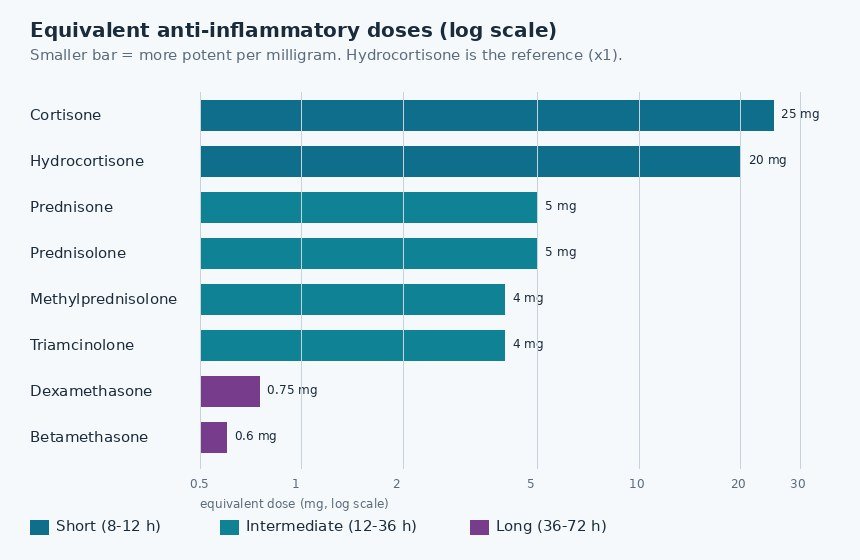
This steroid conversion calculator converts a dose between eight systemic corticosteroids using their standard equivalent doses: hydrocortisone 20 mg = cortisone 25 mg = prednisone 5 mg = prednisolone 5 mg = methylprednisolone 4 mg = triamcinolone 4 mg = dexamethasone 0.75 mg = betamethasone 0.6 mg. Enter a dose of one steroid and the calculator shows the equivalent dose in every other agent, plus the hydrocortisone-equivalent total, relative anti-inflammatory potency, mineralocorticoid activity and duration of action for the pair you compare.
What your result means
The result panel leads with the converted dose for the pair you chose, then lists the equivalent dose in every other agent and the hydrocortisone-equivalent of the whole dose. For 40 mg of prednisone converted to dexamethasone, the calculator reports 6.0 mg of dexamethasone, because the equivalent doses are 5 mg and 0.75 mg, so the conversion factor is 0.75/5 = 0.15. The full table for that 40 mg reads: prednisolone 40.0 mg, methylprednisolone 32.0 mg, triamcinolone 32.0 mg, hydrocortisone 160.0 mg, cortisone 200.0 mg, betamethasone 4.8 mg, and dexamethasone 6.0 mg. The hydrocortisone equivalent is 160 mg, which is the common currency for comparing total steroid exposure across agents, for example when checking whether a stress-dose regimen is adequate.
How the steroid conversion calculator works
Every conversion is one proportion: dose of target = dose of source x (equivalent dose of target / equivalent dose of source). The equivalent doses in the table below are the standard anti-inflammatory equivalents from the glucocorticoid literature. Because they are ratios, the calculator converts in both directions with the same table: prednisone 40 mg to dexamethasone is 40 x 0.75/5 = 6.0 mg, and dexamethasone 4 mg back to hydrocortisone is 4 x 20/0.75 = 106.7 mg. Results are rounded to one decimal place, which is more precision than the underlying equivalents justify; treat the last digit as indicative, not exact.
| Steroid | Equivalent dose (mg) | Anti-inflammatory potency | Mineralocorticoid activity | Duration |
|---|---|---|---|---|
| Cortisone | 25 | 0.8 | 0.8 | Short (8-12 h) |
| Hydrocortisone | 20 | 1 | 1 | Short (8-12 h) |
| Prednisone | 5 | 4 | 0.8 | Intermediate (12-36 h) |
| Prednisolone | 5 | 4 | 0.8 | Intermediate (12-36 h) |
| Methylprednisolone | 4 | 5 | 0.5 | Intermediate (12-36 h) |
| Triamcinolone | 4 | 5 | 0 | Intermediate (12-36 h) |
| Dexamethasone | 0.75 | 25 | 0 | Long (36-72 h) |
| Betamethasone | 0.6 | 25 | 0 | Long (36-72 h) |
Potency per milligram: why dexamethasone numbers look so small
The equivalent-dose table is also a potency ranking read in reverse: the smaller the equivalent dose, the more anti-inflammatory effect per milligram. Dexamethasone at 0.75 mg and betamethasone at 0.6 mg are roughly 25 times as potent as hydrocortisone, which is why a 6 mg dexamethasone dose, for example in the COVID-19 RECOVERY regimen, carries the anti-inflammatory weight of about 160 mg of hydrocortisone. This is also where conversion errors do the most damage: misplacing a decimal point on a dexamethasone dose changes potency twentyfold, so the calculator's one-decimal output should always be sanity-checked against the 5 mg prednisone = 0.75 mg dexamethasone anchor.
Duration of action: short, intermediate and long agents
Equivalent doses ignore how long the effect lasts, and the three duration classes behave differently in practice. Short-acting hydrocortisone and cortisone (8 to 12 hours) suit replacement therapy and stress dosing, where the body expects a daily rhythm. Intermediate agents (12 to 36 hours), prednisone, prednisolone, methylprednisolone and triamcinolone, are the workhorses for inflammatory disease. Long-acting dexamethasone and betamethasone (36 to 72 hours) suppress the hypothalamic-pituitary-adrenal axis most strongly and are hardest to taper, which is one reason they are chosen deliberately rather than by default.
When converting between classes, the equivalent dose is only the starting point: a switch from prednisone to dexamethasone changes the suppression profile, and the dosing frequency usually changes too. These are clinical decisions the conversion number informs but does not make.
Mineralocorticoid activity: salt, water and blood pressure
Corticosteroids also act on mineralocorticoid receptors, causing sodium and water retention, and the agents differ sharply here. Hydrocortisone and cortisone retain the most salt; prednisone, prednisolone and methylprednisolone retain less; triamcinolone, dexamethasone and betamethasone retain essentially none. That is why dexamethasone is the agent of choice when a pure glucocorticoid effect is wanted without fluid retention, for example in cerebral oedema, while hydrocortisone is the agent for adrenal replacement, where some mineralocorticoid effect is physiologic.
A conversion between agents with different mineralocorticoid activity is not a like-for-like switch: moving a patient from hydrocortisone to an equivalent dexamethasone dose removes the salt-retaining component, which can matter in adrenal insufficiency and in heart failure. The result panel flags each agent's mineralocorticoid rating so this is visible at conversion time.
Practical notes: prednisone versus prednisolone, tapering, and what is not covered
Prednisone and prednisolone convert 1:1, but they are not identical drugs. Prednisone is a prodrug activated in the liver to prednisolone; in severe liver failure that activation is unreliable, so prednisolone is the safer choice. For everyone else the two are interchangeable at the same milligram dose.
Steroids used for more than about 3 weeks suppress the adrenal axis, and stopping abruptly risks adrenal crisis; the dose is tapered, often over weeks, and the taper schedule depends on the dose, duration, indication and the agent's duration of action. This calculator converts doses; it does not design tapers.
Topical, inhaled, intranasal and intra-articular steroids are not covered here: their systemic equivalents depend on potency, vehicle, surface area and duration of use, and no simple table converts them. Neither are mineralocorticoid doses such as fludrocortisone, which is a different drug class for this purpose.
Limitations of this calculator
- Equivalent doses are approximate anti-inflammatory equivalents; individual response varies and clinical monitoring decides the final dose.
- The conversion ignores duration of action and mineralocorticoid activity differences, both of which change the clinical effect of a switch.
- It covers systemic oral and injectable dosing only, not topical, inhaled, intranasal or intra-articular steroids.
- It does not design taper schedules, stress-dose regimens or adrenal replacement plans.
Frequently asked questions
How do you convert prednisone to dexamethasone?
The equivalent doses are 5 mg of prednisone = 0.75 mg of dexamethasone, so multiply the prednisone dose by 0.75/5 (0.15). For example, 40 mg of prednisone converts to 6 mg of dexamethasone. The reverse conversion multiplies the dexamethasone dose by 5/0.75 (about 6.67).
What are the equivalent doses of common steroids?
Hydrocortisone 20 mg = cortisone 25 mg = prednisone 5 mg = prednisolone 5 mg = methylprednisolone 4 mg = triamcinolone 4 mg = dexamethasone 0.75 mg = betamethasone 0.6 mg. These are approximate anti-inflammatory equivalents; individual response varies.
Which steroid has the least mineralocorticoid effect?
Dexamethasone, betamethasone and triamcinolone have essentially no mineralocorticoid (salt-retaining) activity, which is why dexamethasone is preferred when fluid retention or hypertension is a concern, for example in cerebral oedema. Hydrocortisone and cortisone have the most mineralocorticoid activity and are the agents used for adrenal replacement.
What is the difference between prednisone and prednisolone?
Prednisone is a prodrug that the liver converts to the active prednisolone, and the two are dose-equivalent (5 mg = 5 mg). In severe liver failure, where that conversion is impaired, prednisolone is preferred because it is already active.
Do steroid conversions apply when tapering?
The calculator converts equivalent anti-inflammatory doses, but tapering is a clinical schedule, not a single conversion. After more than about 3 weeks of systemic steroids, the dose should be tapered rather than stopped abruptly to allow the adrenal axis to recover, and the taper plan depends on the dose, duration, indication and duration of action of the agent used.
Why is dexamethasone dosed so much lower than prednisone?
Dexamethasone is about 25 times more potent than hydrocortisone as an anti-inflammatory (prednisone is 4 times), and it lasts 36 to 72 hours compared with 12 to 36 hours for prednisone. Its equivalent dose is only 0.75 mg against prednisone's 5 mg, so small milligram errors with dexamethasone represent large potency differences; double-check the decimal point.
Related adult dosing calculators
Sources: Meikle AW, Tyler FH. Potency and duration of action of glucocorticoids: effects of hydrocortisone, prednisone and dexamethasone on human pituitary-adrenal function. Am J Med. 1977;63(2):200-207. Equivalent doses, potency ratios, mineralocorticoid ratings and duration classes follow the standard glucocorticoid comparison tables.