Pediatric Maintenance Fluid Calculator
This pediatric maintenance fluid calculator applies the Holliday-Segar 4-2-1 rule to a child's weight: the 24-hour maintenance volume, the hourly infusion rate, maintenance electrolytes, and optional dehydration deficit and emergency bolus volumes.
How the pediatric maintenance fluid calculator uses the Holliday-Segar formula
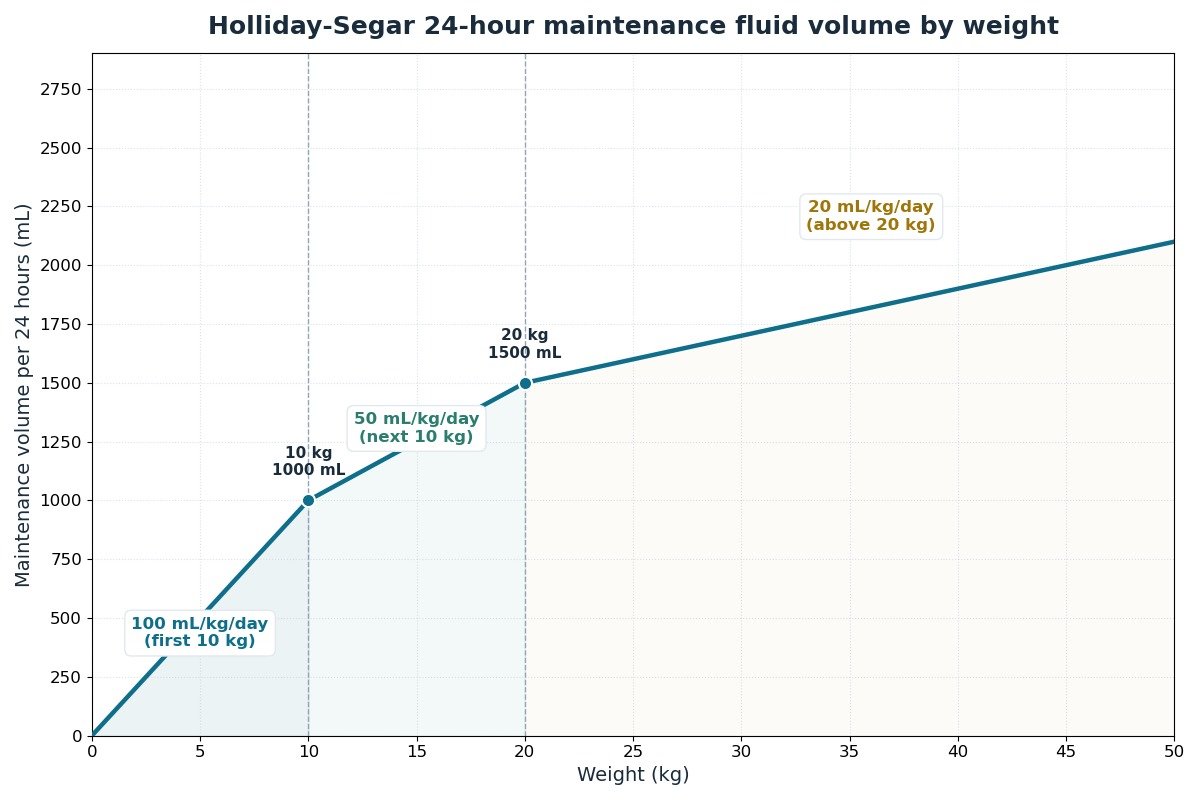
In 1957, Drs. Malcolm Holliday and William Segar at the Indiana University School of Medicine published a landmark paper on the water needs of children receiving parenteral fluid therapy. Their insight was that a child's water requirement follows energy expenditure: every 100 kilocalories burned needs about 100 mL of water to cover urine output and the water lost through the lungs and skin. Because small children burn far more energy per kilogram than larger ones, the relationship is not a straight line, so the formula works in three tiers. This pediatric maintenance fluid calculator applies those three tiers exactly as published: 100 mL per kg for the first 10 kg of body weight, 50 mL per kg for the next 10 kg, and 20 mL per kg for each kilogram above 20.
The tiered design mirrors how metabolic rate falls as children grow. A 6 kg infant has a huge surface area relative to body mass and loses much more heat and water per kilogram than a 30 kg schoolchild, so the first kilograms are "expensive" in water terms. The formula gives a 6 kg infant 600 mL per day (100 mL per kg), while a 30 kg child gets 1700 mL per day, which works out to only about 57 mL per kg. That falling per-kilogram rate is the whole point of the tiers, and it is why a single mL-per-kg number for all ages would be wrong in both directions.
It is worth knowing what this formula does not do. It estimates maintenance needs, meaning the water and salt a normally hydrated child would lose in a day. It does not estimate the deficit from dehydration, it does not cover ongoing abnormal losses such as vomiting or diarrhea, and it was not derived for neonates, for children with kidney or heart failure, or for severe burns. Clinicians add those pieces on top, which is why the calculator above has optional sections for deficit and bolus.
The 4-2-1 rule: hourly rates step by step
Prescribers usually order intravenous fluids as an hourly pump rate, so the daily formula is commonly converted into the 4-2-1 rule: 4 mL per kg per hour for the first 10 kg, 2 mL per kg per hour for the next 10 kg, and 1 mL per kg per hour for each kilogram above 20. For a 20 kg child that is (4 x 10) + (2 x 10) = 60 mL per hour. For a 30 kg child it is 40 + 20 + 10 = 70 mL per hour.
One honest detail: the 4-2-1 hourly rate and the daily 100/50/20 volume are not perfectly consistent. For the 20 kg child, 60 mL per hour times 24 hours is 1440 mL, a little less than the 1500 mL the daily formula gives, because 4 mL per hour times 24 is 96 mL, not 100 mL. This is a known approximation in the rule, and it rarely matters clinically. The calculator shows both numbers: the 4-2-1 hourly rate for setting the pump, and the daily volume spread evenly over 24 hours as a cross-check. In practice, most prescribers use the 4-2-1 hourly rate directly.
A quick way to sanity-check any result is the chart below. Read the child's weight on the horizontal axis and the expected 24-hour volume on the vertical axis. The three straight segments have visibly different slopes, steep for small infants and shallow for larger children, which is the tiered formula made visible.
Worked examples at common weights
The table below shows what the formula gives at typical weights, including the maintenance electrolytes per the original Holliday-Segar composition (3 mEq of sodium and 2 mEq of potassium per 100 mL of water).
| Weight | 24-hour volume | Hourly rate (4-2-1) | Sodium (mEq/24h) | Potassium (mEq/24h) |
|---|---|---|---|---|
| 5 kg | 500 mL | 20 mL/h | 15 | 10 |
| 8 kg | 800 mL | 32 mL/h | 24 | 16 |
| 10 kg | 1000 mL | 40 mL/h | 30 | 20 |
| 15 kg | 1250 mL | 50 mL/h | 37.5 | 25 |
| 20 kg | 1500 mL | 60 mL/h | 45 | 30 |
| 25 kg | 1600 mL | 65 mL/h | 48 | 32 |
| 30 kg | 1700 mL | 70 mL/h | 51 | 34 |
| 40 kg | 1900 mL | 80 mL/h | 57 | 38 |
Dehydration: estimating and replacing the deficit
When a child is dehydrated, the maintenance volume is not enough on its own, because it only covers a normal day's losses. The fluid already lost, called the deficit, must be estimated and replaced separately. The standard bedside estimate is simple: deficit in mL = percent dehydration x weight in kg x 10. In other words, each 1 percent of dehydration equals about 10 mL per kg. An 8 kg infant who is 5 percent dehydrated has a deficit of 5 x 8 x 10 = 400 mL.
The percent dehydration itself is a clinical estimate, usually from weight change if a recent well weight is known, or from physical signs: thirst and restlessness in mild dehydration, sunken eyes, dry mouth, reduced tears, and decreased urine in moderate dehydration, and lethargy, very sunken eyes, and barely any urine in severe dehydration. Scales and signs are imperfect, so experienced clinicians treat the estimate as a starting point and reassess the child repeatedly.
The classic teaching for replacing the deficit is to give half of it over the first 8 hours and the remainder over the following 16 hours, on top of the maintenance rate. For the 400 mL deficit above, that is 200 mL over 8 hours (an extra 25 mL per hour) and then 200 mL over 16 hours (an extra 12.5 mL per hour). The calculator shows exactly this schedule. Two cautions apply. First, severe dehydration, especially with shock, is treated with rapid boluses and urgent care, not with this slow schedule. Second, whenever the gut is working, oral rehydration solution is preferred over intravenous therapy for mild to moderate dehydration, because it is safer, cheaper, and at least as effective.
Fluid bolus for poor perfusion
A bolus is different from maintenance and from deficit replacement. It is a rapid infusion of 20 mL per kg of isotonic crystalloid (such as 0.9% sodium chloride or lactated Ringer's solution), given when a child shows signs of poor perfusion or shock: cold hands and feet, mottled skin, a capillary refill time over 2 to 3 seconds, a fast weak pulse, or low blood pressure. For a 15 kg child, one bolus is 300 mL, given rapidly.
The critical rule with boluses is reassessment after every single one. If perfusion improves, the boluses stop and the child moves to maintenance plus deficit replacement. If signs persist, further boluses may be given, but repeated large volumes can cause fluid overload, so this is a decision for the emergency team with continuous monitoring, never a protocol to run at home. That is why the bolus option in the calculator is labeled as hospital emergency care only. Children with known heart disease or kidney failure need smaller, more cautious volumes decided by their specialist.
Which fluid to hang: the isotonic versus hypotonic debate
Here is a subtlety that trips up many learners. Holliday and Segar calculated volumes, but the fluids actually hung in 1957 were hypotonic, meaning much less salty than blood plasma. That made sense on paper, because their sodium and potassium figures describe what a healthy child needs in a day. In practice, sick hospitalized children are not healthy children: pain, nausea, surgery, and lung disease all trigger antidiuretic hormone, which makes the kidneys hold on to water. Give a hypotonic fluid to a child who cannot excrete the extra water, and the blood sodium falls. Hospital-acquired hyponatremia can cause brain swelling, seizures, and in rare cases death, and it became clear over the following decades that hypotonic maintenance fluids were causing real harm.
In 2018 the American Academy of Pediatrics settled the debate with an evidence-based clinical practice guideline (Feld and colleagues, Pediatrics 2018). Its key action statement recommends that patients 28 days to 18 years of age who need maintenance intravenous fluids should receive isotonic solutions with appropriate potassium chloride and dextrose, because these significantly decrease the risk of developing hyponatremia. The recommendation was graded as strong, based on high-quality evidence from randomized trials. Isotonic means a sodium concentration close to plasma, roughly 135 to 144 mEq per liter, as in 0.9% sodium chloride or lactated Ringer's solution, rather than the dilute fluids of the past.
So modern practice keeps the Holliday-Segar volumes from 1957 but changes the fluid in the bag. Note the guideline's scope: it covers children from 28 days to 18 years in medical and surgical acute care, and it excludes neonates under 28 days, children with neurosurgical disorders, congenital or acquired cardiac disease, hepatic disease, cancer, renal dysfunction, diabetes insipidus, voluminous watery diarrhea, and severe burns. Those children need individualized fluid plans from their specialist team, not a standard formula.
Electrolytes in maintenance fluids
The original Holliday-Segar paper specified not just water but electrolytes: 3 mEq of sodium and 2 mEq of potassium per 100 mL of water. For a 20 kg child receiving 1500 mL per day, that is 45 mEq of sodium and 30 mEq of potassium over 24 hours, which is exactly what the calculator reports. In the hypotonic era these numbers described the bag's contents directly. Today they are better understood as the child's daily requirement, while the bag itself is usually isotonic with added potassium and dextrose, per the 2018 AAP guidance.
Dextrose, usually 5%, is added to maintenance fluids to provide some calories and to prevent ketosis and hypoglycemia in a child who is not eating, not as a meaningful energy source. Potassium is added only when the child is making urine and the serum potassium is known to be safe; it is never pushed rapidly. Because fluid and electrolyte needs change as illness evolves, sodium and potassium levels are monitored with blood tests during intravenous therapy, and the prescription is adjusted. A calculator gives the starting point, not the whole course.
Limitations and safety cautions
- Obesity: the formula was derived for normally proportioned children. Actual body weight overestimates fluid needs in obesity, so use ideal or adjusted body weight and confirm the rate with the treating clinician or pharmacist.
- Neonates: babies under 28 days have immature kidneys and very different fluid handling. They need specialist neonatal input, not this formula.
- Fever and illness: fever increases insensible water loss, while conditions that raise antidiuretic hormone (pneumonia, meningitis, post-surgery states) reduce the ability to excrete water. Both shift needs away from the standard number.
- Heart and kidney disease: children with cardiac failure or renal dysfunction cannot tolerate standard volumes. Fluid plans in these children are deliberately restrictive and specialist-led.
- Special conditions: diabetes insipidus, severe burns, and profuse watery diarrhea follow their own replacement protocols and are excluded from standard maintenance calculations.
- Ongoing losses: the formula covers maintenance only. Vomiting, diarrhea, drains, and high fever losses are replaced separately, usually milliliter for milliliter, with reassessment.
- Clinical judgment rules: this is a prescribing aid for clinicians. Fluid therapy in a sick child needs bedside assessment, monitoring of input, output, weight, and electrolytes, and adjustment as the child improves or deteriorates.
Frequently asked questions
Why not just use the 4-2-1 rule for everything?
The 4-2-1 rule is a handy shortcut for the hourly maintenance rate, but it is still an approximation. For a 20 kg child it gives 60 mL per hour, which is 1440 mL over 24 hours, slightly less than the 1500 mL from the daily 100/50/20 formula. It also says nothing about dehydration deficits, ongoing losses, fluid tonicity, or which children the formula does not fit, such as neonates and children with obesity. Use the full calculation and clinical judgment, not the shortcut alone.
What is the difference between maintenance, deficit, and bolus fluids?
Maintenance fluids replace the water and electrolytes a child loses in a normal day through urine, stool, breathing, and skin. Deficit fluids replace what was already lost to dehydration, estimated as percent dehydration times weight in kg times 10. A bolus is a rapid 20 mL per kg infusion of isotonic crystalloid given for poor perfusion or shock, and it is emergency hospital care, reassessed after every bolus.
Holliday and Segar worked with hypotonic fluids. Why does this page mention isotonic fluids?
The 1957 Holliday-Segar paper calculated volumes, and the hypotonic fluids of that era were later found to cause hospital-acquired hyponatremia in sick children. In 2018 the American Academy of Pediatrics published an evidence-based clinical practice guideline recommending isotonic maintenance fluids with appropriate potassium chloride and dextrose for patients 28 days to 18 years of age, because they significantly decrease the risk of hyponatremia. Modern practice keeps the Holliday-Segar volumes but changes the fluid composition.
Can I use this calculator for my own child at home?
No. This is a prescribing aid for clinicians, not a home remedy. Intravenous fluid therapy is given in a hospital under medical supervision. At home, the correct response to vomiting or diarrhea is oral rehydration solution given in small frequent sips, and any child who is lethargic, has a dry mouth and no tears, passes very little urine, or cannot keep fluids down needs urgent medical assessment.
How do I account for ongoing losses like vomiting or diarrhea?
The Holliday-Segar formula covers maintenance only. Ongoing losses are replaced separately, roughly milliliter for milliliter, on top of maintenance. A common bedside approach is about 10 mL per kg for each watery stool and about 2 mL per kg for each episode of vomiting, with the child reassessed each time. When the gut works, oral rehydration is preferred over intravenous replacement for ongoing losses.
What weight should I enter for an overweight child?
Use ideal or adjusted body weight rather than actual weight, because the Holliday-Segar formula was derived for normally proportioned children and actual weight overestimates needs in obesity. There is no single agreed adjustment, so this is a judgment call for the treating clinician, and a pharmacist or pediatrician should confirm the prescribed rate.
Related calculators
Sources: Holliday MA, Segar WE. The maintenance need for water in parenteral fluid therapy. Pediatrics. 1957;19(5):823-832. doi:10.1542/peds.19.5.823 | Feld LG, Neuspiel DR, Foster BA, et al. Clinical practice guideline: maintenance intravenous fluids in children. Pediatrics. 2018;142(6):e20183083.