Neonatal Jaundice Bilirubin Calculator
This neonatal jaundice bilirubin calculator gives an AAP 2022 guideline based risk assessment: enter your baby's age in hours and bilirubin level for a plain-language risk band, what it means, and what to do next. One honest note first: this tool does not plot Bhutani nomogram percentile zones, because those curves were never published as numbers and the AAP 2022 guideline itself retired them for follow-up decisions. The method is explained in full below.
How this neonatal jaundice bilirubin calculator works
Jaundice, the yellow colouring of a newborn's skin and eyes, is one of the commonest things parents notice in the first week of life. More than 80 percent of newborn infants develop some degree of jaundice, and in most cases it is harmless and fades on its own. The reason clinicians take it seriously is the small minority of babies whose bilirubin climbs high enough to injure the brain, a permanent condition called kernicterus that can cause cerebral palsy, hearing loss, gaze problems and characteristic brain scan findings. Because you cannot tell by looking which baby is which, every jaundiced newborn deserves a structured risk assessment, and that is what this calculator provides.
This neonatal jaundice bilirubin calculator follows the method of the American Academy of Pediatrics 2022 clinical practice guideline on hyperbilirubinemia, the current standard for babies born at 35 weeks of gestation or later. You enter the baby's age in hours, the total serum bilirubin from a blood test, the gestational age, the albumin level if you have it, any neurotoxicity risk factors, and optionally a previous bilirubin reading. The tool then checks five concern-flags taken directly from thresholds printed in the guideline text, and combines them into one of four plain-language risk bands: low, low-intermediate, high-intermediate, or high.
The five flags are: (1) the baby has at least one hyperbilirubinemia neurotoxicity risk factor, which lowers every treatment threshold; (2) the bilirubin to albumin ratio reaches the level at which the guideline says exchange transfusion may be considered; (3) the bilirubin is rising at a rate that suggests hemolysis; (4) jaundice was noticed in the first 24 hours after birth, which is never normal; and (5) the bilirubin has reached 30 mg/dL, the level the guideline defines as hazardous hyperbilirubinemia. Each flag is explained beside your result, so you can see exactly what drove the assessment, and every band comes with concrete next steps.
A note on scope, stated plainly because it matters for safety. This tool covers babies born at 35 weeks or later and ages from 6 hours to 6 days, matching the population the 2022 guideline addresses. It does not plot the famous Bhutani nomogram percentile zones, and the next section explains why that is a deliberate, evidence-based choice rather than a missing feature.
The Bhutani nomogram: what it was, and why this tool does not plot it
In 1999, Vinod Bhutani and colleagues published a landmark study of hour-specific bilirubin levels in healthy term and near-term newborns. They screened more than 13,000 babies and built a percentile-based nomogram from hour-by-hour bilirubin values of 2,840 healthy newborns in a Pennsylvania hospital nursery. Plotting a baby's predischarge bilirubin on that nomogram placed the baby in one of four zones, low, low-intermediate, high-intermediate, or high risk, that predicted the chance of later developing significant hyperbilirubinemia. For two decades it was the standard way to decide how closely a jaundiced baby needed follow-up, and its name is still what most parents and many clinicians search for.
Here is the problem a careful calculator builder cannot dodge. The Bhutani percentile curves were published as a figure, not as a numerical table. Nobody has published the hour-by-hour 40th, 75th and 95th percentile values in a form another calculator can reuse. The only numerical transcription in the literature is a set of straight-line approximations estimated visually from the figure for the first 48 hours only, published by Newman and colleagues in 2005. Beyond 48 hours the real curves bend and flatten as bilirubin peaks, so extending those straight lines would overstate the percentile thresholds and wrongly push babies into lower risk zones. A tool that silently invents those numbers would look precise while being wrong, which is the worst possible combination in newborn care.
The second reason is that the science itself moved on. The AAP 2022 guideline states directly that the old follow-up recommendations used the Bhutani-based nomogram, which did not take gestational age or neurotoxicity risk factors into account, and it replaced that approach with a new one: calculate the difference between the bilirubin concentration and the hour-specific phototherapy threshold at the time of measurement, and use that difference to set the follow-up interval. That is the stated method this calculator implements, using only thresholds that appear as explicit numbers in the guideline text, so every line of its logic can be checked against the source.
The risk factors this calculator checks
The 2022 guideline draws a sharp line between two kinds of risk factors, and the distinction is worth understanding. Hyperbilirubinemia risk factors raise the chance that bilirubin will climb high. Hyperbilirubinemia neurotoxicity risk factors raise the chance that a given bilirubin level will injure the brain, which is why the guideline sets lower treatment thresholds for babies who have any of them. This calculator asks about the neurotoxicity list, because it changes management.
The neurotoxicity risk factors are: gestational age below 38 weeks, with risk rising the more premature the baby is; albumin below 3.0 g/dL; isoimmune hemolytic disease, meaning a positive direct antiglobulin test from maternal antibodies attacking the baby's red cells; G6PD deficiency or other hemolytic conditions; sepsis; and any significant clinical instability in the previous 24 hours. That last item covers the classic warning states clinicians were taught to watch for: birth asphyxia, significant lethargy, temperature instability, and acidosis. If any one of these is present, the baby is managed as higher risk throughout.
The broader hyperbilirubinemia risk factors in the guideline's Table 1 include lower gestational age week by week below 40 weeks, jaundice in the first 24 hours, a predischarge bilirubin close to the phototherapy threshold, hemolysis from any cause, phototherapy already given before discharge, a parent or sibling who needed phototherapy or exchange transfusion, family history or ancestry suggesting inherited red cell disorders including G6PD deficiency, exclusive breastfeeding with suboptimal intake, scalp hematoma or significant bruising, Down syndrome, and being a macrosomic infant of a diabetic mother. G6PD deficiency deserves special mention: the guideline calls it one of the most important causes of hazardous hyperbilirubinemia leading to kernicterus, noting it affects about 13 percent of African American males and about 4 percent of African American females, and it can cause sudden extreme bilirubin rises that are hard to anticipate.
Two practical points follow from these lists. First, gestational age does double duty: being born before 38 weeks is both a neurotoxicity risk factor and a marker of higher hyperbilirubinemia risk, which is why the calculator weights it carefully. Second, feeding matters enormously and is partly in parents' hands: the guideline describes suboptimal intake hyperbilirubinemia, where inadequate milk intake in the first days leads to fewer stools and more bilirubin reabsorbed from the gut, typically peaking on days 3 to 5. Feeding at least 8 times in 24 hours, with attention to latch and milk transfer, is one of the most effective prevention measures available.
Bilirubin, albumin and the exchange transfusion question
To understand the bilirubin to albumin ratio, it helps to know how bilirubin travels in the blood. Unconjugated bilirubin, the form that accumulates in newborn jaundice, circulates mostly bound to the protein albumin. Only the unbound fraction can cross into the brain and cause injury. When albumin is low, more bilirubin stays free, so the same total bilirubin number is more dangerous. That is why the guideline treats a low albumin both as a neurotoxicity risk factor and as part of a ratio used in exchange transfusion decisions.
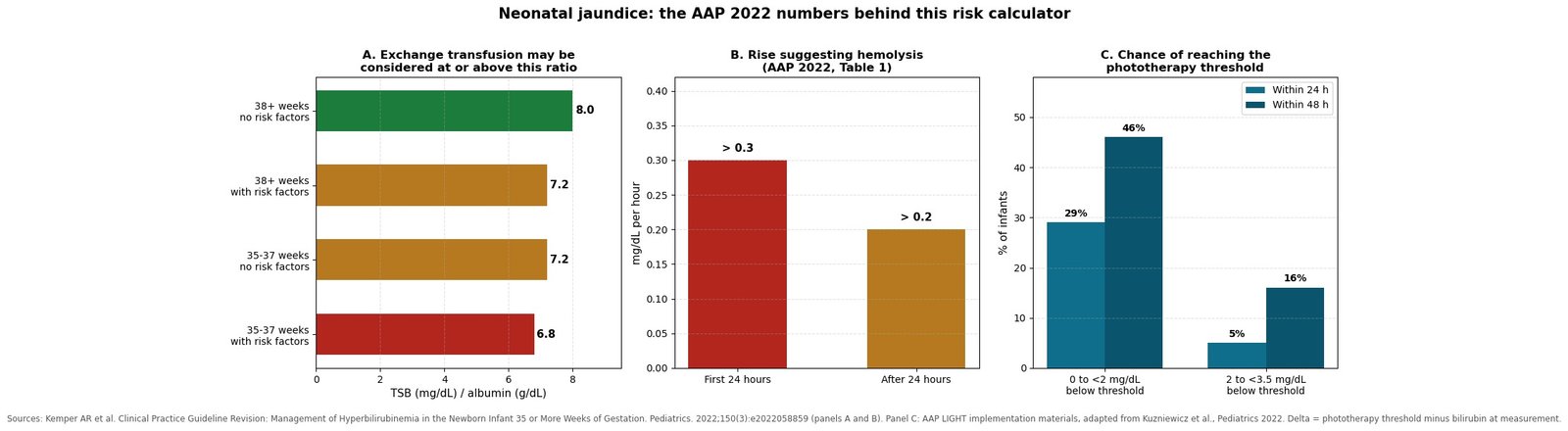
The ratio is simply the total serum bilirubin in mg/dL divided by the albumin in g/dL, and the guideline states exact cutoffs: an exchange transfusion may be considered if the ratio is 8.0 or higher in a baby born at 38 weeks or later with no other risk factors, 7.2 or higher in a baby born at 38 weeks or later who has at least one risk factor, 7.2 or higher in a baby born at 35 to 37 weeks with no other risk factor, or 6.8 or higher in a baby born at 35 to 37 weeks with at least one risk factor. This calculator picks the right cutoff for the baby you describe and tells you where the baby's ratio sits against it. If you do not have an albumin value, enter it when you can; the rest of the assessment still runs.
One step below exchange transfusion sits escalation of care. The guideline defines the escalation of care threshold as 2 mg/dL below the exchange transfusion threshold, and says care should be escalated when the bilirubin reaches or exceeds it. In practice that means intensive phototherapy, intravenous fluids where indicated, and preparation for possible exchange transfusion, which is usually a double volume exchange using cross matched washed packed red cells mixed with fresh frozen plasma. The exact phototherapy and exchange thresholds themselves are hour-specific curves that differ by gestational age and risk status; your clinician reads them from the guideline's graphs, which this tool deliberately does not try to reproduce.
It is worth knowing how far the field has come. The guideline notes that after universal predischarge bilirubin screening with closer postdischarge follow-up was adopted, the incidence of hazardous hyperbilirubinemia, defined as a total serum bilirubin of 30 mg/dL or more, fell in at least three large United States health systems. Screening works, which is why the guideline recommends measuring bilirubin between 24 and 48 hours after birth or before discharge if that comes earlier.
How fast is too fast: the rate of bilirubin rise
The absolute bilirubin number is only half the story; the speed at which it climbs is the other half. A bilirubin that jumps quickly usually means red blood cells are being destroyed faster than the liver can handle, a process called hemolysis. The guideline's Table 1 gives the cutoffs that should raise suspicion: a rise faster than 0.3 mg/dL per hour in the first 24 hours, or faster than 0.2 mg/dL per hour after that. This calculator checks the rise if you enter a previous reading, and flags it when it crosses those lines.
Hemolysis has a short list of usual suspects in newborns. ABO or Rh blood group incompatibility, where maternal antibodies attack the baby's red cells, is the classic cause of jaundice in the first day of life and is picked up with the direct antiglobulin test. G6PD deficiency can trigger sudden hemolytic episodes. Significant bruising or a scalp hematoma from birth adds a load of red cells to break down. Whatever the cause, a rapidly rising bilirubin deserves same-day reassessment, because it can cross treatment thresholds in hours rather than days.
This is also why jaundice visible in the first 24 hours is treated as guilty until proven innocent. Normal physiological jaundice does not appear that early; early jaundice usually means hemolysis or another pathological process. The guideline calls for a bilirubin measurement immediately when jaundice is noted within 24 hours of birth, and this calculator treats first-day jaundice as a major flag on its own.
What your result means and what to do next
The calculator assigns one of four bands using a scoring rule shown with your result, so the logic is fully transparent. A baby with no concern-flags lands in the low band. One flag gives low-intermediate. Two flags, a hemolysis-range rise, or first-day jaundice gives high-intermediate. A bilirubin to albumin ratio at or above the exchange-consideration cutoff, a bilirubin of 30 mg/dL or more, or three or more flags gives high. These bands are this tool's plain-language summary of the AAP 2022 concern-flags; they are not Bhutani percentile zones, and the page says so wherever it matters.
| Risk band | What it means | Suggested next step |
|---|---|---|
| Low | No AAP 2022 concern-flags were found in your entries. | Continue routine newborn care and the follow-up your clinician arranged. Make sure bilirubin was measured between 24 and 48 hours or before discharge. |
| Low-intermediate | One concern-flag is present, for example lower gestational age alone. | Discuss the timing of the next bilirubin check with your clinician, keep up frequent feeding, and watch for warning signs. |
| High-intermediate | Two flags, a hemolysis-range rise, or first-day jaundice. | Contact your clinician today. The guideline supports repeating the bilirubin within 4 to 24 hours using clinical judgment when a baby is near concern thresholds. |
| High | Meets a threshold linked with escalation of care or exchange transfusion consideration, or several flags together. | Seek urgent same-day evaluation. Bring the bilirubin value, the exact age in hours, gestational age, and these results. |
A few timing rules from the guideline are worth memorising. Every baby should have bilirubin measured between 24 and 48 hours after birth or before discharge. If the skin reading is within 3 mg/dL of the phototherapy threshold or is 15 mg/dL or higher, the guideline says to confirm with a blood test. When a level is close to a treatment threshold, repeating the bilirubin within 4 to 24 hours, with the exact timing left to clinical judgment, is the recommended approach. And any baby discharged before 12 hours of age should have a follow-up bilirubin between 24 and 48 hours of age, because the follow-up framework is not validated on earlier readings.
Whatever the band, feeding remains central. Poor intake worsens jaundice through the enterohepatic circulation described earlier, so frequent effective feeds, monitoring of wet nappies and stools, and attention to weight loss are part of every jaundice plan. The guideline also asks that families receive written and verbal education about jaundice before discharge, including when and where follow-up happens; if you did not get that, ask for it.
Warning signs that need urgent care
Do not wait for a calculator result if any of these are present. Seek urgent medical care the same day if your baby was visibly jaundiced in the first 24 hours; if the yellow colour is spreading rapidly or now covers the arms, legs, palms or soles; if feeding is poor, with fewer than expected feeds, weak sucking, or excessive sleepiness that makes waking for feeds hard; if the baby is unusually floppy or unusually stiff, arches the back, or has a high-pitched cry; if there is fever, vomiting, or a worrying change in alertness; or if stools are pale or clay coloured while urine is dark, which can signal a bile drainage problem rather than ordinary newborn jaundice. These are the signs clinicians associate with advancing bilirubin effects, and they override any reassuring number.
Two groups need a lower threshold for calling. Babies born before 35 weeks are outside this guideline entirely and need direct specialist management, and babies born at 35 to 37 weeks, while covered, deserve closer clinician judgment than the numbers alone suggest. When in doubt, call: a prompt bilirubin check is simple, and the guideline's whole philosophy is that timely measurement prevents the rare catastrophes.
Frequently asked questions
Why does this calculator not plot my baby on the Bhutani nomogram?
Because the Bhutani percentile curves were published as a figure, not as a numerical table, so no web calculator can plot an exact percentile from verified data. The only published numerical approximation covers just the first 48 hours of life. The American Academy of Pediatrics 2022 guideline also retired the Bhutani risk zones for follow-up decisions, replacing them with the difference between the bilirubin level and the hour-specific phototherapy threshold. This calculator implements the guideline's stated risk-assessment approach instead, using thresholds printed in the guideline text.
What are hyperbilirubinemia neurotoxicity risk factors?
The AAP 2022 guideline lists: gestational age below 38 weeks; albumin below 3.0 g/dL; isoimmune hemolytic disease, G6PD deficiency or other hemolytic conditions; sepsis; and any significant clinical instability in the previous 24 hours. Infants with any of these are managed with lower treatment thresholds, because unbound bilirubin is more likely to injure the brain.
What bilirubin level means my baby needs urgent care?
There is no single number, because treatment thresholds change with every hour of age and with risk factors. Seek urgent same-day care if your baby was visibly jaundiced in the first 24 hours, if bilirubin is rising fast, if feeding is poor or the baby is unusually sleepy or floppy, or if this calculator returns a high-risk band. The AAP defines escalation of care at 2 mg/dL below the exchange transfusion threshold, and hazardous hyperbilirubinemia as a total serum bilirubin of 30 mg/dL or more.
How soon should the bilirubin be checked again?
The AAP 2022 guideline recommends measuring bilirubin between 24 and 48 hours after birth or before discharge, and using clinical judgment to repeat it within 4 to 24 hours when the level is close to a treatment threshold. Any infant discharged before 12 hours of age should have a follow-up bilirubin between 24 and 48 hours of age. Your clinician sets the exact timing.
Can I enter a transcutaneous (skin) bilirubin reading?
This calculator is designed for total serum bilirubin from a blood test. Skin readings correlate reasonably with blood levels below 15 mg/dL, but the AAP advises confirming with a blood test if the skin reading is within 3 mg/dL of the phototherapy threshold or is 15 mg/dL or higher. If you only have a skin reading, treat the result as provisional and confirm with your clinician.
My baby is jaundiced in the first 24 hours. What should I do?
Arrange same-day medical evaluation and ask for a bilirubin measurement immediately. Jaundice in the first 24 hours is never considered normal physiological jaundice; it often signals hemolysis, such as blood group incompatibility, and needs prompt assessment. Do not wait for a routine appointment.
Related calculators
- Child Development calculators hub
- Developmental Milestones Checklist: track whether your baby is meeting age-expected milestones
- Weight-for-Age Centile: place your baby's weight on its growth centile, useful alongside jaundice follow-up
- Height-for-Age Centile: track length growth in the early months
References
- Kemper AR, Newman TB, Slaughter JL, et al. Clinical Practice Guideline Revision: Management of Hyperbilirubinemia in the Newborn Infant 35 or More Weeks of Gestation. Pediatrics. 2022;150(3):e2022058859. doi:10.1542/peds.2022-058859 (verified 2026-10-02; source of the risk-assessment approach, neurotoxicity risk factors, bilirubin to albumin cutoffs, escalation of care definition, and follow-up timing used by this calculator).
- Bhutani VK, Johnson L, Sivieri EM. Predictive ability of a predischarge hour-specific serum bilirubin for subsequent significant hyperbilirubinemia in healthy term and near-term newborns. Pediatrics. 1999;103(1):6-14. PubMed PMID: 9917432. (Original hour-specific bilirubin nomogram; published as a figure, which is why this calculator does not plot percentile zones.)
- Newman TB, Liljestrand P, Escobar GJ. Combining clinical risk factors with serum bilirubin levels to predict hyperbilirubinemia in newborns. Arch Pediatr Adolesc Med. 2005;159(2):113-119. JAMA Pediatrics full text (verified 2026-10-02; visually estimated linear approximations of the Bhutani 40th, 75th and 95th percentile tracks, stated as approximately linear for the first 48 hours only).
- American Academy of Pediatrics. Learning and Implementing Guidelines for Hyperbilirubinemia Treatment (LIGHT): family and outpatient provider education materials. downloads.aap.org (verified 2026-10-02; predicted probability of exceeding the AAP 2022 phototherapy threshold by distance below it, adapted from Kuzniewicz et al., Pediatrics 2022, as used in the chart).