Weight for Age Percentile Calculator
This weight for age percentile calculator places your child on the WHO Child Growth Standards for ages 0 to 5 years. Enter sex, age in months, and the measured weight in kilograms for an instant centile, z-score, and plain-language interpretation.
What your weight for age percentile calculator result means
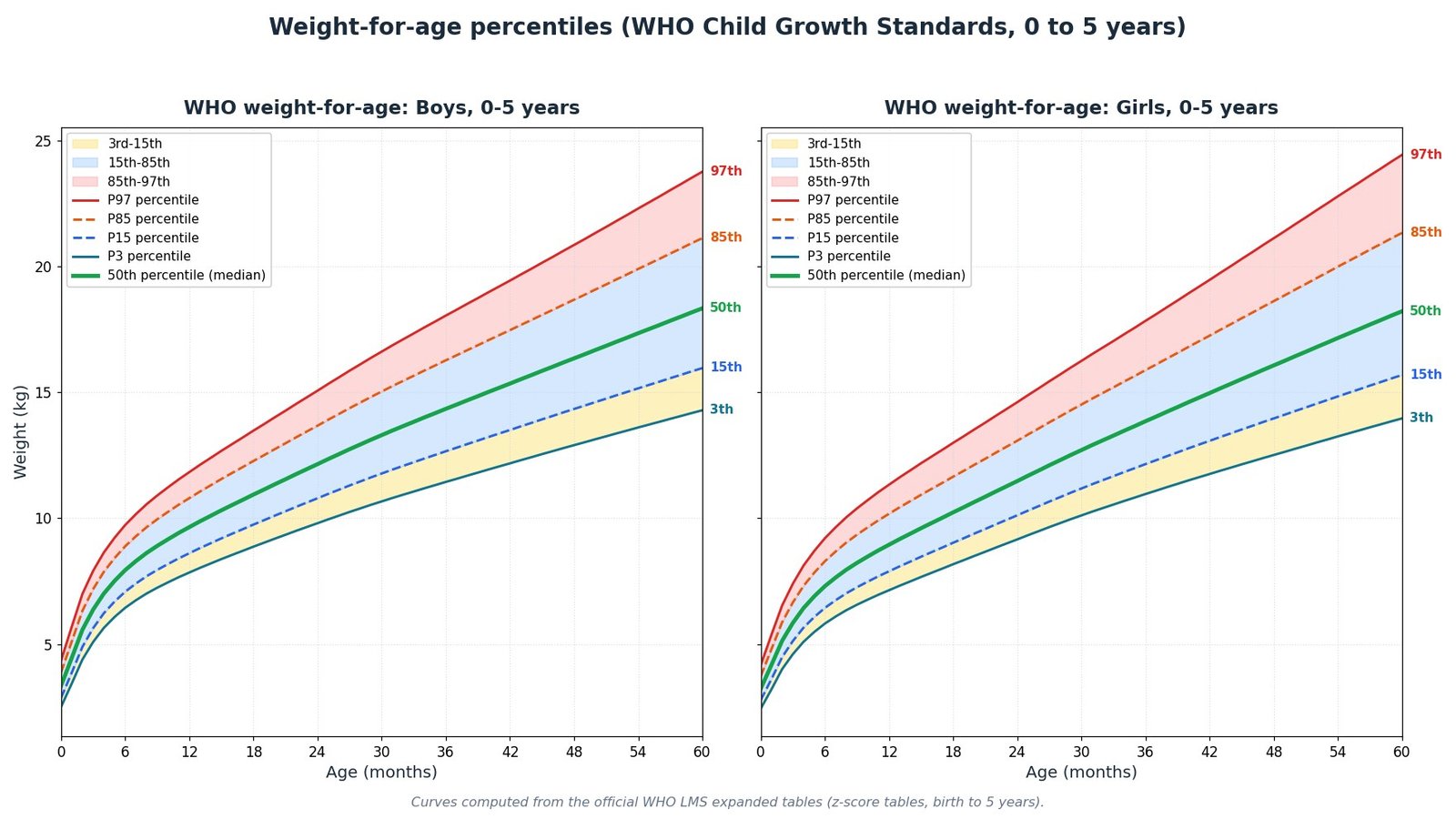
A centile compares your child with 100 healthy children of the same age and sex from the WHO reference population. A child on the 40th centile weighs more than 40 of those 100 children and less than 60. The middle of the scale, around the 50th centile, is simply the average; anywhere between the 3rd and 97th centiles sits within the typical range for that age and sex. Centiles describe where a child sits in the population, not a grade to pass or a target to chase.
| Centile (z-score) | Interpretation | What to do |
|---|---|---|
| 3rd to 97th (z -2 to +2) | Typical range | Normal growth pattern. Keep measuring at routine checks. |
| Below 3rd (z below -2) | Underweight range | Warrants clinical evaluation. A single reading does not diagnose malnutrition. |
| Above 97th (z above +2) | High weight for age | May indicate overweight, but weight-for-length or BMI-for-age is the better indicator. Discuss with a clinician. |
The trend over time matters more than any single reading. A child steadily following one centile line is growing normally even far from the 50th, while a child crossing two centile bands in either direction deserves a review even while the readings sit inside the typical range. A one-off unusual number should always be confirmed with a careful reweigh before anyone draws conclusions from it.
How the weight for age percentile calculator works
The WHO Child Growth Standards come from the Multicentre Growth Reference Study (1997 to 2003), which followed about 8,440 healthy, breastfed children in Brazil, Ghana, India, Norway, Oman, and the United States. Because these children were raised in conditions that support full growth, the standards describe how children should grow, not just how they do grow, and they apply to children everywhere regardless of ethnicity.
This calculator uses the official WHO LMS parameters for weight-for-age, birth to 5 years, taken from the WHO expanded tables for constructing growth charts. For each month the WHO publishes an L (which adjusts for skew), an M (the median), and an S (the spread of values around the median). The z-score is computed with the LMS formula: z = ((weight / M)^L - 1) / (L x S). The centile is the matching point on the standard normal distribution: a z-score of 0 sits exactly on the 50th centile, -2 on about the 2.3rd centile, and +2 on about the 97.7th centile. Your child's age is matched to the nearest completed month of the WHO tables, which are built on per-day values.
Why weight-for-age is measured in the first five years
Weight is the most responsive of the standard growth measurements. Length and head circumference change slowly, but weight can shift within weeks in response to feeding problems, illness, or an improving diet. That responsiveness is exactly why paediatricians weigh children at every routine visit and why weight-for-age is one of the oldest and most widely used growth indicators in the world. A single weight tells you how the child is today; a series of weights tells you where they are heading.
Of the standard weight indicators, weight-for-age is the one that tracks overall body weight against age, which makes it the natural first screen for underweight. Global nutrition monitoring uses it heavily: children whose weight-for-age sits more than two standard deviations below the WHO median are classed as underweight, a group that overlaps with children who are not getting enough nutrition, who have an underlying illness, or who were born prematurely and are still catching up. The indicator does not explain why the weight is low, but it reliably flags which children deserve a closer look, and that flag has guided child health programmes in every country for decades.
Parents sometimes expect weight to follow the 50th centile closely, but real children do not work that way. Growth in the first years comes in bursts and pauses, and appetite varies with illness, teething, and temperament. A healthy child may sit on the 20th centile for a year without anything being wrong, provided the line they follow stays steady. What clinicians look for is not closeness to the middle but consistency of the child's own path, which is why every reading goes onto a chart instead of being judged in isolation.
How to weigh a young child accurately
- Use a calibrated digital scale placed on a hard, level floor. Carpet and rugs make scales read low, so move the scale onto tile or wood before stepping on.
- Weigh the child in light clothing or a dry nappy. A wet nappy or a full set of winter clothes can add a meaningful fraction of a kilogram, enough to shift the centile in a small infant.
- For infants, either use a baby scale with the baby undressed, or weigh an adult holding the baby and subtract the adult's own weight. Take each reading twice to check they agree.
- Weigh at a similar time of day when you are comparing visits. A feed, a large meal, or a wet nappy moves the reading more than most parents expect.
- The child should be still and centred on the scale. A bouncing toddler gives a jumping number, so wait for the display to settle.
- Record the weight to the nearest 0.1 kg along with the date and the child's exact age in months. That record is what turns isolated readings into a growth trend.
Below the 3rd centile: the underweight range
When a confirmed weight-for-age sits below the 3rd centile, meaning a z-score below -2, clinicians class it as underweight. The term describes a measurement, not a cause, and reaching for a diagnosis from a single calculator result would be a mistake. Many low readings resolve on reweigh: a scale on a soft floor, heavy clothing, or a baby weighed right after a large feed can all produce a misleading number. A meaningful share of low readings also reflect a constitutionally slight build that simply runs in the family. Premature babies need their age corrected for how early they were born, usually until at least 2 years of age, before their centile means anything at all.
When a low reading persists across careful repeat weighings, the clinician looks at the whole child rather than the number alone: feeding history, the pattern of weight gain over recent visits, length and head circumference growth, the parents' builds, the pregnancy and birth history, and any recent illness. Causes they consider range from inadequate intake or feeding difficulties, through chronic conditions that increase energy needs, to rare underlying disorders, but the evaluation always begins with confirming the measurement and taking a careful history. The appropriate response to a low reading is a timely clinical review, not alarm, because context determines what the number means. A single reading does not diagnose malnutrition.
Above the 97th centile: what a high reading means
A confirmed weight-for-age above the 97th centile, a z-score above +2, tells you the child weighs more than nearly all same-age children of the same sex. It may indicate overweight, but there is an important caveat: weight-for-age does not account for height. A tall child is expected to weigh more, and a muscular or large-framed child can sit high on weight-for-age while being perfectly proportionate. For that reason, clinicians do not judge overweight from weight-for-age alone.
The proper assessment uses weight-for-length in children under 2, or BMI-for-age from age 2 onward, because both adjust weight for the child's actual build. If your child lands above the 97th centile on weight-for-age, the right next step is to check those indicators: try our weight-for-length centile calculator for children under 2, or the BMI percentile calculator for ages 2 and up. Mention a high reading at the next routine check so it can be assessed properly. A single high reading is a reason to look more carefully, not a verdict on the child's health.
Centiles and z-scores: two ways to read the same result
This calculator shows both a centile and a z-score, and they describe the same position in two different ways. The z-score counts standard deviations from the WHO median: a z-score of 0 is exactly average, -1 is one standard deviation below the median, and +1 is one above. The centile translates that position into "out of 100 children": a z-score of -2 sits at about the 2.3rd centile, and +2 at about the 97.7th.
Clinicians often prefer z-scores for tracking because centiles compress at the extremes. A child moving from a z-score of -2.5 to -3.5 has changed substantially, but on the centile scale that looks like a tiny shift from roughly the 0.6th to the 0.02nd centile, which is easy to misread as no change. For day-to-day understanding, centiles are more intuitive; for following a child over months and years, the z-score tells the truer story.
The trend matters more than one reading
Growth charts were invented to be read as lines, not points. Each weighing adds one dot, and the line joining the dots is what the clinician interprets. A child who holds steady along the 15th centile for a year is showing a healthy, consistent growth pattern. A child who slides from the 60th to the 25th over three visits is showing a pattern that deserves attention, even though every point along the way sat inside the typical range. The number of centile lines crossed, and the direction, carry more meaning than where the latest reading happens to land.
This is also why small wobbles between visits are normal. A child who ate poorly during a week of illness may weigh slightly less at the next check, then rebound at the following one. Clinicians expect this noise and look through it for the underlying direction. Bring the full history of readings, with dates and ages, to every check rather than remembering only the latest one, because the pattern is the diagnosis.
Limitations
- These standards cover birth to 5 years. For ages 5 to 19 the WHO publishes a separate 2007 growth reference; ask your paediatrician for those charts.
- Premature babies need their age corrected for prematurity until at least 2 years; use the corrected age in this calculator.
- A centile describes one moment. The growth pattern across several visits is more informative than any single reading.
- Weight-for-age does not adjust for height, so it is a weak indicator of overweight on its own. Use weight-for-length or BMI-for-age when overweight is the question.
- Illness, dehydration, and recent meals shift the number. A weight taken during an acute illness should not be treated as the child's usual growth.
- This tool does not diagnose underweight, malnutrition, overweight, or any other condition, and it does not replace professional assessment.
Frequently asked questions
What is a weight-for-age centile?
A weight-for-age centile compares your child's weight with the WHO reference population of healthy children of the same age and sex. A child on the 40th centile weighs more than 40 out of 100 same-age children and less than 60. It describes where the child sits in the population, not a grade or a pass mark.
How is weight-for-age different from BMI-for-age?
Weight-for-age reflects overall body weight for a given age but does not show whether the weight is proportionate to height. BMI-for-age adjusts weight for height, so it is the better indicator when overweight is the question. Clinicians use weight-for-age mainly to screen for underweight, and weight-for-length or BMI-for-age when overweight is a concern.
Which ages does this weight for age percentile calculator cover?
This calculator covers birth to 5 years (0 to 60 months), using the WHO Child Growth Standards. For children aged 5 to 19, the WHO publishes a separate 2007 growth reference, so ask your paediatrician for those charts.
My child is below the 3rd centile. Does that mean malnutrition?
Not from one reading. Below the 3rd centile is the range where clinicians start calling it underweight when the finding is confirmed, but many single low readings turn out to be measurement slips, a naturally slight build that runs in the family, or an age that was not corrected for prematurity. The correct next step is a careful reweigh and a paediatric review, not a diagnosis from a calculator.
My child is above the 97th centile. Should I be concerned about overweight?
Weight-for-age alone is a weak indicator of overweight because it does not account for height: a tall child is expected to weigh more. A high weight-for-age reading deserves a look, but the proper assessment uses weight-for-length in children under 2 or BMI-for-age in children 2 and over. Mention the reading at the next routine check so it can be assessed properly.
How should I weigh my child for an accurate result?
Use a calibrated digital scale on a hard, level floor. Weigh the child in light clothing or a dry nappy and subtract any clothing weight. Weigh at a similar time of day when comparing visits, and weigh twice to check the readings agree. For infants, an adult can hold the baby and subtract their own weight, or use a baby scale with the baby undressed.
Related child development calculators
Source: WHO Child Growth Standards: Weight-for-age. WHO Multicentre Growth Reference Study Group. Geneva: World Health Organization; 2006. LMS parameters from the official WHO expanded tables for weight-for-age, birth to 5 years (downloaded from cdn.who.int). Ages 5 to 19 use the separate WHO Reference 2007.