Weight for Length Percentile Calculator (WHO, 0-2 Years)
This weight for length percentile calculator uses recumbent length, weight and sex to give the WHO weight-for-length z-score and centile for a baby or toddler, with wasting and overweight interpretation bands.
Calculate the z-score and centile
| Reference | Weight (kg) |
|---|---|
| 3rd percentile | |
| 50th percentile (median) | |
| 97th percentile |
Based on the WHO Child Growth Standards expanded z-score tables for weight-for-length, birth to 2 years, interpolated to 0.1 cm.
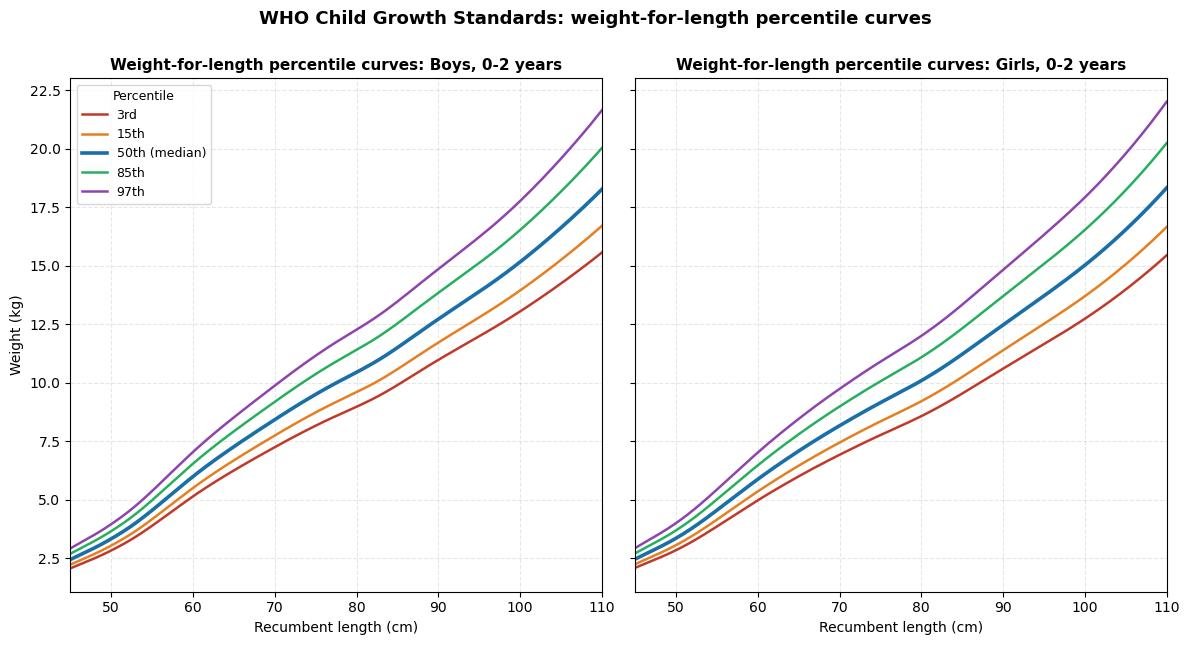
What this weight for length percentile calculator measures
A weight for length percentile calculator answers a different question from the growth charts most parents know. Weight-for-age and length-for-age charts ask whether a child is heavy or tall for their age. Weight-for-length asks whether a child is heavy or light for their body length. It compares the child's weight with the weights of healthy children of the same length, regardless of how old they are.
This length-based view is the World Health Organization's preferred screening tool for wasting in children under 2 years of age. Wasting means a child is too thin for their length, and it usually reflects a recent and severe process: inadequate food intake, an infection that increased nutritional needs, or a combination of the two. Because a longer child is naturally expected to weigh more, judging weight against length avoids penalising a tall thin child or masking a problem in a short one. The reference curves used here come from the WHO Multicentre Growth Reference Study, which followed healthy, breastfed children growing up in favourable conditions in six countries. The study showed that children everywhere grow similarly when their needs are met, so one international standard applies to all.
Indexing by length rather than age also removes a common source of confusion. Parents often worry when a baby born a little early or a little small seems "behind" on age-based charts. Weight-for-length sidesteps the age question entirely: whatever the child's age, a given length carries an expected weight distribution, and the calculator places the child on that distribution as a z-score and a centile.
How the z-score is calculated
The calculator uses the LMS method, the same statistical technique the WHO uses for all of its growth standards. For every combination of sex and length, the reference tables provide three parameters: L (the skewness of the weight distribution), M (the median weight) and S (the coefficient of variation). The official expanded tables give these values at 0.1 cm intervals from 45.0 cm to 110.0 cm, and this page embeds those exact values, 651 rows for boys and 651 rows for girls. For a length that falls between tabulated rows, the L, M and S values are linearly interpolated.
With the parameters for the child's sex and length in hand, the z-score is:
z = ((weight / M)L - 1) / (L x S)
The centile is then the standard normal cumulative probability of that z-score, multiplied by 100. A z-score of 0 always corresponds to the 50th centile, a z-score of about -1.88 to the 3rd centile, and a z-score of -3 to about the 0.13th centile. The calculation makes no use of the child's age, which is why entering the correct recumbent length matters so much.
Understanding the result: WHO interpretation bands
The WHO defines fixed z-score cutoffs for weight-for-length. These cutoffs are used worldwide in clinics, growth monitoring programmes and emergency nutrition surveys, so a result from this calculator speaks the same language as your health worker's chart.
| Z-score | Centile | Interpretation |
|---|---|---|
| Below -3 | Below the 0.13th | Severe wasting (severe thinness). Needs urgent clinical evaluation. |
| -3 to -2 | 0.13th to 2.28th | Moderate wasting. Prompt clinical follow-up. |
| -2 to +1 | 2.28th to 84.13th | Typical range. |
| +1 to +2 | 84.13th to 97.72nd | Possible risk of overweight. Review feeding with a clinician. |
| +2 to +3 | 97.72nd to 99.87th | Overweight range. |
| Above +3 | Above the 99.87th | Obese range. Clinical assessment advised. |
A result below -2 deserves prompt attention, and a result below -3 deserves urgent attention. Severe wasting in young children carries real danger: their energy reserves are small, infections hit harder, and complications can develop quickly. Health workers will re-measure, look for swelling of the feet, check appetite, and ask about recent illness and feeding. Do not wait to see if the number improves on its own.
At the upper end, the language is deliberately cautious. "Possible risk of overweight" between +1 and +2 is a prompt to look at feeding patterns, not a label. In the first two years, rapid weight gain relative to length is worth discussing with your clinician, but restrictive dieting is never appropriate for infants and toddlers without medical supervision. What matters most at every point on the scale is the trend: a child drifting steadily downward across centile lines over several visits is more concerning than a single reading sitting quietly on the 5th centile.
Measuring recumbent length and weight correctly
The z-score is only as good as the two numbers you feed it, and in small babies a centimetre here or half a kilo there can move the result across a cutoff. Length is measured with the child lying flat on a firm surface. One person holds the head straight against the fixed end of the length board with the eyes looking upward, while a second person straightens the legs, presses the knees gently down and slides the footboard firmly against the soles. Read the length to the nearest 0.1 cm. Hats, bulky nappies and curled toes all add error, so keep the setup simple and repeat the measurement if the first two readings disagree.
Weight should be taken on a calibrated infant scale with the baby undressed, or in a light dry nappy only, and recorded to the nearest 0.01 kg where the scale allows it. Ordinary bathroom scales are not precise enough for this purpose. If a result surprises you, the most useful next step is to repeat both measurements rather than to worry: a surprising number is more often a measuring slip than a growth problem.
Weight-for-length versus weight-for-height
Parents sometimes meet two similar-sounding indicators. Weight-for-length is the under-2 version: the child is measured lying down, and the reference tables in this calculator cover 45 to 110 cm of recumbent length. From the second birthday, children who can stand are measured standing, and the indicator becomes weight-for-height with its own tables covering 65 to 120 cm of standing height.
The two are not interchangeable because lying and standing measurements differ. When a child stands, gravity compresses the spine slightly, so standing height averages about 0.7 cm less than recumbent length for the same child. If you enter a standing height into this calculator, or a recumbent length into a weight-for-height tool, the z-score will be biased. Use this page only for recumbent length in children under 2 years. Once your child is measured standing, switch to a weight-for-height calculator.
Why one reading is never a diagnosis
A z-score describes where one measurement sits on a population distribution. It does not explain why it sits there, and it cannot by itself diagnose malnutrition, overweight or any disease. A child at the 4th centile who has always tracked near that line, feeds well and is developing normally is a different clinical story from a child who has fallen from the 60th to the 4th centile in three months. Only repeated measurements over time, plotted as a trend, can tell those stories apart.
Clinical assessment adds what the number cannot: appetite, feeding history, recent infections, alertness, swelling, and the parents' own observations. Health workers also consider context the chart knows nothing about, such as a recent stomach bug that temporarily pulled weight down, or a growth pattern that runs in the family. Use this calculator as a screening and learning tool, bring the numbers to your appointments, and let a qualified clinician put them together with the rest of the picture.
Frequently asked questions
Why is this calculator indexed by length instead of age?
Weight-for-length compares a child's weight with the weight expected for their body length, not their age. Two children of the same age can have very different lengths, and a longer child is expected to weigh more. Indexing by recumbent length makes this a measure of body proportion, which is why the World Health Organization uses it to screen for wasting (acute undernutrition) in children under 2 years.
What is the difference between weight-for-length and weight-for-height?
Weight-for-length is used for children under 2 years who are measured lying down (recumbent length). Weight-for-height is used from 2 years onward, when children are measured standing. On average, a child's recumbent length is about 0.7 cm more than their standing height because gravity compresses the spine when standing. Use this calculator only for recumbent length measurements in children under 2.
What does a z-score below -2 mean on this calculator?
A weight-for-length z-score between -3 and -2 indicates moderate wasting, and a z-score below -3 indicates severe wasting. Wasting means a child is too light for their length and can reflect acute undernutrition or illness. Any result below -2 should be followed up promptly with a clinician, who will repeat the measurements, assess feeding and recent illness, and check for complications. A single reading does not by itself diagnose malnutrition.
Can I use this calculator for a baby born prematurely?
For preterm infants, clinicians usually interpret growth using corrected age until the child is 24 to 36 months old, because growth expectations depend on maturity. Because this reference is indexed by length rather than age, the length measurement itself still places the baby on the chart, but expectations and follow-up timing differ for preterm babies. Discuss the result with your pediatrician, who will apply the appropriate corrections.
How accurate do the length and weight measurements need to be?
Small measurement errors can shift the z-score noticeably, especially in young infants. Length should be measured lying down on a firm surface with a length board or tape, head held straight, legs fully extended, and read to the nearest 0.1 cm. Weight should be taken on a calibrated infant scale with the baby undressed or in light dry clothing only. If a result looks surprising, repeat both measurements before acting on it.
What should I do if the result falls in the overweight range?
A z-score above +2 indicates the overweight range and above +1 a possible risk of overweight by WHO cutoffs. In infants and toddlers this warrants a calm discussion with your clinician about feeding patterns, milk and juice intake, and growth trends over time, not a restrictive diet on your own. Restricting food in young children without medical guidance can harm growth and development.