ABCD2 Score Calculator: 2-Day Stroke Risk After TIA
The ABCD2 score calculator estimates the 2-day risk of stroke after a transient ischaemic attack (TIA). It adds points for five features of the presentation: age 60 or over, blood pressure of 140/90 mmHg or higher, the clinical features of the episode (unilateral weakness scores 2, speech disturbance without weakness scores 1), symptom duration, and diabetes, for a total of 0 to 7. In the validation study, scores of 0 to 3 carried a 1.0% 2-day stroke risk, scores of 4 to 5 carried 4.1%, and scores of 6 to 7 carried 8.1%. The score helps clinicians set the urgency of the stroke-prevention workup; it never replaces clinical judgment.
Calculate the ABCD2 score
Enter the patient's details from the TIA presentation. All fields are required except diabetes.
What your ABCD2 result means
The score sorts patients into three risk bands. The percentages below are the 2-day stroke rates observed in the validation cohorts of the Johnston study (4,804 patients in derivation and validation groups combined), and they are the reason the 2-day window matters: the danger after a TIA is front-loaded, concentrated in the first days, so the urgency of the workup has to match.
| Score | Risk band | 2-day stroke risk | What it usually means for urgency |
|---|---|---|---|
| 0 to 3 | Low | 1.0% | Urgent evaluation, often through an expedited same-day outpatient pathway |
| 4 to 5 | Moderate | 4.1% | Urgent evaluation, commonly within 24 hours |
| 6 to 7 | High | 8.1% | Immediate evaluation; admission or observation is common practice |
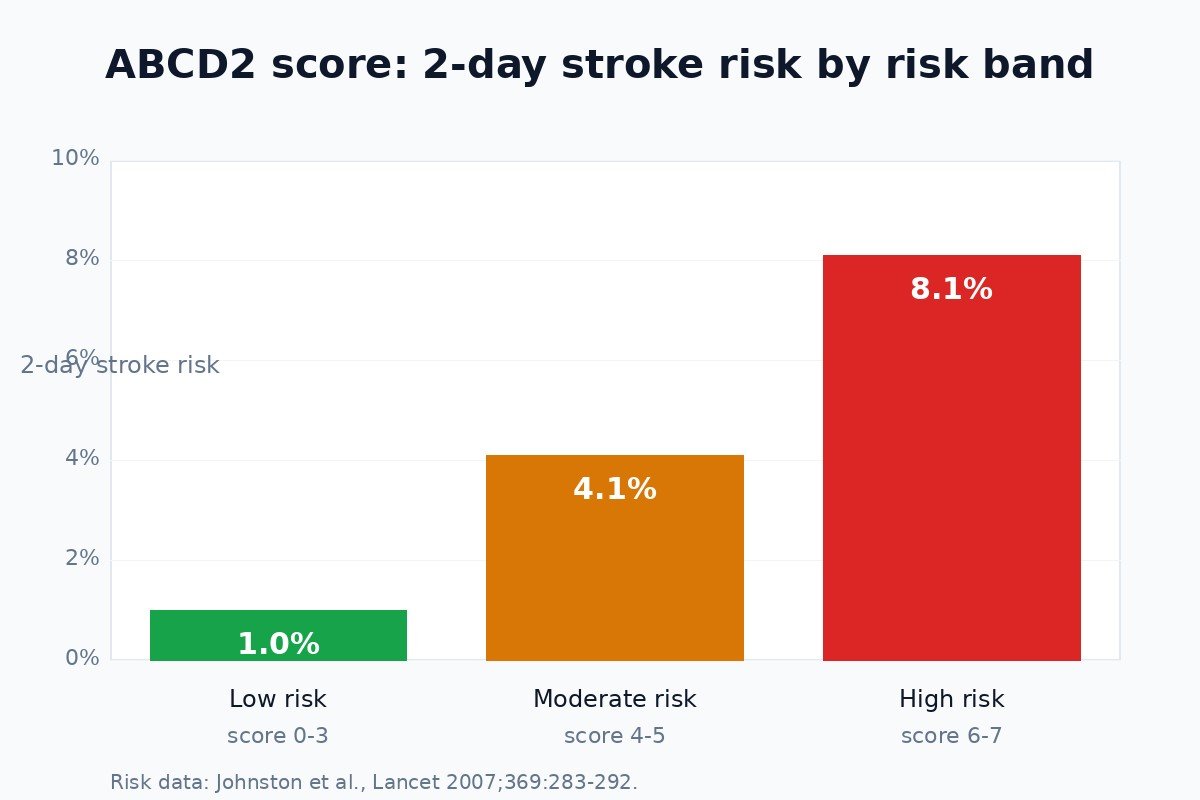
Two points about reading these numbers. First, they are population averages. An individual with a score of 2 can still have a stroke, and many with a score of 7 will not; the score shifts probabilities, it does not determine outcomes. Second, 1.0% sounds small, but it is roughly the risk of one in a hundred patients having a stroke within two days, which is far higher than the background risk and justifies urgent attention rather than routine referral.
How the ABCD2 score calculator works
The mnemonic ABCD2 names its five components: Age, Blood pressure, Clinical features, Duration, and Diabetes. Each contributes points according to how strongly it predicted early stroke in the derivation data. The design is deliberately coarse: the thresholds are round numbers and the weights are 1s and 2s, so the score can be tallied at the bedside in under a minute.
| Component | Criterion | Points |
|---|---|---|
| Age | 60 years or older | 1 |
| Blood pressure | Systolic 140 mmHg or higher, or diastolic 90 mmHg or higher, at presentation | 1 |
| Clinical features | Unilateral weakness (face, arm or leg) | 2 |
| Speech disturbance without unilateral weakness | 1 | |
| Other symptoms | 0 | |
| Duration of symptoms | 60 minutes or longer | 2 |
| 10 to 59 minutes | 1 | |
| Under 10 minutes | 0 | |
| Diabetes | Known diabetes mellitus | 1 |
The heavy weighting of unilateral weakness and long duration is not arbitrary. Both mark the most brain-like, most ischaemic episodes: a focal motor deficit lasting an hour is clinically far closer to a stroke than a two-minute spell of dizziness, and the data confirmed that. Speech disturbance without weakness earns one point because isolated aphasia or dysarthria is still a strong cortical signal, just a weaker one than hemiparesis. Duration works the same way: very brief symptoms are more likely to be non-ischaemic mimics, while symptoms persisting an hour suggest tissue genuinely at risk.
The blood pressure component is often misunderstood. It is not the patient's usual blood pressure or their hypertension diagnosis; it is the pressure measured at presentation, and either the systolic or the diastolic crossing the threshold earns the point. Acute stress raises pressure, and the elevated reading is part of the risk signal the score is trying to capture. Similarly, age and diabetes are proxies for diseased vasculature: older arteries with diabetes are more likely to have the unstable plaque or atrial substrate that turns a transient event into a permanent one.
How clinicians use the ABCD2 score in the emergency department
The practical question after a TIA is not whether the patient needs evaluation but how fast and where. Secondary prevention after TIA is highly effective when started promptly: antiplatelet therapy, statins, blood pressure control, and, where indicated, carotid intervention or anticoagulation for atrial fibrillation. The ABCD2 score helps match the tempo of that workup to the risk. In many emergency departments, a score of 6 or 7 prompts admission or a period of observation with same-day neurology input, a score of 4 or 5 leads to evaluation within 24 hours, and a score of 0 to 3 is handled through an urgent TIA clinic pathway on the same or next day. These are common patterns of practice, not fixed rules; local protocols differ, and no guideline sets a score threshold that mandates admission.
The score is most useful when combined with the rest of the assessment. A high score in a patient whose carotid ultrasound shows a critical stenosis is a different situation from a high score with no identifiable cause, and the first patient moves faster toward surgery. Findings that the score ignores entirely, such as atrial fibrillation on the ECG, a crescendo pattern of repeated TIAs, or a haemorrhagic risk that complicates anticoagulation, can override it. Used properly, ABCD2 is a triage aid that structures a decision, not a decision by itself.
One more use deserves mention: the score gives clinicians a shared language for communicating urgency. When a primary care doctor calls the emergency department with "a 72-year-old with a 40-minute episode of right-sided weakness, pressure 150 over 95, ABCD2 of 5," the receiving team instantly knows this is a moderate-risk patient who needs review today. That handover function is almost as valuable as the numerical prediction.
ABCD2, ABCD3-I and diffusion-weighted MRI: what the newer add-ons offer
The ABCD2 score is purely clinical, which is its strength and its ceiling. Since its publication, researchers have shown that adding a few more features improves prediction. The ABCD3-I score keeps the ABCD2 core and adds three items: a second TIA within the preceding 7 days (a "dual TIA," worth 2 points), carotid stenosis of 50% or more on the symptomatic side (2 points), and an acute infarct on diffusion-weighted MRI (2 points), taking the total to 13.
The logic is straightforward. A recurrent TIA is an unstable process declaring itself. A tight carotid stenosis is a visible source of emboli that can be fixed surgically. And a positive diffusion-weighted MRI lesion, even when symptoms have resolved, proves the event was a true ischaemic insult to brain tissue rather than a mimic, which changes both the diagnosis and the prognosis. In studies, these additions meaningfully improved risk stratification beyond ABCD2 alone.
So why is ABCD2 still the standard at the bedside? Because the add-ons need information that is not available at first presentation. A diffusion-weighted MRI requires an urgent scan slot, a carotid ultrasound requires a vascular laboratory, and the dual-TIA criterion needs the history to be taken carefully. In an emergency department at 2 a.m., the clinician has age, blood pressure, the story, and the duration, which is exactly what ABCD2 asks for. The practical workflow is therefore sequential: ABCD2 now, for the immediate triage decision, and imaging-informed scores later, once the scans are done, to refine the risk and guide treatment such as carotid surgery. It is also worth knowing that modern practice has moved partly toward a tissue-based definition of TIA, where the absence of infarction on imaging is what separates TIA from stroke. A DWI-positive "TIA" is, by that definition, already a stroke, which is another reason imaging changes management independently of any score.
Limitations of the ABCD2 score
- The score does not reliably distinguish TIA from mimics. Migraine aura, seizures, functional symptoms, and hypoglycaemia can all produce transient neurological symptoms, and the score treats them the same as true ischaemia. A low score in a clear stroke mimic means little, and a high score in a mimic is misleading.
- It ignores the presumed cause of the TIA. Atrial fibrillation, carotid stenosis, and cardioembolic sources drive treatment decisions but contribute nothing to the score.
- It ignores imaging. A patient with a score of 2 but an acute infarct on MRI is at substantially higher risk than the score suggests.
- The blood pressure reading is a single snapshot. Pressures fluctuate, and a patient whose pressure settles below the threshold an hour later keeps the point the first reading earned.
- Duration depends on the history, which is often imprecise. Witnesses overestimate or underestimate, and patients may not notice exactly when symptoms began, especially with speech or cognitive symptoms.
- The score was derived and validated before the widespread use of urgent MRI-based TIA pathways, so its performance in a modern rapid-access clinic with immediate imaging may differ from the published figures.
- Discrimination is moderate. The c statistics in the validation cohorts ranged from 0.62 to 0.83, which is useful for triage but far from a perfect test. It should never be the sole basis for a disposition decision.
Frequently asked questions
What does the ABCD2 score measure?
The ABCD2 score estimates the short-term risk of stroke after a transient ischaemic attack, most precisely the 2-day risk. It combines five clinical features (age, blood pressure, clinical features of the episode, symptom duration, and diabetes) into a score from 0 to 7. In the Johnston validation study, patients scoring 0 to 3 had a 1.0% 2-day stroke risk, those scoring 4 to 5 had a 4.1% risk, and those scoring 6 to 7 had an 8.1% risk.
What is a high ABCD2 score?
A score of 6 to 7 is the high-risk band, carrying an 8.1% risk of stroke within 2 days of the TIA in the validation cohorts. Such patients generally need immediate emergency evaluation and an urgent stroke-prevention workup, which commonly means admission or observation depending on the local pathway. A score of 4 to 5 is moderate risk (4.1% at 2 days) and usually calls for evaluation within 24 hours.
Does a low ABCD2 score mean the patient is safe to go home?
Not by itself. A score of 0 to 3 carries a 1.0% 2-day stroke risk, which is lower but not negligible, and the score is a population-level estimate rather than a guarantee for any individual. Many centres still evaluate low-risk TIA patients urgently, often the same day, through an expedited outpatient pathway rather than admission. The score should support, not replace, clinical judgment and the local TIA protocol.
What is the difference between the ABCD, ABCD2 and ABCD3-I scores?
The original ABCD score used age, blood pressure, clinical features and duration. The ABCD2 score (Johnston et al., 2007) added diabetes and was calibrated specifically for 2-day stroke risk. The ABCD3-I score adds imaging and recurrence features: a second TIA within 7 days, significant carotid artery stenosis, and an acute lesion on diffusion-weighted MRI. The ABCD3-I predicts risk better in research settings, but it needs imaging results that are not always available at first presentation, so ABCD2 remains the practical bedside tool.
How is blood pressure measured for the ABCD2 score?
The score uses the blood pressure recorded at presentation with the TIA: either a systolic reading of 140 mmHg or higher, or a diastolic reading of 90 mmHg or higher, earns the point. It is a one-off reading tied to the episode, not the patient's usual baseline. Acute stress can raise readings, and that elevation is part of the risk signal the score captures.
Can the ABCD2 score be used in the emergency department to decide admission?
It is widely used as one input to that decision, but no guideline sets a fixed score threshold that mandates admission. High scores (6 to 7) commonly prompt admission or urgent specialist review; moderate scores (4 to 5) usually prompt evaluation within 24 hours; low scores (0 to 3) often go through an urgent same-day outpatient pathway. The final decision also weighs factors the score ignores, such as the suspected cause of the TIA, imaging findings, atrial fibrillation, and whether the patient can return promptly if symptoms recur.
Clinical source: Johnston SC, Rothwell PM, Nguyen-Huynh MN, Giles MF, Elkins JS, Bernstein AL, Sidney S. Validation and refinement of scores to predict very early stroke risk after transient ischaemic attack. Lancet. 2007;369(9558):283-292. doi:10.1016/S0140-6736(07)60150-0 (verified via PubMed PMID 17258668)