PERC Rule Calculator for Pulmonary Embolism
This PERC rule calculator applies the 8 pulmonary embolism rule-out criteria to a patient who has already been judged at low risk. First confirm the low-risk gate, then enter the 8 items: age, pulse, oxygen saturation, and five yes-or-no questions. If every criterion is met, PE is ruled out and no D-dimer is needed; if any criterion fails, the rule cannot rule out PE and the next step is D-dimer testing. The tool enforces the gate because the rule is only validated in low-risk patients.
What your PERC rule calculator result means
The calculator gives one of three results. PERC negative (PE ruled out): all 8 criteria are met in a patient confirmed low risk, so pulmonary embolism is ruled out and no D-dimer is needed. This is the intended payoff of the rule: it identifies the roughly one in five evaluated patients in whom the post-test probability is below the testing threshold, sparing them the radiation and contrast of CT pulmonary angiography and the false positives of D-dimer testing. PERC positive: at least one criterion is failed, so the rule cannot rule out PE and the next step in a low-risk patient is D-dimer testing, with imaging if the D-dimer is positive or the clinician remains concerned. PERC does not apply: the low-risk gate was not met, so the rule is invalid here and the patient needs D-dimer testing or imaging guided by their actual pretest probability.
Notice the asymmetry: a negative result is decisive, while a positive result is not a diagnosis of anything. This is deliberate. The rule was built as a block rule, a checklist in which all eight items must pass, because the evidence question is a narrow one: can we identify low-risk patients whose risk is already below the level at which any further test does more harm than good? The 2008 validation found that among low-suspicion PERC-negative patients, the composite of image-proven VTE or death within 45 days occurred in 16 of 1,666, a false-negative rate of 1.0% (95% CI 0.6 to 1.6%). That sits below the 1.8% test threshold estimated in the derivation study, which is why the authors concluded that no further testing is needed in this group.
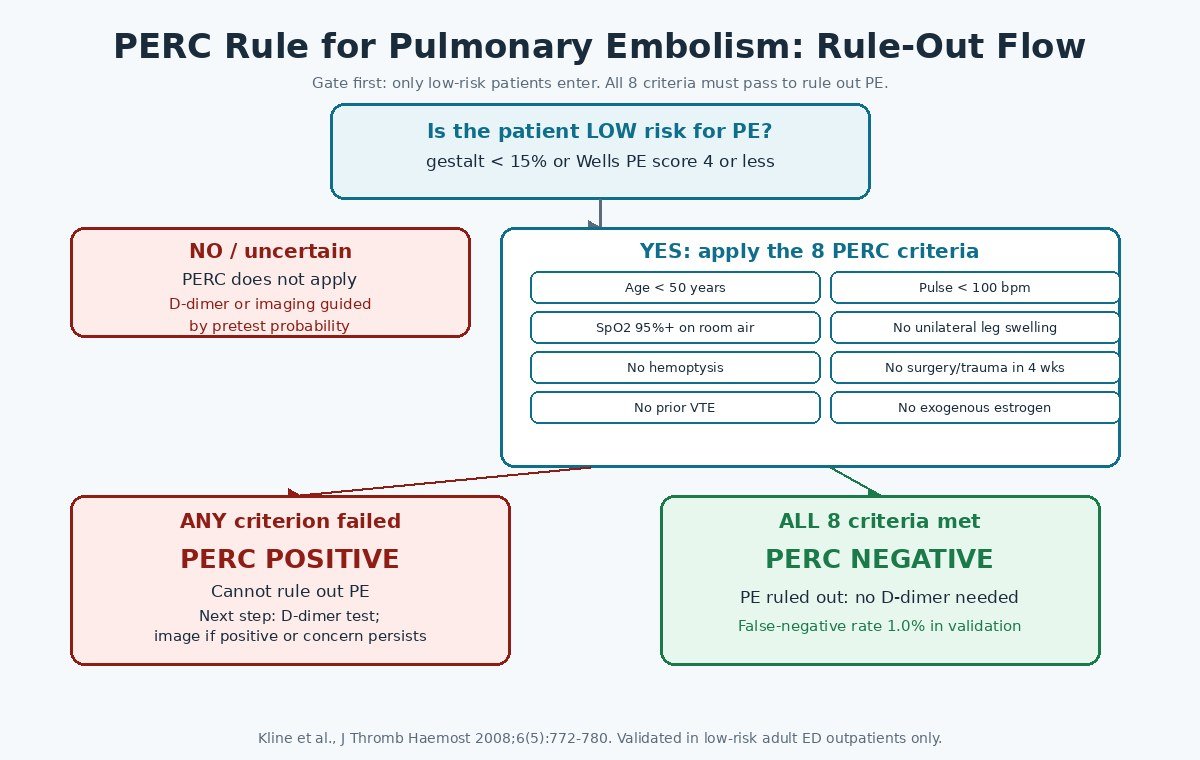
The 8 PERC criteria explained
All eight criteria must be true. The rule is not a score, so there is no partial credit: failing one item is the same as failing five, because each item is a known risk marker for venous thromboembolism whose absence is what makes the rule work.
1. Age under 50 years
The criterion is strictly under 50: a patient aged exactly 50 fails it. Age is the most common reason the rule does not apply, because venous thromboembolism risk rises steeply with age. In practice this makes PERC a rule mainly for younger adults, which fits the group in whom over-testing is the biggest problem: a 35-year-old with pleuritic chest pain and a normal examination is exactly the patient who too often gets a CT scan for a reassuringly low risk.
2. Pulse under 100 beats per minute
Tachycardia is one of the most consistent clinical signs associated with pulmonary embolism, and a resting pulse of 100 or more fails the criterion. The pulse should be measured at rest; anxiety and pain can raise it transiently, so a single high reading in an otherwise reassuring patient deserves a repeat measurement before it is allowed to fail the rule. But a persistently fast pulse is a red flag that keeps the patient in the testing pathway, and rightly so.
3. SpO2 of 95% or more on room air
The saturation must be measured while the patient breathes room air, not while on supplemental oxygen, because oxygen can mask the hypoxaemia that embolism causes. A reading below 95% fails the criterion. Note the boundary: 94% fails, 95% passes. Altitude, chronic lung disease, and poorly perfused fingers can all distort pulse oximetry, so a borderline reading should be checked against a good waveform and, if unreliable, treated as a fail.
4. No unilateral leg swelling
Asymmetric swelling of the calves suggests a deep vein thrombosis that may have embolised, so any visible asymmetry fails the criterion. The assessment is a visual comparison of the calves, which the derivation study kept because it showed acceptable interobserver agreement. Bilateral symmetric swelling from another cause does not count: it is the one-sided asymmetry, the classic sign of DVT, that the rule cares about.
5. No hemoptysis
Coughing up blood is one of the classic, if uncommon, presenting symptoms of pulmonary embolism, and any history of hemoptysis with the current illness fails the criterion. The question is about the present illness, not a remote history: a nosebleed last year is irrelevant, but blood-streaked sputum with this chest pain is an automatic fail.
6. No surgery or trauma requiring hospitalisation in the previous 4 weeks
Recent surgery or trauma is one of the strongest acquired risk factors for venous thromboembolism, through the combination of immobility, endothelial injury, and a prothrombotic state. The criterion specifies events requiring hospitalisation, roughly the previous 4 weeks, and it includes surgery needing endotracheal intubation. Minor injuries that did not need hospital care do not fail the criterion, but any clinician uncertainty should resolve toward failing it: the safe direction is the testing pathway.
7. No prior venous thromboembolism
A previous deep vein thrombosis or pulmonary embolism is the single strongest predictor of a future event, and any history of VTE fails the criterion permanently. This includes events years ago: the thrombophilia or propensity that caused the first clot does not expire. Patients on long-term anticoagulation for a prior VTE are excluded from the rule on this item alone.
8. No exogenous estrogen use
Estrogen-containing contraceptives and hormone replacement therapy increase the risk of venous thromboembolism several-fold, so current exogenous estrogen use fails the criterion. Progestin-only contraception was not counted in the original studies. The practical point is worth stating plainly: young women are the demographic most likely to be over-tested for PE, and estrogen use is also commonest in that group, so this item often decides the outcome.
One feature the derivation study deliberately excluded deserves mention: immobility. Prolonged immobility was significantly associated with venous thromboembolism in the data, but it showed poor interobserver agreement, meaning two clinicians often disagreed on whether the patient was immobile, so the authors left it out of the final eight-item rule. That decision is a good illustration of what makes a bedside rule work in practice: every item must be something any clinician can answer the same way.
Why the low-risk gate is non-negotiable
The PERC rule is a second-stage filter, not a first impression. In both the derivation and validation studies, the rule was applied only to patients the clinician had already judged at low pretest probability: a gestalt estimate below 15% in the 2008 validation, or equivalently a Wells score of 4 or less (PE unlikely) under the two-level Wells scheme. The validation's key numbers, the 1.0% false-negative rate and the 97.4% sensitivity, were measured in that gated population and mean nothing outside it.
The reason is arithmetic, not authority. Every rule-out test has a false-negative rate, and whether that rate is acceptable depends on the risk before the test is applied. In a low-risk patient, a negative PERC result pushes the post-test probability below the 1.8% test threshold, the level at which further testing is expected to do more harm than good. In a moderate- or high-risk patient, the same negative result would leave a post-test probability well above that threshold, so the rule would appear to reassure while actually leaving the patient dangerously under-tested. That is why this calculator asks you to confirm low risk before it will give a rule-out result, and why the correct response to uncertainty about risk is to treat the gate as failed and proceed to testing.
The practical workflow this enforces is: gestalt or Wells first, PERC second. If you find yourself reaching for the PERC rule because the patient feels risky, that feeling is itself the answer: the patient is not low risk and the rule does not apply. The rule exists to justify no test in the patients you were already inclined not to test, not to talk you out of testing the ones you are worried about.
How the PERC rule was developed and validated
Jeffrey Kline and colleagues derived the rule in a prospective study of 3,148 emergency department patients evaluated for suspected pulmonary embolism at 10 US hospitals, published in the Journal of Thrombosis and Haemostasis in 2004. Starting from 21 candidate variables, they used logistic regression with stepwise backward elimination to build an eight-item block rule, choosing variables that were both associated with the outcome and reliably measurable at the bedside. They estimated the test threshold for D-dimer, the risk below which testing causes more harm than good, at 1.8% using the method of Pauker and Kassirer, and showed the rule reduced the pretest probability below that threshold in two test populations: a low-risk group of 1,427 patients selected for D-dimer testing, where the rule's sensitivity was 96% and specificity 27%, and a very-low-risk group of 382 patients with dyspnea in whom PE was not initially suspected, where sensitivity was 100% and specificity 15%. The prevalence of PE among those meeting all criteria was 1.4% (95% CI 0.5 to 3.0%) in the low-risk group and 0% (0 to 6.2%) in the very-low-risk group.
The multicenter validation followed in 2008, again in the Journal of Thrombosis and Haemostasis, and it is the study that justifies the rule's current use. The investigators enrolled 8,138 outpatients with suspected PE across 13 emergency departments. Clinicians recorded a structured gestalt pretest probability at the time of test ordering, with low suspicion defined as an estimate below 15%. In 1,666 patients (20%), the clinician reported low suspicion together with a negative PERC result. The main outcome was image-proven venous thromboembolism or death from any cause within 45 days. Overall, 561 patients (6.9%, 95% CI 6.5 to 7.6) had VTE and 56 others died. Among the low-suspicion PERC-negative patients, 15 had VTE and one other died, giving a false-negative rate of 16 of 1,666, or 1.0% (95% CI 0.6 to 1.6%). As a diagnostic test in the low-risk population, low suspicion plus PERC-negative had a sensitivity of 97.4% (95.8 to 98.5%) and a specificity of 21.9% (21.0 to 22.9%). The authors concluded that the combination reduces the probability of VTE to below 2% in about 20% of outpatients evaluated for suspected PE.
Two aspects of these numbers are worth keeping in view. First, the specificity of roughly 22% means the rule is positive in most tested patients, so it only spares testing in about one in five. The rule is good at ruling out, not at ruling in, and a positive result should never be read as evidence for PE. Second, the validation cohort was 85% patients with a chief complaint of dyspnea or chest pain, the classic presentations, so the numbers apply best to that population. The evidence base has since grown, including a French randomized trial finding the PERC strategy non-inferior to usual care with fewer CT scans, shorter emergency department stays, and fewer admissions, but the 2004 derivation and 2008 validation remain the foundation every version of the rule rests on.
Limitations of the PERC rule
The rule's biggest limitation is its low specificity, already discussed: roughly four in five evaluated patients fail at least one criterion, usually age, and proceed to testing anyway. In an older population the rule rarely changes management, which is fine, since the rule was never meant to replace testing where testing is warranted, but it does mean the efficiency gain concentrates in younger, healthier patients.
Second, the rule is only as good as the gate. The validation required a gestalt estimate below 15%, and gestalt is subjective: a cautious clinician and a bold one can look at the same patient and disagree about whether the gate is passed. The rule cannot fix a misjudged pretest probability; if anything, it amplifies the error, because it converts a vague low-risk feeling into a concrete decision not to test. Structured risk scores such as Wells can reduce this subjectivity, which is why the calculator accepts a Wells score of 4 or less as equivalent to low gestalt.
Third, the rule does not apply to large groups of patients who present with suspected PE: pregnant patients, children, inpatients, and patients with a prior VTE on long-term anticoagulation were not in the derivation or validation populations. The estrogen criterion makes PERC especially awkward in pregnancy, and pregnancy has its own validated diagnostic pathways. Fourth, the rule is a rule-out tool only: it says nothing about who actually has PE, and PERC-positive patients still need a properly chosen test, D-dimer for low risk and usually CT pulmonary angiography for higher risk, rather than reassurance from a structured process.
Finally, the clinical context has shifted since 2008. D-dimer thresholds are now commonly age-adjusted, which reduces some of the false-positive burden the rule was designed to avoid, and YEARS-based algorithms offer an alternative way to reduce imaging. PERC remains the simplest option, requiring no blood test at all, and that simplicity is its enduring advantage: in a young low-risk patient with all eight criteria met, the evidence supports discharge without testing, and nothing newer has removed that option.
Frequently asked questions
What does a negative PERC rule mean?
A negative PERC result means all 8 rule-out criteria are met in a patient already judged at low pretest probability for pulmonary embolism. In the 2008 multicenter validation study of 8,138 patients, low-suspicion PERC-negative patients had a false-negative rate of 1.0 percent (16 of 1,666) for VTE or death at 45 days, so no D-dimer and no imaging are needed.
Can the PERC rule be used in a high-risk patient?
No. The PERC rule applies only to patients already judged at low pretest probability, defined in the validation study as a gestalt estimate below 15 percent or equivalently a Wells score of 4 or less. In a moderate- or high-risk patient the rule has not been shown to rule out PE safely, and D-dimer testing or CT pulmonary angiography is required.
What is the difference between PERC positive and PERC negative?
PERC negative means all 8 criteria are met and the patient is low risk: PE can be ruled out without further testing. PERC positive means at least one criterion is failed: the rule cannot rule out PE, and the usual next step is D-dimer testing in the low-risk patient, or imaging when D-dimer is positive or the risk is higher.
What are the 8 PERC criteria?
The 8 criteria are: age under 50 years, pulse under 100 beats per minute, oxygen saturation of 95 percent or more on room air, no unilateral leg swelling, no hemoptysis, no surgery or trauma requiring hospitalization in the previous 4 weeks, no prior venous thromboembolism, and no exogenous estrogen use. All 8 must be true to rule out pulmonary embolism.
Is the PERC rule validated in pregnancy or children?
No. The PERC rule was derived and validated in adult emergency department outpatients, and the estrogen criterion and age cutoff do not transfer to children or pregnancy. Pregnant patients with suspected pulmonary embolism should be evaluated with validated pregnancy-adjusted diagnostic pathways and clinical judgment, not with PERC.
Why can a negative PERC result skip the D-dimer test?
Because in low-risk patients the observed risk after a negative PERC result sits below the test threshold for D-dimer testing, estimated at about 1.8 percent in the derivation study. Below that threshold, testing is expected to cause more harm through false positives, unnecessary radiation, and anticoagulation complications than it prevents, so the safest strategy is no test at all.
Related emergency medicine calculators
Sources: Kline JA, Courtney DM, Kabrhel C, Moore CL, Smithline HA, Plewa MC, Richman PB, O'Neil BJ, Nordenholz K. Prospective multicenter evaluation of the pulmonary embolism rule-out criteria. J Thromb Haemost. 2008;6(5):772-780 (validation in 8,138 patients; DOI verified via PubMed PMID 18318689, 2026-10-02) and Kline JA, Mitchell AM, Kabrhel C, Richman PB, Courtney DM. Clinical criteria to prevent unnecessary diagnostic testing in emergency department patients with suspected pulmonary embolism. J Thromb Haemost. 2004;2(8):1247-1255 (derivation study). Note: a commonly quoted DOI of 10.1001/jama.299.14.1667 for the validation paper is incorrect; the validation study was published in the Journal of Thrombosis and Haemostasis, not JAMA.