CURB-65 Calculator
This CURB-65 calculator scores the severity of community-acquired pneumonia from five bedside variables: new confusion, blood urea, respiratory rate, blood pressure, and age. Enter the values below and the calculator returns the CURB-65 score from 0 to 5, the widely quoted 30-day mortality for that score, and the usual disposition guidance. It is a decision aid for clinicians, and it does not replace clinical judgment.
What your CURB-65 calculator result means
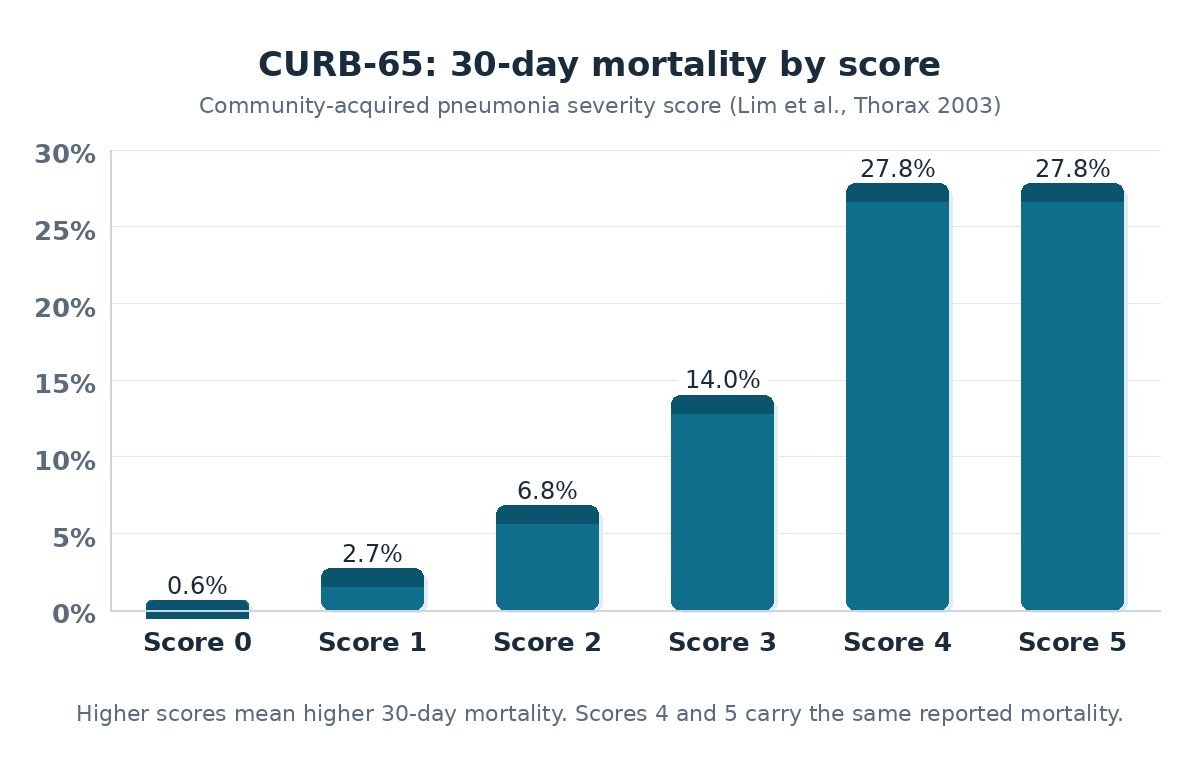
The calculator adds one point for each abnormal variable and reports a total from 0 to 5. The widely quoted 30-day mortality rises steeply across the range, which is why the score is useful for deciding where a patient with pneumonia should be managed. The table below pairs each score with its reported mortality and the usual disposition.
| CURB-65 score | 30-day mortality | Usual disposition |
|---|---|---|
| 0 | 0.6% | Outpatient management can be considered |
| 1 | 2.7% | Outpatient management can be considered |
| 2 | 6.8% | Short-stay supervised outpatient care or hospital admission |
| 3 | 14.0% | Hospital admission with urgent senior review |
| 4 | 27.8% | Hospital admission with urgent senior review; assess for ICU admission |
| 5 | 27.8% | Hospital admission with urgent senior review; assess for ICU admission |
Notice the jump between scores 2 and 3: mortality roughly doubles, which is why most guidelines treat a score of 3 or more as a hospital admission. The mortality figures are population averages from the published validation literature, not predictions for an individual patient. A fit 66-year-old with a score of 1 and no comorbidities faces a very different real-world risk from a frail 66-year-old with heart failure and the same score. The score stratifies populations well; the clinician still judges the person.
The five components of CURB-65, explained
The letters stand for the five variables, each contributing one point. Understanding what each one measures explains why the score works.
C: Confusion (new disorientation to person, place, or time)
New confusion in pneumonia usually reflects cerebral hypoperfusion or hypoxaemia: the brain is the first organ to complain when oxygen delivery fails. The criterion means new disorientation, not the patient's baseline. A patient with established dementia who is at their usual cognitive baseline does not score this point, while a patient who was oriented yesterday and cannot say where they are today does. When in doubt, compare with the documented baseline or ask a family member what is new.
U: Urea above 7 mmol/L
A raised urea reflects a combination of dehydration, reduced renal perfusion from hypotension, and the catabolic state of acute infection. The cutoff is strictly above 7 mmol/L. The calculator also accepts blood urea nitrogen (BUN) in mg/dL, which many laboratories report instead of urea: BUN divided by 2.8 gives urea in mmol/L, so a BUN above about 19.6 mg/dL scores the point. Note that chronic kidney disease can raise urea at baseline, and a score should be interpreted with the patient's usual renal function in mind.
R: Respiratory rate of 30 per minute or more
Tachypnoea is one of the earliest and most sensitive signs of physiological distress in pneumonia, and it is the component most often measured badly. A respiratory rate counted over 15 seconds and multiplied by four is unreliable; the rate should be counted for a full minute with the patient unaware they are being watched, since voluntary control lowers the rate. A rate of 30 or more per minute scores the point.
B: Low blood pressure (systolic below 90 mmHg or diastolic 60 mmHg or below)
Either a systolic below 90 mmHg or a diastolic of 60 mmHg or below scores one point; meeting both still scores only one point. Hypotension signals circulatory failure and predicts deterioration. Patients on antihypertensive treatment may normally run low, so the score should be read alongside the patient's usual blood pressure and the trend since arrival.
65: Age 65 years or older
Age is the single strongest predictor in the score. The physiology of pneumonia is less forgiving after 65: physiological reserve is lower, comorbidities accumulate, and the immune response is blunted. The cutoff includes exactly 65: a patient on their 65th birthday scores the point.
One feature that makes CURB-65 practical is that four of the five items need nothing more than vital signs and a birth date. Only the urea requires a blood test, which is why the four-item CRB-65 variant exists for primary care. The items are deliberately dichotomous: each is either present or absent, so the score can be worked out at the bedside in under a minute and is the same whoever calculates it.
How the CURB-65 score was developed
CURB-65 was derived and validated by Lim and colleagues in a prospective study of 1,068 adults hospitalised with community-acquired pneumonia in the United Kingdom, New Zealand, and the Netherlands, published in Thorax in 2003. The authors combined data from three prospective studies and used multiple logistic regression with 30-day mortality as the outcome to identify the variables that independently predicted death. Age of 65 or older and a low albumin were independently associated with mortality on top of the modified British Thoracic Society rule, and the final six-point model, with one point for each of confusion, urea, respiratory rate, blood pressure, and age, stratified patients into clearly separated mortality groups. The validation cohort reproduced the pattern, which is what turned a research finding into a tool used in emergency departments worldwide.
The score's staying power comes from what it left out. Earlier rules leaned on laboratory and radiographic variables that are not always available at first assessment. CURB-65 uses information available at the initial hospital assessment, which is when the admission decision has to be made. Guidelines including those of the British Thoracic Society and the Infectious Diseases Society of America have endorsed CURB-65 or its PSI counterpart for site-of-care decisions, which is why the calculator above frames the result around disposition as well as mortality.
CRB-65: the primary-care version without the blood test
In general practice or in settings where a urea result is not immediately available, the urea component is dropped to give CRB-65, a four-point score: Confusion, Respiratory rate of 30 or more, low Blood pressure, and age 65 or older. The usual reading is that a score of 0 can be managed at home, 1 to 2 should be assessed in hospital, and 3 to 4 needs urgent hospital admission. CRB-65 is less discriminating than the full score, but it preserves the core idea: simple bedside variables, scored dichotomously, stratify risk well enough to guide the admission decision. Where a urea result becomes available later, the full CURB-65 should be recalculated.
Limitations of CURB-65: what the score misses
CURB-65 is deliberately simple, and simplicity has blind spots. First, it says nothing about comorbidities. A patient with a CURB-65 of 1 who also has metastatic cancer, advanced heart failure, or immunosuppression carries a far higher real risk than the score suggests, and most guidelines explicitly list such conditions as reasons to admit regardless of the score. Second, it does not measure oxygenation. A patient can be profoundly hypoxaemic with a reassuring respiratory rate and blood pressure, especially early on, so pulse oximetry is a mandatory parallel assessment rather than an optional extra.
Third, the score underestimates risk in younger patients. A 40-year-old with multilobar pneumonia, a respiratory rate of 28, and a urea of 6.9 scores 0, yet many clinicians would admit. The score was calibrated on a cohort with a mean age of 64, and its discrimination is weakest at the low end of the age range. Fourth, it does not account for social circumstances: a score of 1 in a patient who lives alone, cannot reliably take oral antibiotics, or cannot return promptly if they deteriorate is an admission, not an outpatient, in practice.
Fifth, CURB-65 applies to community-acquired pneumonia. It was not derived for hospital-acquired pneumonia, aspiration pneumonia, or immunocompromised hosts, and it is not validated in children. Using it outside its derivation population is extrapolating beyond the evidence. Finally, the score is a snapshot at presentation. Pneumonia is a dynamic illness: a patient with an initial score of 2 who becomes hypotensive and confused two hours later has a score of 4, and the score should be recalculated when the clinical picture changes.
When CURB-65 does not replace clinical judgment
The score is a decision aid, and every guideline that endorses it says the same thing: it supports, and never substitutes for, the clinician's assessment of the individual patient. A low score must not reassure when the bedside picture is alarming: severe hypoxaemia, cyanosis, inability to complete sentences, or a lactate that keeps rising all demand escalation whatever the number. Conversely, a high score must not trigger automatic ICU referral for a patient whose goals of care, frailty, or values make that inappropriate; the score knows nothing about what the patient wants.
In practical terms, the safest way to use this calculator is as a starting point for structured thinking: calculate the score, state the suggested disposition, then deliberately ask what the score might be missing. Comorbidities, oxygenation, social context, the trajectory since presentation, and the patient's own wishes are the five things CURB-65 cannot see, and they are often the five things that decide the outcome. Document the score, document the judgment, and when the two disagree, the judgment wins.
Frequently asked questions
What does CURB-65 stand for?
CURB-65 stands for Confusion, Urea greater than 7 mmol/L, Respiratory rate of 30 per minute or more, low Blood pressure (systolic below 90 mmHg or diastolic 60 mmHg or below), and age 65 years or older. Each of the five items scores one point, so the total ranges from 0 to 5, with higher scores meaning higher 30-day mortality from community-acquired pneumonia.
How do I convert BUN to urea for the CURB-65 urea criterion?
Blood urea nitrogen (BUN) in mg/dL can be converted to urea in mmol/L by dividing by 2.8. A BUN of 19.6 mg/dL equals a urea of 7 mmol/L, so BUN above about 19 to 20 mg/dL meets the CURB-65 urea point. This calculator accepts either urea in mmol/L or BUN in mg/dL and converts automatically.
What CURB-65 score means the patient needs hospital admission?
As a guide, scores of 0 to 1 suggest outpatient management can be considered, a score of 2 suggests short-stay supervised outpatient care or hospital admission, and scores of 3 to 5 suggest hospital admission with urgent senior review, with ICU assessment considered for scores of 4 and 5. The score supports but never replaces the clinician's judgment.
Is CURB-65 valid for children?
No. CURB-65 was derived and validated in adults hospitalised with community-acquired pneumonia. It has not been validated in children, and the urea and age cutoffs are not meaningful in paediatric patients. Use paediatric severity assessments and clinical judgment for children with pneumonia.
What is the difference between CURB-65 and CRB-65?
CRB-65 is a four-item version of the score that drops the urea blood test: Confusion, Respiratory rate of 30 or more, low Blood pressure, and age 65 or older. It is used in primary care or settings where blood tests are not immediately available. Scores of 0 suggest home management, 1 to 2 suggest hospital assessment, and 3 to 4 suggest urgent hospital admission.
Does CURB-65 replace clinical judgment?
No. CURB-65 is a decision aid, not a substitute for clinical judgment. It does not capture comorbidities such as cancer, heart failure or immunosuppression, hypoxaemia, multilobar involvement, or social circumstances that may make home care unsafe. A low score should not override concerning bedside findings, and a high score should not be the only reason for ICU referral.
Related emergency medicine calculators
Source: Lim WS, van der Eerden MM, Laing R, Boersma WG, Karalus N, Town GI, Lewis SA, Macfarlane JT. Defining community acquired pneumonia severity on presentation to hospital: an international derivation and validation study. Thorax. 2003;58(5):377-382 (derivation and validation of CURB-65 in 1,068 adults; DOI verified 2026-10-02).