PECARN Head Injury Calculator
This PECARN head injury calculator applies the Pediatric Emergency Care Applied Research Network prediction rules for clinically important traumatic brain injury in children. Enter the child's age and the six age-appropriate predictors, and the calculator returns one of three tiers: CT recommended, observation versus CT, or very low risk with CT not recommended. It is a prediction aid for clinicians and does not replace clinical judgment.
What your PECARN head injury calculator result means
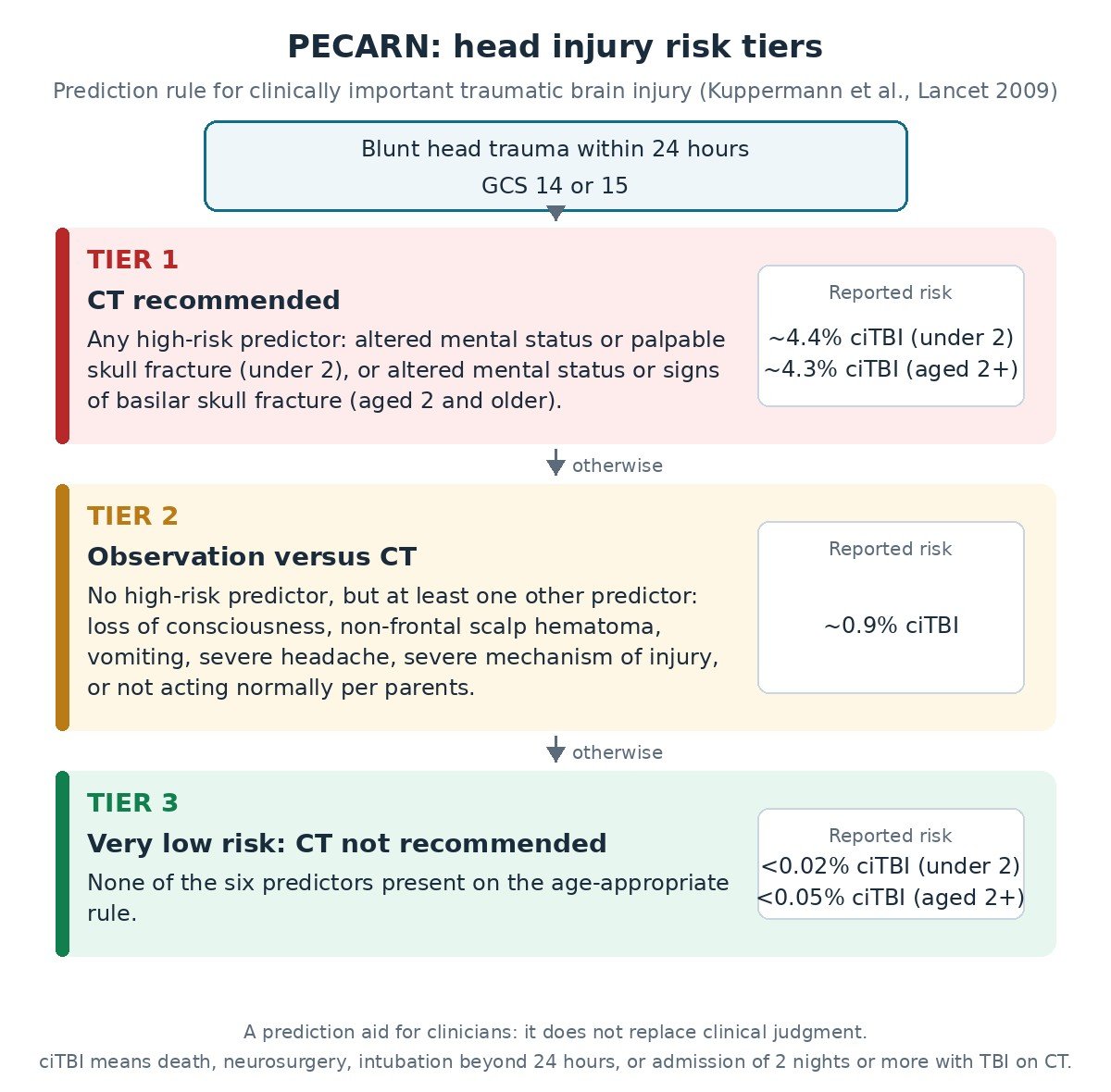
The calculator works through the rule exactly as published. First it checks the two high-risk predictors for the child's age group; if either is present, the tier is CT recommended. Otherwise it looks for any of the remaining four predictors; if at least one is present, the tier is observation versus CT. With none of the six predictors present, the child is at very low risk and CT is not recommended. The table below pairs each tier with the reported risk of a clinically important traumatic brain injury from the PECARN study.
| Tier | Finding | Reported ciTBI risk |
|---|---|---|
| CT recommended | Under 2: altered mental status or palpable skull fracture. Aged 2 and older: altered mental status or signs of basilar skull fracture. | About 4.4% under 2; about 4.3% at 2 and older |
| Observation versus CT | No high-risk predictor, but at least one other predictor present | About 0.9% |
| Very low risk: CT not recommended | None of the six predictors present | Under 2: less than 0.02%; aged 2 and older: less than 0.05% |
Notice how wide the risk gap is between tiers: roughly one child in twenty-five in the high-risk group had a clinically important brain injury, against roughly one in a hundred in the intermediate group and fewer than one in several thousand with no predictors. The intermediate tier is the deliberate gray zone where the rule is assistive rather than directive. In the original paper the authors recommended that this decision rest on parental preference, very young age, worsening symptoms during emergency department observation, physician experience, and whether the findings are single or multiple. The rule tells you the child is not clearly in either camp; the clinician, the child, and the parents decide together.
The six predictors for children under 2 years
Infants and toddlers cannot describe symptoms, so this rule leans on observable signs and on what parents notice. Tick every predictor that is present; the calculator does the rest. The two high-risk predictors are marked.
Altered mental status (high-risk predictor)
A Glasgow Coma Scale score of 14, or other signs of altered mental status: agitation, sleepiness or somnolence, a slow response to verbal communication, or repetitive questioning. In this age group mental status is judged against the child's normal behavior, which is why the parents' report is a separate predictor below. If the GCS is 14 rather than 15, tick this box.
Palpable skull fracture (high-risk predictor)
A skull fracture felt on palpation, or suspected on the basis of scalp swelling or distortion. This is the second high-risk predictor for children under 2. A suspected fracture on palpation is enough; the rule does not require radiographic confirmation first, which is the point, since the predictor exists to decide about the scan.
Occipital, parietal or temporal scalp hematoma
A scalp hematoma anywhere except the forehead. These non-frontal locations matter because the skull is thinner over the temporal and parietal regions and the underlying vessels, including the middle meningeal artery, are more vulnerable there. A frontal hematoma alone, however dramatic it looks, does not count as a predictor.
Loss of consciousness for 5 seconds or more
A witnessed loss of consciousness lasting at least 5 seconds. Brief unresponsiveness that is shorter than this, or episodes that may simply have been staring or breath-holding, do not meet the predictor. When the history is unclear, the conservative approach is to ask exactly what the witness saw and how long it lasted.
Severe mechanism of injury
Whether the forces involved were large enough to injure the brain. The exact definition is given in its own section below. A high-energy mechanism raises concern even when the child looks well, because significant intracranial injury can be clinically silent in the first hours.
Not acting normally according to parents
The parents' report that the child is not behaving normally. Parents know the baseline better than any clinician seeing the child for the first time, so this predictor captures subtle behavioral change that the examination misses: a baby who is usually voracious but now refuses feeds, or a toddler who is usually busy but now sits quietly. Take this report seriously.
The six predictors for children aged 2 years and older
Older children can report symptoms, so vomiting and headache enter the rule here, and the loss-of-consciousness predictor loses its 5-second threshold. Again, tick everything present; the two high-risk predictors are marked.
Altered mental status (high-risk predictor)
The same definition as in younger children: a GCS of 14, or agitation, sleepiness, slow response to verbal communication, or repetitive questioning. Together with signs of basilar skull fracture, this is one of the two findings that push a child straight to the CT-recommended tier.
History of any loss of consciousness
Any loss of consciousness, of any duration. Unlike the under-2 rule, there is no 5-second threshold here; any witnessed LOC counts. This is an intermediate predictor, so an isolated brief LOC with no other findings lands the child in the observation-versus-CT tier.
History of vomiting
Any vomiting since the injury. Vomiting is common after head trauma in children and, on its own, is a weak predictor; isolated vomiting without any other risk factor is an uncommon presentation of clinically important brain injury. But vomiting combined with other predictors increases concern, which is why it sits in the intermediate group.
Severe mechanism of injury
The same high-energy definition as for younger children, with a higher fall threshold (more than 1.5 metres rather than 0.9). A severe mechanism with no other findings still places the child in the intermediate tier, where observation is usually the right call unless other concerns accumulate.
Severe headache
A headache the child describes as severe. This is the hardest predictor to assess in young children who cannot grade their pain reliably, and it should be interpreted cautiously at the younger end of this age group. A mild headache that is improving does not meet the predictor.
Signs of basilar skull fracture (high-risk predictor)
Clinical signs of a base-of-skull fracture: blood behind the eardrum (haemotympanum), bruising around the eyes (raccoon eyes), bruising behind the ear (Battle sign), or cerebrospinal fluid leaking from the ear or nose. These signs mean the injury reached the skull base, and they are the second high-risk predictor in this age group.
What counts as a severe mechanism of injury
The rule defines a severe mechanism precisely, and the fall height differs by age. A mechanism counts as severe if any of the following apply:
- A motor vehicle crash with patient ejection, death of another passenger, or a rollover.
- A pedestrian or a cyclist without a helmet struck by a motorised vehicle.
- A fall of more than 0.9 metres (3 feet) in a child under 2, or more than 1.5 metres (5 feet) in a child aged 2 and older.
- The head struck by a high-impact object.
These are proxies for the energy transferred to the head. The distinction matters in practice: a toddler who topples from a sofa is a very different mechanism from a toddler who falls down a full flight of stairs, and the rule bakes that distinction in. When the mechanism is genuinely unclear, it is safer to treat it as severe and let the rest of the assessment, plus observation, sort out the risk.
How the PECARN rule was developed and validated
The rule was derived by the Pediatric Emergency Care Applied Research Network in a prospective cohort study published in The Lancet in 2009 by Kuppermann and colleagues. Children with blunt head trauma and a GCS of 14 or 15 who presented within 24 hours were enrolled. It was the largest study of its kind to date, and remains the largest ever conducted in children under 2, the age group in which clinical assessment is hardest and CT decisions are most fraught.
The study's outcome was deliberately clinical rather than radiological. Clinically important traumatic brain injury was defined as death from the head injury, a neurosurgical procedure, intubation for more than 24 hours for the injury, or a hospital admission of 2 nights or more with traumatic brain injury confirmed on CT. Choosing this outcome matters: many CT abnormalities never change management, and a rule that predicts "any CT finding" would send far more children to the scanner without helping any of them.
In the derivation study the rule was 100% sensitive for clinically important brain injury in children under 2 and 96.8% sensitive at 2 and older, with negative predictive values of 100% and 99.95% respectively. Fewer than 1 in 100 children in the study (0.9%) had a clinically important brain injury, and neurosurgery was needed in only 0.1%. More than half of the children in each age group had none of the six predictors, which is the group for whom CT can be routinely avoided. It has been estimated that applying the rule could avoid 20 to 25 percent of head CTs in children.
The rule has since been validated. A large multicentre validation study enrolled 19,999 children with minor head trauma and reported a sensitivity of 100% in children under 2 (42 of 42 clinically important injuries detected) and 98.8% at 2 and older (168 of 170), with a negative predictive value of 100% in both groups. The two children misclassified by the rule were admitted to hospital for observation but did not need neurosurgery. That is the evidence base this calculator applies.
Why avoiding unnecessary CT matters: radiation in children
CT is the reference standard for diagnosing traumatic brain injury, and nothing about this rule changes that. The problem the rule solves is overuse. Over the past decades CT became the default evaluation for paediatric head injury, and the rising use has been described as alarming because ionising radiation carries a small but real risk of inducing later malignancies. Children are more sensitive to radiation than adults, both because their tissues are more radiosensitive and because they have more years ahead in which a radiation-induced cancer can appear.
This is the bargain the PECARN rule strikes. For a child with no predictors, the risk of a clinically important brain injury is measured in hundredths of a percent, while a CT delivers a definite dose of radiation for no clinical gain. For a child with a high-risk predictor, the injury risk is measured in whole percents, and the scan is clearly worth it. The intermediate group is where the clinician's judgment, the parents' values, and the option of watchful observation do the work that no rule can.
Limitations: when the rule does not apply
Every prediction rule has a boundary, and using it outside that boundary is not caution, it is error. The PECARN head injury rule applies only to blunt head trauma with a GCS of 14 or 15 assessed within 24 hours of injury. It was not derived for penetrating injuries, for children presenting more than a day after the trauma, or for children with a GCS of 13 or below, and it must not be used when there is concern for nonaccidental head trauma.
The rule also identifies very low risk of clinically important brain injury; it does not rule out concussion or guarantee a normal CT. A child can have a genuine concussion with no predictors and a normal scan, and concussion management (rest, return to school and play guidance, follow-up) still applies. Very young infants, under about 3 months, deserve extra caution even when the rule places them in the intermediate tier, and many clinicians lean toward imaging or longer observation in this group.
Finally, the rule covers the head, not the whole child. A normal PECARN assessment says nothing about cervical spine injury, facial fractures, or the abdominal injuries that a severe mechanism can also cause. Assess the whole patient, not just the rule.
Using the rule at the bedside: the observation strategy
For children in the intermediate tier, the published guidance is to observe for 4 to 6 hours for changes in clinical status rather than scanning immediately, or to obtain a CT if the clinician judges it warranted. Observation is an active process: repeated neurological checks, watching for new vomiting, increasing sleepiness, worsening headache, or any change in behavior, with a low threshold to scan if anything deteriorates.
The factors that should tip the decision between observation and CT in this tier are the ones the original authors named: the clinician's experience, whether there is a single isolated finding or multiple findings, any worsening of symptoms during the observation period, very young age, and parental preference. Document the tier, document the shared decision, and document the plan for re-evaluation.
Children discharged without imaging need clear, specific return precautions and a follow-up plan. The family should return or seek urgent care for repeated vomiting, increasing sleepiness or difficulty waking the child, unequal pupils, weakness, seizure, clear fluid or blood draining from the nose or ears, worsening headache, or behavior that continues to be abnormal. Written instructions matter more than verbal ones: worried parents forget half of what they are told in the emergency department.
Frequently asked questions
What does ciTBI mean?
ciTBI means clinically important traumatic brain injury. In the PECARN study it was defined as death from head trauma, a neurosurgical procedure, intubation for more than 24 hours for the injury, or a hospital stay of 2 nights or more with traumatic brain injury confirmed on CT. The rule was designed to predict this clinical outcome rather than any CT abnormality, because many CT findings never change management.
Which children does the PECARN rule apply to?
The rule applies to children under 18 with blunt head trauma who present within 24 hours and have a Glasgow Coma Scale score of 14 or 15. It does not apply to children with a GCS below 14, penetrating head trauma, or injuries presenting more than 24 hours after the event, and it should not be used when there is concern for nonaccidental head trauma.
Why does the rule split at age 2?
Children under 2 differ from older children in anatomy, in how injury presents, and in what can be assessed. Infants cannot report headache or describe events, so the under-2 rule uses signs a clinician or parent can observe, such as a non-frontal scalp hematoma and whether the child is acting normally. The two age-specific rules were derived and validated separately in the original study.
If the rule says very low risk, can the child skip the CT?
Yes, that is the purpose of the rule. With no predictors present, the reported risk of a clinically important brain injury was less than 0.02% in children under 2 and less than 0.05% at 2 and older, so CT is not recommended. The child can be discharged with strict return precautions and follow-up, provided the clinician's overall assessment agrees.
What if the child has a GCS of 13 or is deteriorating?
Do not use the PECARN rule. It was derived and validated only in children with a GCS of 14 or 15. A child with a GCS below 14, deteriorating neurology, or focal neurological signs needs urgent senior assessment and usually immediate head CT regardless of any calculator result.
Does the intermediate tier mean the child can be watched at home?
Not usually. The intermediate tier means observation versus CT, and the observation the rule refers to is clinical observation, typically 4 to 6 hours in the emergency department watching for changes in clinical status, or a CT if the clinician judges it warranted. Factors favouring CT over observation include multiple findings rather than a single isolated one, worsening symptoms during observation, very young age, and parental preference. The rule is assistive rather than directive in this tier.
Related emergency medicine calculators
Source: Kuppermann N, Holmes JF, Dayan PS, Hoyle JD Jr, Atabaki SM, Holubkov R, et al. Identification of children at very low risk of clinically-important brain injuries after head trauma: a prospective cohort study. Lancet. 2009;374(9696):1160-1170 (DOI verified 2026-10-02). The rule was subsequently validated in a large multicentre study of 19,999 children with minor head trauma (Lancet Child and Adolescent Health).