Centor score calculator: estimating strep throat risk
This Centor score calculator estimates the likelihood that a sore throat is caused by group A streptococcus, the bacterium behind strep throat. It uses the four classic Centor criteria (fever over 38 C, tonsillar exudates or swelling, tender anterior cervical lymph nodes, and absence of cough) plus the McIsaac age modification (plus 1 point for ages 3 to 14, 0 for 15 to 44, minus 1 for 45 and older), giving a total score from minus 1 to 5. The score maps to a probability of group A strep ranging from 2 to 3 percent at the lowest band to 51 to 53 percent at the highest. The score does not diagnose strep throat; a rapid antigen test or throat culture decides. Its real job is to guide who should be tested and who should receive antibiotics, so that antibiotics reach true strep infections and not viral sore throats.
Calculate the Centor/McIsaac score
Tick each criterion that applies, then enter the patient's age in years. Age is required because the score cannot be completed without the McIsaac age adjustment.
Validated for ages 3 and older. The score is not validated in children under 3.
What your Centor score result means
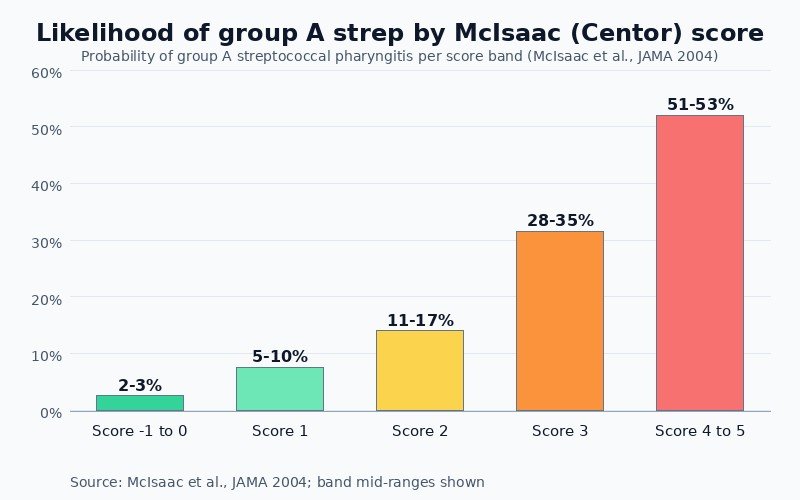
The McIsaac validation study assigned each score band a probability of group A streptococcal pharyngitis. These probabilities come from the original research population, so think of them as estimates, not guarantees. The management advice follows the Infectious Diseases Society of America (IDSA) guideline for group A streptococcal pharyngitis:
| Score | Risk band | Likelihood of group A strep | Recommended action |
|---|---|---|---|
| -1 to 0 | Low | 2 to 3 percent | Symptomatic care only; no strep test and no antibiotics |
| 1 | Low | 5 to 10 percent | Symptomatic care only; no strep test and no antibiotics |
| 2 | Intermediate | 11 to 17 percent | Rapid antigen test; antibiotics only if the test is positive |
| 3 | Intermediate | 28 to 35 percent | Rapid antigen test; antibiotics only if the test is positive |
| 4 to 5 | High | 51 to 53 percent | Test for group A strep; consider empiric antibiotics per IDSA guidance while awaiting results |
Notice how the score works in practice. Low scores are common and mostly viral, which is why testing everyone with a sore throat wastes tests and drives unnecessary antibiotics. Intermediate scores are the true decision zone, where the test earns its keep. High scores are uncommon but carry a better than even chance of strep, which is why guidelines allow empiric treatment while results are pending.
How the Centor score calculator works
The calculator adds one point for each of the four clinical criteria that are present, then applies the age adjustment: plus 1 for ages 3 to 14, 0 for ages 15 to 44, and minus 1 for ages 45 and older. The minimum possible score is minus 1 (an older adult with none of the clinical criteria) and the maximum is 5 (a school-age child with all four criteria). Each criterion was chosen because it independently raises the odds that the sore throat is bacterial rather than viral, and the score simply counts how many of those clues are present.
The original Centor criteria were derived in an adult emergency department population in 1981. The McIsaac modification followed in 1998 and was validated in a large primary care study published in JAMA in 2004, adding age because strep pharyngitis has a strong age pattern: it peaks in school-age children, is less common in young adults, and is rare in older adults. Most online calculators, including this one, use the McIsaac version, which is the more accurate of the two.
The five criteria explained
1. Fever over 38 C
A documented or reported fever above 38 C (about 100.4 F) earns one point. Fever is a classic sign of the immune system fighting a bacterial infection, while many viral sore throats come with little or no fever. The criterion accepts a reliable history of fever, not just a thermometer reading in the clinic, because patients often take antipyretics before arriving.
2. Tonsillar exudates or swelling
White or yellow patches of pus on the tonsils, or markedly swollen tonsils, earn one point. Exudates are the visible debris of the immune battle: dead bacteria, white blood cells, and tissue. They are one of the strongest visual clues pointing toward strep rather than a virus, though some viral infections can also produce exudates, which is why the score uses several criteria together.
3. Tender anterior cervical adenopathy
Swollen and tender lymph nodes at the front of the neck earn one point. The anterior cervical nodes drain the throat, so they enlarge and become painful when the throat is infected. Posterior nodes, by contrast, more often point to viral causes such as infectious mononucleosis, which is why the criterion specifies anterior nodes specifically.
4. Absence of cough
This is the criterion people find most counterintuitive, because it scores the absence of a symptom. Cough points strongly toward a viral upper respiratory infection, and antibiotics cannot help viral infections. A sore throat without any cough is therefore more likely to be bacterial, so ticking this box (the patient does not cough) earns one point, while a coughing patient scores zero here.
5. Age modification (the McIsaac addition)
Age 3 to 14 adds one point, age 15 to 44 adds nothing, and age 45 and older subtracts one point. This reflects the epidemiology: group A strep pharyngitis is a disease of school-age children above all, becomes less common through young adulthood, and is genuinely uncommon in older adults. An older adult with a sore throat and no other criteria scores minus 1, which correctly captures how unlikely strep is in that group.
Centor versus McIsaac: why age matters so much
The original Centor score ignored age entirely, which meant a 65-year-old and a 7-year-old with identical symptoms received identical scores. That is a real problem, because the pre-test probability of strep differs enormously between those two patients. The McIsaac study fixed this by folding age into the score, and the validation showed it improved discrimination: the same set of symptoms now maps to different probabilities depending on the age group.
Consider two patients with fever, exudates, tender nodes, and no cough. A 10-year-old scores 4 (four clinical points plus one for age), giving a 51 to 53 percent likelihood of strep and a clear case for testing and likely treatment. A 50-year-old with the same findings scores 3 (four clinical points minus one for age), giving a 28 to 35 percent likelihood, where testing first is the obvious move. Age changes the interpretation without changing the examination findings, and that is exactly what a good prediction rule should do.
For the same reason, the score is not validated in children under 3 years old. Group A streptococcal pharyngitis is uncommon in toddlers, rheumatic fever after strep is essentially unheard of in this age group, and the IDSA guideline recommends against routine testing for them. This calculator refuses to score ages under 3 rather than produce a misleading number.
Rapid antigen tests and throat cultures: what the score is for
The Centor score is a testing strategy, not a diagnosis, so it helps to understand the tests it guides. The rapid antigen detection test (RADT) looks for strep antigens from a throat swab and returns a result in minutes. Its specificity is excellent: a positive rapid test is trustworthy and confirms strep. Its sensitivity is good but not perfect, in the range of roughly 70 to 90 percent depending on the kit and technique, which means a negative rapid test can miss some true infections.
That is why guidelines pair the two tests by age group. In children and adolescents, a negative rapid test should be confirmed with a throat culture, which takes 24 to 48 hours but is the reference standard. In adults, confirmation of a negative rapid test is generally not required, because the risk of rheumatic fever after untreated strep is very low in adults and the added value of the culture is small. This difference matters for the score's intermediate band: a 10-year-old with a score of 2 needs a rapid test plus a backup culture if negative, while a 30-year-old with a score of 2 needs the rapid test alone.
Technique matters more than most people realize. A proper swab rubs both tonsils (or tonsillar fossae) and the posterior pharynx, avoiding the tongue and cheeks. A quick, timid swab lowers sensitivity. And testing should follow the score: testing a patient with a score of 0 or 1 finds mostly carriers and false positives, while not testing a patient with a score of 4 misses infections that needed treatment.
Antibiotic stewardship: treating the test, not the score
The main reason the Centor score exists is antibiotic stewardship. Most sore throats are viral, and antibiotics do nothing for viral infections except cause side effects and drive resistance. Yet sore throat is one of the most common reasons antibiotics are prescribed in primary care, and a large share of those prescriptions are unnecessary. The score gives clinicians a structured, defensible way to say no: a score of 0 or 1 means no test and no antibiotics, and that decision is backed by a validated rule and a major guideline, not just gut feeling.
When strep is confirmed, the IDSA guideline recommends penicillin or amoxicillin as first-line treatment: narrow spectrum, effective, inexpensive, and with no documented group A strep resistance to penicillin to this day. A first-generation cephalosporin is an alternative for patients without immediate-type penicillin allergy, and clindamycin or a macrolide for those with true penicillin allergy. Treatment shortens symptoms by roughly a day, reduces contagiousness (patients are generally no longer infectious after 24 hours of antibiotics), and, most importantly, prevents acute rheumatic fever and reduces suppurative complications such as peritonsillar abscess.
There is one nuance worth stating plainly. Acute rheumatic fever, the main complication antibiotics prevent, is rare in high-income countries today but remains a serious risk in many parts of the world, including South Asia. That does not change the score's logic: testing and treating by the score is how you find the strep that matters. It does mean that in settings where rheumatic fever is common, a high score deserves prompt action rather than watchful waiting, which is exactly what the score's high band already recommends.
Limitations of the Centor score
- Even the highest score is a coin flip. A score of 4 to 5 carries a 51 to 53 percent probability of strep, which means nearly half of high-scoring patients do not have it. The score prioritizes, it does not diagnose.
- Carriers distort the picture. A meaningful share of school-age children carry group A strep in the throat without illness. A carrier with a viral sore throat can score high and test positive, yet the virus is the real cause. This is why clinical judgment still matters and why every positive test in a low-risk context deserves a second thought.
- Not validated under age 3. The score has no validated meaning in children younger than 3, and guidelines recommend against routine strep testing in this group.
- Viral mimics exist. Infectious mononucleosis and some other viral infections can produce exudates, fever, and tender nodes, mimicking a high Centor score. Atypical lymphocytes, prolonged course, or posterior adenopathy should prompt reconsideration.
- It was derived in specific populations. The criteria come from emergency department and primary care populations in North America. Performance can vary where strep epidemiology, care-seeking behavior, or testing practices differ.
- The score is a snapshot. It applies to the current episode. A patient who scored 1 last week and now scores 4 has a new clinical picture and should be reassessed, not averaged.
Frequently asked questions
What Centor score means you need antibiotics?
No Centor score by itself means antibiotics are needed. A score of 2 to 3 means order a rapid antigen test and give antibiotics only if the test is positive. A score of 4 to 5 means test for group A strep and consider empiric antibiotics per the IDSA guideline while awaiting results. A score of 0 to 1 means symptomatic care only, with no testing and no antibiotics.
What is the difference between the Centor score and the McIsaac score?
The McIsaac score is the Centor score with an age modification added. It keeps the four original clinical criteria and adds one point for age 3 to 14, zero points for age 15 to 44, and subtracts one point for age 45 and older. This reflects that group A strep pharyngitis is most common in school-age children and uncommon in older adults. This calculator uses the McIsaac version.
Can the Centor score diagnose strep throat?
No. It estimates the probability of group A strep from 2 to 3 percent at the lowest scores to about 51 to 53 percent at the highest. Diagnosis requires a rapid antigen detection test or throat culture. The score exists to decide who should be tested.
Why is the absence of cough a criterion?
Cough points toward a viral upper respiratory infection, which antibiotics cannot help. A sore throat without cough is more likely to be bacterial, so the absence of cough earns one point while the presence of cough earns none.
Can children under 3 use the Centor score?
No. The Centor and McIsaac scores are not validated in children younger than 3, and group A streptococcal pharyngitis is uncommon in that age group. The IDSA guideline recommends against routine testing for group A strep in children under 3, and this calculator gives no result for ages under 3.
What is a strep carrier, and how does it affect the score?
A strep carrier is someone who carries group A streptococcus in the throat without it causing their illness. Some school-age children are carriers at any given time, so a positive rapid test in a patient with viral symptoms can reflect carriage rather than true strep pharyngitis. This is one reason the score uses clinical criteria to decide who to test, and why clinicians interpret results in context rather than treating every positive test.
Clinical sources: McIsaac WJ, Kellner JD, Aufricht P, Vanjaka A, Low DE. Empirical validation of guidelines for the management of pharyngitis in children and adults. JAMA. 2004;291(13):1587-1595. DOI: 10.1001/jama.291.13.1587 (verified via PubMed PMID 15069046). Shulman ST, Bisno AL, Clegg HW, et al. Clinical practice guideline for the diagnosis and management of group A streptococcal pharyngitis: 2012 update by the Infectious Diseases Society of America. Clin Infect Dis. 2012;55(10):e86-e102. doi:10.1093/cid/cis629