Hypertension Classification Calculator
This hypertension classification calculator applies the 2017 American College of Cardiology / American Heart Association (ACC/AHA) blood pressure categories to your systolic and diastolic readings and returns stage-matched guidance: the recommended treatment approach, how soon to reassess, and the blood pressure goal on treatment. It also weighs the risk factors that push stage 1 hypertension toward earlier medication, using the same risk logic the guideline itself uses. Enter your readings and any risk details below, then read the sections underneath for the reasoning behind each recommendation. The guideline behind this tool is Whelton et al., Hypertension 2018 (DOI 10.1161/HYP.0000000000000065).
Why blood pressure categories changed in 2017
In 2017, the American College of Cardiology and the American Heart Association released the first comprehensive US hypertension guideline since the Seventh Joint National Committee (JNC 7) report in 2003. The headline change was the threshold: hypertension was redefined as blood pressure of 130/80 mmHg or higher, replacing the older 140/90 cutoffs. That single move meant many adults who had been told their blood pressure was merely borderline were now classified as hypertensive, and it brought the diagnosis closer to the blood pressure levels where cardiovascular risk actually begins to climb.
Why the change? The writing committee reviewed observational evidence and trial data showing that cardiovascular risk rises continuously from blood pressure levels well below 140/90, and that treating earlier in higher-risk patients prevents heart attacks, strokes, and heart failure. Waiting for 140/90 had left a large group of at-risk people untreated. The new threshold was a judgement that the benefits of earlier treatment, in the right patients, outweigh the harms.
The old JNC 7 label "prehypertension" (120 to 139 systolic or 80 to 89 diastolic) was retired at the same time. It was replaced with two sharper categories that match the recommended action. "Elevated blood pressure" covers systolic 120 to 129 with diastolic below 80: the response is lifestyle therapy and a yearly reassessment. "Stage 1 hypertension" covers systolic 130 to 139 or diastolic 80 to 89: the response is a risk-based decision about whether to add medication. The label now tells the patient and the clinician what to do, not just what to watch.
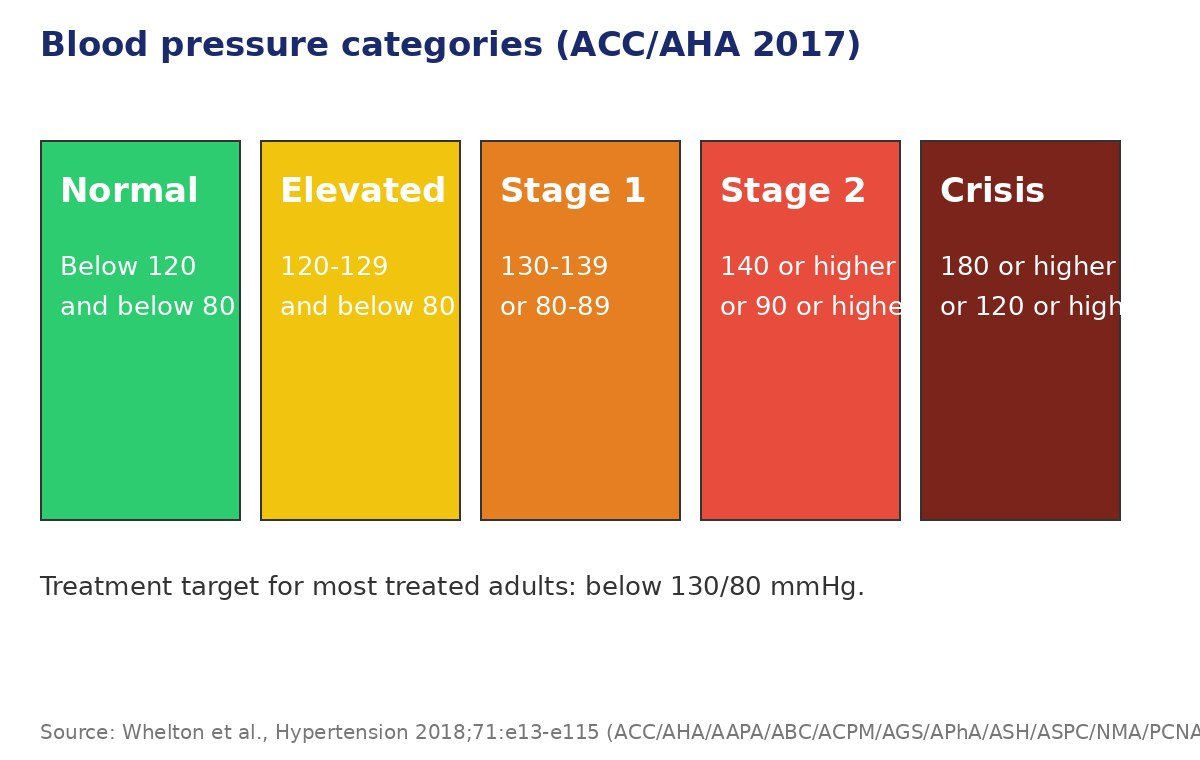
The four ACC/AHA blood pressure categories
The 2017 guideline sorts adult blood pressure into four categories, and the table is deliberately simple. Normal blood pressure is below 120 systolic and below 80 diastolic. Elevated blood pressure is systolic 120 to 129 with diastolic below 80. Stage 1 hypertension is systolic 130 to 139 or diastolic 80 to 89. Stage 2 hypertension is systolic 140 or higher or diastolic 90 or higher. Readings of 180 systolic or higher, or 120 diastolic or higher, sit outside this table as a hypertensive crisis, which is handled as an emergency rather than a category.
| Category | Systolic (mmHg) | Diastolic (mmHg) |
|---|---|---|
| Normal | Below 120 | Below 80 |
| Elevated | 120 to 129 | Below 80 |
| Stage 1 hypertension | 130 to 139 | 80 to 89 |
| Stage 2 hypertension | 140 or higher | 90 or higher |
Two reading rules make this table work in practice. First, the category follows the higher of the two numbers: a patient with 118/92 is stage 2 because of the diastolic value, and a patient with 139/79 is stage 1 because of the systolic value. Second, the guideline stresses that a classification should rest on an average of 2 or more readings taken on 2 or more occasions, measured with proper technique, because blood pressure varies from moment to moment and from setting to setting.
How this hypertension classification calculator works
The calculator applies the guideline's own logic in a fixed order. It checks your systolic and diastolic readings against each category boundary from the most severe to the least severe, and the first branch that matches decides the result. The crisis check comes first: systolic 180 or higher, or diastolic 120 or higher, produces the crisis guidance, which points you toward immediate evaluation instead of the routine recommendations.
If there is no crisis, the calculator moves down the table. Systolic 140 or higher or diastolic 90 or higher gives stage 2. Systolic 130 or higher or diastolic 80 or higher gives stage 1. Systolic 120 or higher gives elevated blood pressure: note that this branch can only be reached when the diastolic is below 80, because any diastolic of 80 or higher would already have matched the stage 1 branch. Anything below that is normal.
For stage 1, the calculator takes one further step that the other branches do not need. It looks at the risk details you entered: clinical cardiovascular disease, diabetes, chronic kidney disease, and the 10-year ASCVD risk if you provided one. If any of these is present, the calculator recommends lifestyle therapy plus blood-pressure-lowering medication with reassessment in 1 month, because the guideline places these patients in the higher-risk category automatically. Without any of them, it recommends lifestyle therapy alone with reassessment in 3 to 6 months, noting that medication becomes reasonable (Class IIa) if blood pressure stays at 130/80 or higher after the lifestyle measures.
What treatment the guideline recommends for each stage
Every recommendation below is paired with the guideline's class of recommendation, which states how strongly the evidence supports the action. Class I means the action should be performed: it is the "should do" category. Class IIa means the action is reasonable. Class IIb means the action may be reasonable. These short phrases are the guideline's own language, and they matter, because a Class I recommendation carries more weight than a IIb one when a clinician weighs benefits against harms.
| Category | Treatment | Follow-up |
|---|---|---|
| Normal | Promote optimal lifestyle habits | Reassess in 1 year |
| Elevated | Nonpharmacologic (lifestyle) therapy (Class I) | Reassess in 1 year (Class I) |
| Stage 1, lower risk | Lifestyle therapy only (Class I); medication reasonable (Class IIa) if blood pressure stays 130/80 or higher after lifestyle measures | Reassess in 3 to 6 months (Class I) |
| Stage 1, higher risk | Lifestyle therapy plus blood-pressure-lowering medication (Class I) | Reassess in 1 month (Class I) |
| Stage 2 | Lifestyle therapy plus blood-pressure-lowering medication: two first-line agents of different classes (Class I) | Reassess in 1 month (Class I) |
| Hypertensive crisis | Immediate medical evaluation; emergency care if there are signs of organ damage | None: routine follow-up does not apply |
For every branch where treatment applies, the blood pressure goal is below 130/80 mmHg. That target carries a Class I recommendation for adults with known cardiovascular disease or a 10-year ASCVD risk of 10% or higher, and it is considered reasonable (Class IIb) for adults without those additional risk markers. The 10-year risk figure used in that decision can be estimated with our 10-year ASCVD risk calculator, which uses the pooled cohort equations.
First-line drug classes
When the guideline recommends medication, it begins with three classes of first-line agents. The first is thiazide or thiazide-like diuretics, which lower blood pressure by reducing sodium and water retention. The second is calcium channel blockers, typically the dihydropyridine type such as amlodipine, which relax the blood vessel walls. The third is ACE inhibitors or angiotensin II receptor blockers (ARBs), which interfere with the renin-angiotensin system that raises blood pressure. For most patients these drugs work well, and most patients need two or more drugs to reach the goal.
Stage 2 hypertension gets a stronger start by design. The guideline recommends beginning with two first-line agents of different classes (Class I), because the distance from 140/90 or higher down to below 130/80 is rarely closed by a single drug, and starting both together shortens the time spent above goal. For stage 1 hypertension in higher-risk patients, one first-line agent is the usual starting point, with the dose increased or a second agent added if the goal is not reached.
One combination is explicitly off-limits: an ACE inhibitor should not be combined with an ARB (Class III: harm). The pairing adds adverse effects without added benefit, so the guideline gives it its strongest negative rating. Beyond that rule, certain conditions steer the choice toward a specific class, in what the guideline calls compelling indications. Chronic kidney disease with albuminuria, or diabetes with albuminuria, favours an ACE inhibitor or ARB. Recurrent stroke prevention favours a thiazide diuretic. These indications are presented here qualitatively; matching a drug to a specific patient's conditions, doses, and interactions is the prescribing clinician's job.
Lifestyle measures that lower blood pressure
Every branch of the guideline, including the ones that add medication, starts with nonpharmacologic therapy. Lifestyle change works alongside drugs rather than instead of them, and for elevated blood pressure and lower-risk stage 1 it is the whole treatment. The guideline's lifestyle prescription has six parts, and it expects them to be reinforced at every visit, not mentioned once and forgotten.
First, adopt the DASH eating pattern: a diet rich in fruits, vegetables, whole grains, and low-fat dairy products, and low in saturated fat and cholesterol. Second, reduce sodium intake and increase potassium intake, for example by eating more potassium-rich foods, unless a kidney condition or a medication makes extra potassium unsafe. Third, engage in regular aerobic physical activity, which lowers blood pressure independently of weight change. Fourth, lose weight if overweight or obese, and aim for a healthy body weight: excess weight is one of the strongest modifiable drivers of hypertension. Fifth, limit alcohol consumption, because heavy drinking raises blood pressure and interferes with treatment. Sixth, stop smoking and avoid all tobacco: smoking does not cause sustained hypertension in the same way, but it multiplies the cardiovascular risk that hypertension creates.
The practical point is that these measures are cumulative. Each one helps on its own, and together they can move a patient from needing medication to not needing it, or from needing two drugs to needing one. The guideline treats lifestyle therapy as a Class I recommendation across the board, which puts it on the same footing as the drug recommendations, not beneath them.
Getting an accurate reading
A classification is only as good as the reading behind it. The guideline is explicit about technique, because small errors in how blood pressure is measured produce large errors in how it is classified. Sit in a chair with your back supported and your feet flat on the floor, with the arm supported at heart level. Use the correct cuff size: a cuff that is too small reads falsely high, and a cuff that is too large reads falsely low. Avoid caffeine, exercise, and smoking in the 30 minutes before the measurement, rest quietly for several minutes first, and take 2 or more readings a minute or two apart, then average them.
Technique alone is not enough, because setting matters too. Two patterns make out-of-office readings essential. White-coat hypertension is high blood pressure in the clinic with normal readings at home or on ambulatory monitoring: it reflects the stress of the medical setting rather than the patient's usual pressure. Masked hypertension is the reverse: normal clinic readings with high readings outside the clinic, and it carries real cardiovascular risk because the clinic number is the misleading one. When office and home readings disagree, ambulatory blood pressure monitoring helps sort out which pattern applies, and it is the reference standard for confirming the diagnosis.
This calculator classifies the numbers you type in; it cannot judge how they were obtained. If your readings were taken casually, for example a single reading at a pharmacy kiosk, treat the result as a prompt to measure properly, not as a diagnosis. The result panel repeats this measurement-quality note for exactly that reason.
When to suspect secondary hypertension
Most hypertension is primary, meaning no single identifiable cause explains it. A smaller share is secondary: driven by an underlying condition that may itself be treatable, which makes recognising the pattern worthwhile. The guideline flags several clues that should prompt a clinician to look for a secondary cause rather than simply adding another drug.
The first clue is age of onset: hypertension beginning before age 30, especially without the usual risk factors, deserves a workup. The second is behaviour of the blood pressure itself: abrupt onset of hypertension, hypertension that resists treatment with several drugs, or blood pressure that was previously well controlled and suddenly escapes control. The third is disproportion: blood pressure that is unusually severe for the patient's age, or target-organ damage, such as kidney injury or heart changes, that is out of proportion to the blood pressure history. Any of these patterns calls for a clinician's evaluation and a search for an underlying, potentially treatable cause. The point of this section is recognition, not self-diagnosis.
Frequently asked questions
What is normal blood pressure in the 2017 guideline?
Normal blood pressure in the 2017 ACC/AHA guideline is systolic below 120 mmHg and diastolic below 80 mmHg. Readings of 120/80 or higher fall into elevated blood pressure or one of the two hypertension stages.
Is 130/80 considered hypertension now?
Yes. The 2017 ACC/AHA guideline redefined hypertension as blood pressure of 130/80 mmHg or higher. A reading with systolic 130 to 139 or diastolic 80 to 89 is stage 1 hypertension; 140/90 or higher is stage 2.
Do I need medication for stage 1 hypertension?
It depends on your risk. The guideline recommends lifestyle therapy plus blood-pressure-lowering medication (Class I) for stage 1 hypertension when there is clinical cardiovascular disease, diabetes, chronic kidney disease, or a 10-year ASCVD risk of 10% or higher. Without those risk factors, lifestyle therapy alone with reassessment in 3 to 6 months is recommended (Class I); medication is reasonable (Class IIa) if blood pressure stays at 130/80 or higher after lifestyle measures.
What is the blood pressure goal on treatment?
The goal is below 130/80 mmHg. That target is a Class I recommendation for adults with known cardiovascular disease or a 10-year ASCVD risk of 10% or higher, and it is considered reasonable (Class IIb) for adults without those additional risk markers.
Which blood pressure medicines are first-line?
The 2017 guideline names three first-line classes: thiazide or thiazide-like diuretics, calcium channel blockers (typically dihydropyridines such as amlodipine), and ACE inhibitors or ARBs. An ACE inhibitor should not be combined with an ARB (Class III: harm). Specific conditions may favour one class, for example an ACE inhibitor or ARB for chronic kidney disease with albuminuria.
What is the difference between elevated blood pressure and stage 1 hypertension?
Elevated blood pressure is systolic 120 to 129 with diastolic below 80, and it is managed with lifestyle therapy and reassessment in 1 year. Stage 1 hypertension is systolic 130 to 139 or diastolic 80 to 89, and it triggers a risk-based treatment decision: medication plus lifestyle for high-risk patients, or lifestyle alone with a 3 to 6 month reassessment for others.
Related cardiology calculators
Sources: Whelton PK et al. 2017 ACC/AHA Guideline for the Prevention, Detection, Evaluation, and Management of High Blood Pressure in Adults. Hypertension. 2018;71:e13-e115. DOI: 10.1161/HYP.0000000000000065 (blood pressure categories, stage-matched treatment and follow-up, blood pressure goal below 130/80, first-line drug classes, and class-of-recommendation framework used on this page).