Warfarin Dosing Calculator
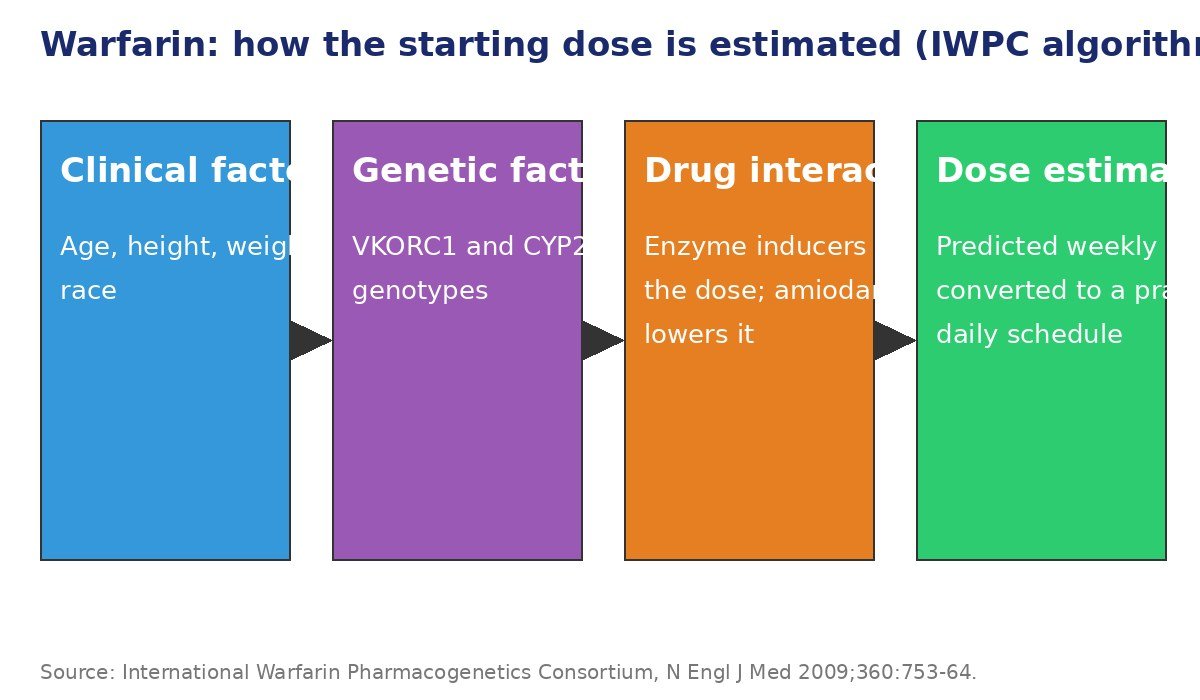
This warfarin dosing calculator predicts your likely maintenance dose of warfarin using the International Warfarin Pharmacogenetics Consortium (IWPC) algorithm, published in the New England Journal of Medicine in 2009. It combines your age, height, weight, race, VKORC1 and CYP2C9 genotypes, and two interacting medicines (amiodarone and enzyme inducers such as rifampin) into a single validated equation that estimates the weekly warfarin dose in milligrams. Because warfarin has a narrow therapeutic index and required doses vary about tenfold between patients, a personalised starting-dose estimate helps clinicians avoid the slow trial-and-error that leaves patients under- or over-anticoagulated in the first weeks. Enter your details below; the calculator also works when genetic test results are not yet available, substituting population-average coefficients until they arrive.
Why warfarin dosing varies so much
Warfarin is one of the hardest drugs in medicine to dose correctly, because the gap between "not enough" and "too much" is unusually narrow. Too little and the patient is unprotected against clots, the very thing the drug was prescribed to prevent; too much and the patient bleeds. Clinicians call this a narrow therapeutic index, and it means warfarin dosing is never a one-size-fits-all prescription. The maintenance dose that keeps one patient's INR in range can be ten times the dose another patient needs, so the traditional approach of starting everyone on the same tablet strength and adjusting by trial and error leaves many patients outside the therapeutic range for days or weeks.
Several ordinary factors explain part of that variation. Age is one of the strongest: older patients generally need lower doses, because drug clearance slows and sensitivity to anticoagulants rises with age. Body size matters too, since larger patients tend to need more drug to reach the same effect. Diet matters because warfarin works by blocking the recycling of vitamin K, so big swings in vitamin K intake, from leafy greens, green teas, or multivitamins, can push the INR up or down. Other medicines matter enormously: some speed up warfarin metabolism and some slow it down, which is why any new prescription, over-the-counter product, or herbal supplement during warfarin therapy deserves a pharmacist's review. But the largest single source of variation between individuals is written into their DNA.
Two genes dominate the genetics of warfarin response. CYP2C9 makes the liver enzyme that clears S-warfarin, the more potent of the two mirror-image forms in the tablet; people carrying the reduced-function *2 or *3 variants clear the drug more slowly and need lower doses. VKORC1 encodes the vitamin K epoxide reductase enzyme that warfarin actually blocks; people carrying the -1639A variant are more sensitive to the blockade and likewise need lower doses. Together these two genes account for a large share of the differences in dose requirements between patients, which is exactly why the IWPC consortium built a dosing equation around them. Understanding this biology is the key to understanding what this calculator is doing with your answers.
What this warfarin dosing calculator predicts
This warfarin dosing calculator implements the IWPC pharmacogenetic dosing algorithm, the equation published by the International Warfarin Pharmacogenetics Consortium in the New England Journal of Medicine in 2009 and later incorporated into the Clinical Pharmacogenetics Implementation Consortium (CPIC) warfarin guideline. The equation takes nine inputs, age, height, weight, race, VKORC1 genotype, CYP2C9 genotype, enzyme inducer use, and amiodarone use, and predicts the weekly warfarin dose in milligrams. It also shows the equivalent daily dose and a practical weekly pill schedule, because warfarin tablets come in fixed strengths and most regimens alternate between two tablet sizes across the week.
The mathematics has one quirk worth knowing. The IWPC equation does not predict the weekly dose directly; it predicts the square root of the weekly dose, which the calculator then squares to get the weekly milligrams. The square root step is a statistical device the researchers used to make dose variation behave better in the model, and it is applied exactly as published, including the "unknown" coefficients the model substitutes when genotype results are not available. The output is a starting-dose estimate for the first days of therapy. It is not a final maintenance dose: the INR on days 3 to 5, and the weekly INRs after that, will tell your clinician whether to nudge the dose up or down until it settles.
One deliberate design choice: this calculator does not ask for your target INR, because the IWPC equation predicts dose, not the INR itself. The target is set by your indication and your clinician. For most indications, including atrial fibrillation and venous thromboembolism, the typical target INR is 2.0 to 3.0; for mechanical heart valves it is usually 2.5 to 3.5. Your clinician adjusts the predicted dose against whichever target applies to you.
The two genes that matter most
CYP2C9 and VKORC1 are the two genes every warfarin dosing conversation comes back to, because together they explain most of the genetic influence on dose. CYP2C9 sits in the liver and does the bulk of the work clearing S-warfarin from the blood. The normal version of the gene, called *1, does this job at full speed. The *2 and *3 variants produce a slower enzyme, so S-warfarin lingers longer in the bloodstream and the same tablet produces a stronger anticoagulant effect. Patients carrying one or two copies of these variants therefore need lower doses, and they also take longer to reach a steady level when a dose is changed, which matters for how quickly the INR can be rechecked after an adjustment.
VKORC1 works on the other side of the equation. It encodes vitamin K epoxide reductase, the enzyme warfarin binds to and blocks. The -1639 variant, usually reported as the A allele, makes the enzyme scarcer or more easily blocked, so a given amount of warfarin shuts down vitamin K recycling more completely. Patients with one A allele (A/G) are more sensitive than those with none (G/G), and patients with two (A/A) are the most sensitive of all, needing the lowest doses. This is a sensitivity effect rather than a clearance effect, which is why the two genes appear as separate terms in the IWPC equation: one changes how fast the drug leaves, the other changes how hard it hits while it is there.
If your genotypes have not been tested, the calculator does not leave those terms blank. The IWPC model includes dedicated "unknown" coefficients for VKORC1 and CYP2C9 that act as population averages, so the output becomes a clinical starting-dose estimate built on age, size, race, and interacting drugs alone. The CPIC warfarin guideline notes that dosing accuracy improves once genotype results are available, which is simply another way of saying the gene terms carry real information. When results do arrive, rerun the calculator with them and hand both versions to your clinician: the difference between the two estimates shows how much the genetics were contributing.
How to use your predicted dose
Treat the calculator's output as a starting point for a conversation with your prescriber, not as a prescription. The predicted weekly dose is the number to discuss: it represents where the evidence suggests your maintenance dose will land, before your individual INR response is known. The daily equivalent and the weekly pill schedule translate that number into something practical, because nobody can split tablets into 5.9 mg every day; instead, a 42 mg weekly prediction becomes a simple 6 mg each day, while a 45 mg prediction becomes 6 mg on four days and 7 mg on three days. Your pharmacist can map the schedule onto the tablet strengths actually stocked in your country.
After the first dose, the INR takes over as the guide. The standard rhythm is an INR check on days 3 to 5, then weekly checks until the INR is stable within the target range, then checks every 4 to 6 weeks during steady therapy. If the early INR comes back too low, the clinician raises the dose; too high, and the dose comes down or a dose is held. This titration phase is where the starting estimate pays off: beginning near your true requirement means fewer adjustments, fewer out-of-range readings, and less time spent in the danger zones on either side of the target.
Interacting drugs deserve special attention, because they are the most common reason a stable warfarin dose suddenly stops working. Amiodarone, a widely used antiarrhythmic, slows warfarin clearance and can push the INR up within days of starting; the calculator already discounts the predicted dose when amiodarone is ticked. Enzyme inducers do the opposite: rifampin, carbamazepine, phenytoin, and St. John's wort rev up the liver enzymes that clear warfarin, so patients on these agents need substantially higher doses, and stopping an inducer without lowering the warfarin dose can cause dangerous over-anticoagulation. Beyond the two built into the equation, common culprits that raise the INR include the antibiotic trimethoprim-sulfamethoxazole and azole antifungals such as fluconazole and metronidazole. The rule is simple: before starting or stopping anything, from antibiotics to herbal teas, tell the clinician or pharmacist managing your warfarin.
What the algorithm does not cover
No dosing equation captures everything, and the IWPC model is honest about its boundaries. It includes the two genes that matter most, but not every genetic variant: CYP4F2, which affects vitamin K metabolism, is absent from the model, as are the CYP2C9 *5, *6, *8, and *11 variants that are more relevant in people of African ancestry. The race terms in the equation partly compensate for population-level differences, but they are coarse categories, and the "missing or mixed" option exists precisely because real patients do not always fit the boxes. If you know you carry a variant the model ignores, the calculator's estimate is less certain for you, and closer INR monitoring is the sensible response.
Diet and illness are the other big blind spots, because no baseline equation can predict how your vitamin K intake or your health will change next month. A sudden increase in leafy green vegetables lowers the INR; a bout of gastroenteritis, fever, or liver congestion can raise it. Alcohol binges, new over-the-counter painkillers (especially NSAIDs, which add bleeding risk on top of any INR change), and even some vitamin supplements can all move the numbers. The algorithm assumes a reasonably stable version of you, so the practical safeguard is consistency: keep vitamin K intake steady rather than avoiding greens altogether, and recheck the INR whenever something in your routine changes.
Finally, it is worth knowing what the clinical trials showed, stated plainly. The GIFT trial, which randomised patients undergoing hip or knee replacement to genotype-guided versus clinically guided warfarin dosing, found that genotype-guided dosing reduced a composite of adverse events including high INRs, bleeding, and clotting. That is supportive but not decisive evidence: the effect was modest, the population was specific, and guidelines still treat genotyping as helpful-when-available rather than mandatory. The IWPC equation remains the best-validated tool for turning genetic and clinical information into a starting dose, but the INR remains the final judge.
When genotyping is most useful
Genetic testing for warfarin dosing is not necessary for everyone, but it earns its keep in patients where the clinical guess is most uncertain. The very elderly and the very young sit at the extremes of the dose range, where a wrong starting estimate has the largest consequences. Patients already taking interacting drugs, especially amiodarone or enzyme inducers, have dose requirements the clinical factors alone predict poorly. And anyone with a history of unstable INRs, unexplained bleeding, or clotting while on warfarin is a strong candidate, because an unrecognised *3/*3 genotype or A/A VKORC1 status may be the missing explanation for years of difficult control.
Practically, testing is a one-time blood or saliva test whose result never changes, and the CPIC guideline provides dosing recommendations for when results are known. If testing is unavailable or unaffordable, the calculator's "not tested" path still gives a reasonable starting dose from the clinical variables, and careful INR titration will find your maintenance dose the traditional way. Either way, keep a record of your genotypes once known: they remain relevant for as long as you take warfarin, and for family members who may share the same variants.
Frequently asked questions
How accurate is the IWPC warfarin algorithm?
The IWPC algorithm was derived and validated in a large multi-ethnic cohort and explains substantially more of the variation in warfarin dose requirements than clinical factors alone. That said, it is a starting-dose estimate, not a guarantee: every patient still needs INR monitoring and dose titration, because diet, illness, and interacting drugs change requirements over time.
What if I do not have genetic test results?
The algorithm still works: choose "Not tested" for VKORC1 and CYP2C9 and it substitutes population-average "unknown" coefficients so you get a clinical starting-dose estimate. Accuracy improves once your VKORC1 and CYP2C9 results are available, as the CPIC warfarin guideline notes, because the genotype terms carry a large share of the algorithm's predictive power.
Which drugs change my warfarin dose?
Amiodarone lowers the warfarin dose requirement, while enzyme inducers such as rifampin, carbamazepine, phenytoin, and St. John's wort raise it; the calculator adjusts for both. Many other drugs also interact, including antibiotics such as trimethoprim-sulfamethoxazole and azole antifungals, which tend to raise the INR. Always tell your prescriber or pharmacist before starting or stopping any medicine, supplement, or herbal product.
Can I use this for a mechanical heart valve?
Yes, the dose prediction itself applies to patients with mechanical valves, but the target INR is different: most indications aim for an INR of 2.0 to 3.0, while mechanical valves typically need 2.5 to 3.5. Your cardiologist sets the target and adjusts the dose against it.
How often should INR be checked after starting?
A common schedule is an INR check on days 3 to 5 after starting, then weekly until the INR is stable in range, then every 4 to 6 weeks during stable therapy. Check sooner if you start or stop an interacting drug, change your diet substantially, become ill, or notice bleeding.
What is a normal starting dose of warfarin?
A commonly used starting dose is 5 mg daily in adults, but required daily doses across patients can range from 0.5 to 20 mg per day. That wide range is the whole point of this calculator: it personalises the starting estimate instead of giving everyone the same tablet strength.
Related cardiology calculators
Sources: Klein TE et al. Estimation of the warfarin dose with clinical and pharmacogenetic data. N Engl J Med. 2009;360:753-764 (IWPC algorithm). Johnson JA et al. Clinical Pharmacogenetics Implementation Consortium (CPIC) guideline for pharmacogenetics-guided warfarin dosing: 2017 update. Clin Pharmacol Ther. 2017;102(3):397-404.